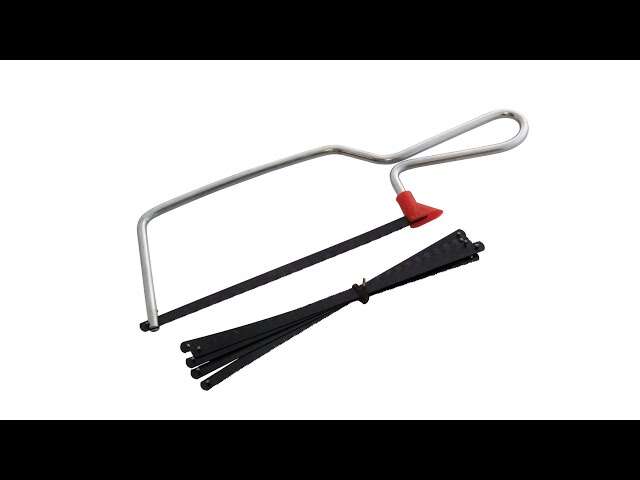
How To Fix Hacksaw Blade: Easy Repair Guide
For homeowners, DIY users, and tradespeople in the United States, a damaged hacksaw blade is usually not something to repair. The safest fix is to remove the blade and install a new one that matches the hacksaw frame, blade length, and material being cut.
You can fix some hacksaw problems without replacing the whole tool. A loose blade may only need more tension. A blade that cuts poorly may need the correct tooth pitch or a better cutting angle. But a cracked, bent, dull, or missing-tooth blade should be replaced.
Can a hacksaw blade be repaired?
A hacksaw blade should not be welded, glued, straightened, or reused after it cracks. Hacksaw blades are thin, hardened pieces of steel. They work under tension, so a repaired spot can fail without much warning.
A broken blade may snap during a cut and send sharp pieces toward your hand or face. A bent blade can also twist in the cut, damage the workpiece, or pull the saw off line.
The practical rule is simple:
- Loose blade: Adjust the tension.
- Wrong blade length: Install the correct length.
- Dull blade: Replace it.
- Bent blade: Replace it.
- Cracked blade: Replace it at once.
- Missing or broken teeth: Replace it.
- Damaged frame or tension screw: Repair or replace the hacksaw frame.
Most full-size hacksaws in the United States use 12-inch blades, but some compact frames use 6-inch or 10-inch blades. Check the frame before buying a replacement.
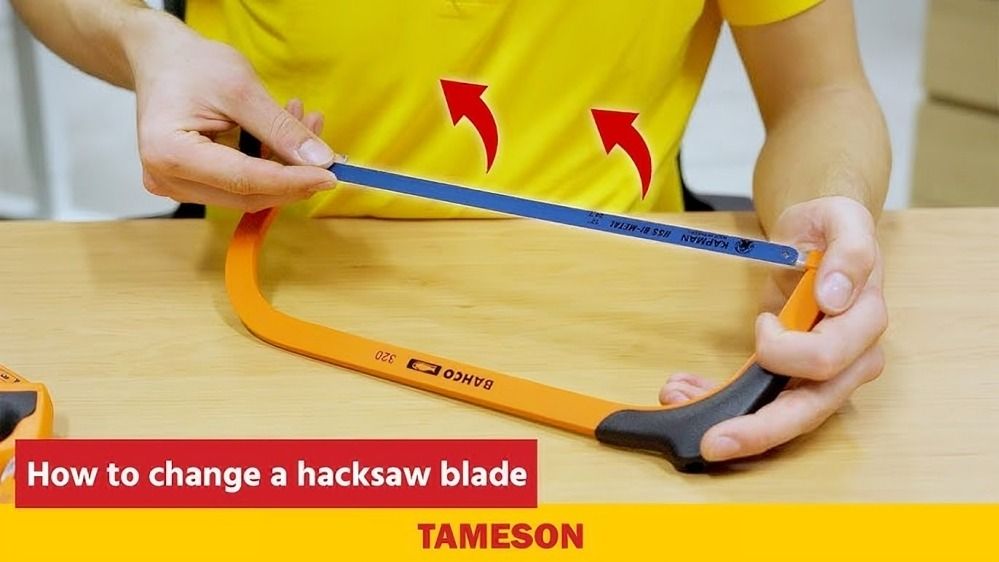
How to replace a hacksaw blade
Replacing a hacksaw blade takes only a few minutes. You need the hacksaw frame, a matching replacement blade, and work gloves if the old blade has sharp edges.
1. Wear basic protection
Put on safety glasses before removing the blade. A broken tooth or metal chip may fall from the frame.
Use gloves when handling a damaged blade. Do not grip the teeth with bare fingers. Keep the blade away from children and pets while you work.
2. Release the blade tension
Most hacksaws have a tension screw, lever, or wing nut near one end of the frame. Turn the tension screw counterclockwise until the blade becomes loose.
Some quick-release frames use a lever. Open the lever slowly and keep your fingers away from the blade path.
3. Remove the old blade
Lift the blade off the two mounting pins. On some frames, the blade holes fit over small posts. On others, the blade attaches to slotted hooks.
If the blade is broken, remove both pieces. Do not pull hard if one piece is stuck. Release more tension first.
4. Check the frame
Before installing the new blade, inspect the frame and mounting points. Look for:
- Bent side rails
- Cracks near the handle
- Worn blade pins
- A stripped tension screw
- A loose handle
- Rust that prevents smooth adjustment
A new blade will not work well if the frame cannot hold it straight and tight.
5. Install the new blade in the correct direction
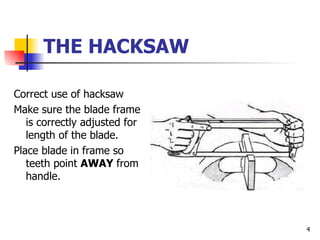
For a standard hacksaw, point the teeth away from the handle. This makes the saw cut on the forward stroke.
Some compact or specialty saws use a different setup. Follow the markings on the frame or the blade package if they conflict with this general rule.
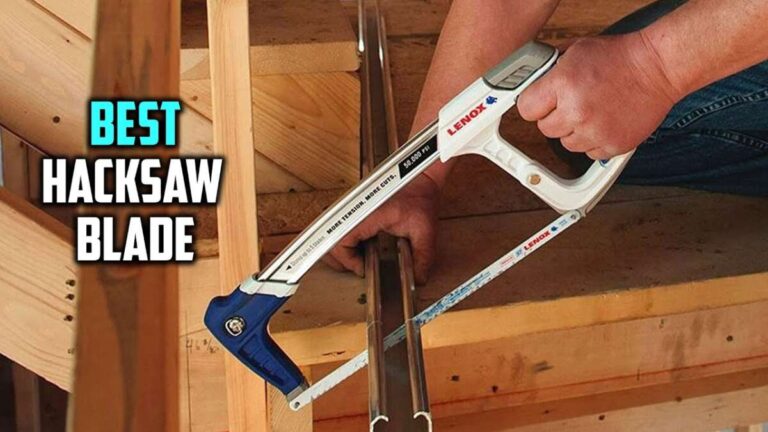
Make sure both blade holes sit fully on the mounting pins. The blade should lie straight along the frame, not twist to one side.
6. Tighten the blade
Turn the tension screw clockwise until the blade is firm. It should feel tight, but do not force the screw or use pliers to increase tension.
A blade that is too loose may bend, chatter, or wander. A blade that is too tight can place extra stress on the blade and frame.
A good visual check is this: the blade should stay straight when you press it lightly from the side. It should not sag, but it should not feel like a rigid wire.
7. Make a test cut
Secure a piece of scrap metal in a vise. Start with light pressure and slow strokes.
The blade should track in one line. It should not jump, twist, or make a sharp snapping sound. Stop at once if the blade moves sideways or shows a crack.

How to fix a loose hacksaw blade
A loose hacksaw blade usually needs more tension, not a new frame. First, stop cutting and check whether the blade is seated on both mounting pins.
Turn the tension screw clockwise in small amounts. Test the blade after each adjustment. If the screw turns but the blade does not tighten, the screw, nut, or frame may be damaged.
Do not solve a loose blade by bending the frame by hand. This can weaken the frame and make the blade sit at an unsafe angle.
Signs the blade is too loose
- The blade bows during a cut.
- The saw vibrates or chatters.
- The cut wanders from the marked line.
- The teeth catch and release.
- The blade makes a loose, buzzing sound.
- The blade slips off the mounting pins.
Signs the blade is too tight
- The tension screw is difficult to turn.
- The frame bends inward.
- The blade breaks soon after installation.
- The mounting pins look stressed or bent.
- The frame makes a creaking sound.
If the tension system cannot hold the blade firmly, replace the frame or have the tool assessed by a qualified tool repair professional. A hacksaw frame is inexpensive compared with an avoidable hand injury.
How to choose the right replacement blade
Choose a blade by length, tooth pitch, width, thickness, and the material you plan to cut. The most common mistake is choosing a blade only by length.
Match the blade length
Measure the distance between the blade mounting pins, not just the outside length of the frame. The replacement blade must fit both pins without forcing the frame.
Common U.S. hacksaw blade lengths include:
- 6 inches for compact hacksaws
- 10 inches for some smaller frames
- 12 inches for most standard hacksaws
A blade that is too long may remain loose. A blade that is too short may not reach both pins.
Choose the right tooth pitch
Tooth pitch is often listed as teeth per inch, or TPI. A higher TPI gives smaller teeth. A lower TPI gives larger teeth.
| Cutting task | Useful starting range | Reason |
|---|---|---|
| Thin sheet metal or tubing | 24–32 TPI | More teeth stay in contact with thin material |
| General steel, aluminum, or copper | 18–24 TPI | A balanced choice for many home repairs |
| Thick steel bar or heavy stock | 14–18 TPI | Larger gullets clear chips better |
| Plastic or soft material | 10–18 TPI, depending on thickness | Helps reduce clogging and heat |
These ranges are starting points, not fixed rules. The blade package may give more specific guidance for its tooth design and material.
Try to keep at least two or three teeth in the material during the cut. If only one tooth engages, it may catch and break. If too many teeth are buried in thick material, the cut can clog with chips.
Pick a blade material
Common hacksaw blade materials include:
- Carbon steel: Usually costs less and works for light-duty cutting.
- High-speed steel: Holds its cutting edge well but may be less flexible.
- Bi-metal: Combines a hard cutting edge with a more flexible back. It is often a practical choice for steel and general repair work.
A bi-metal blade does not make the hacksaw unbreakable. Poor tension, side pressure, and twisting can still damage it.

How to use a hacksaw without breaking the blade
Correct technique helps the blade last longer and keeps the cut straight.
- Secure the workpiece. Clamp the metal in a vise so it cannot move.
- Mark the cut. Use a scribe, marker, or layout line.
- Use the correct blade direction. The teeth normally face forward.
- Start with short strokes. Create a shallow groove on the marked line.
- Keep the blade square. Hold the frame at about 90 degrees to the workpiece unless the cut requires another angle.
- Use steady pressure. Press on the forward stroke and ease off on the return stroke.
- Let the teeth cut. Excess force does not make a hacksaw safer or faster.
- Use the full blade length. Long, smooth strokes spread wear across more teeth.
- Keep the blade moving straight. Do not twist the frame to speed up a corner.
- Slow down near the end. Thin remaining metal can break suddenly and damage teeth.
For very hard metal, use a blade made for that material. Do not force a general-purpose blade through hardened steel, stainless steel, or thick alloy stock.
Why a hacksaw blade keeps breaking
Repeated blade failure usually points to a problem with tension, alignment, technique, or blade selection.
| Symptom | Likely cause | What to do |
|---|---|---|
| Blade breaks near a mounting hole | Excess tension or frame misalignment | Reduce tension and inspect the pins |
| Teeth strip off quickly | Wrong TPI or excessive pressure | Use the correct tooth pitch and lighter pressure |
| Blade bends in the cut | Loose tension or side force | Tighten the blade and keep the frame straight |
| Blade snaps during a turn | Twisting the saw | Make straight cuts or use a suitable tool |
| Cut becomes slow | Dull blade or wrong material rating | Replace the blade with a suitable type |
| Blade slips off the frame | Poor seating or damaged pins | Refit the blade or replace the frame |
| Blade vibrates | Loose workpiece or loose blade | Secure the material and adjust tension |
A blade can also break when the workpiece closes on the blade. This can happen when cutting a supported board, pipe, or piece of sheet material that shifts as the cut progresses. Support the work so the cut does not pinch the blade.
How to fix a hacksaw that cuts crooked
A crooked cut is often caused by the user, the workpiece, or the blade rather than a major tool failure.
Start with the simplest checks:
- Install a fresh blade.
- Confirm that the teeth face forward.
- Tighten the blade.
- Clamp the work securely.
- Check that the blade sits straight in the frame.
- Start the groove with short, light strokes.
- Keep both hands steady and the frame square.
If the cut still wanders, inspect the frame. Place it on a flat surface and look for a bent rail. Compare the blade position at both ends. If the blade angles sharply toward one side, the mounting pins or frame may be damaged.
Do not try to straighten a badly bent hacksaw frame with force. Replace it if it cannot hold the blade in line.

Can you reuse a dull hacksaw blade?
You can sometimes reuse a blade that feels less sharp if it still has intact teeth and cuts cleanly. However, most hacksaw blades are not designed to be sharpened by hand.
Replace the blade when:
- The cut requires much more force than before.
- The teeth look rounded.
- Several teeth are missing.
- The blade slips instead of cutting.
- The cut creates excessive heat.
- The blade produces a rough or uneven kerf.
Hacksaw teeth are small and precisely formed. Filing them by hand often changes the tooth shape and spacing. For most home and job-site work, a new blade is safer and more efficient than trying to restore a dull one.
What to do if the hacksaw frame is damaged
A damaged frame can cause blade failure even when the replacement blade is correct. Examine the handle, rails, tension screw, nut, and mounting pins.
Replace the frame if it has:
- A crack
- A bent rail
- A stripped tension mechanism
- A missing mounting pin
- A handle that moves independently of the frame
- Severe rust at a load-bearing point
A minor surface-rust spot may be cleaned with a wire brush and protected with a light coat of tool oil. Do not rely on oil to repair a crack, weakened metal, or a stripped tension part.
For a valuable specialty frame, contact the manufacturer or a qualified tool repair shop. For a common low-cost frame, replacement is usually the sensible option.
Safety rules for replacing and using a hacksaw blade
Hacksaw blades have sharp teeth and can break under tension. Follow these basic rules:
- Wear safety glasses.
- Keep fingers away from the teeth and blade path.
- Clamp the workpiece before cutting.
- Do not cut metal while holding it in your hand.
- Do not use a cracked, bent, or repaired blade.
- Do not use a hacksaw frame with a damaged tension system.
- Keep your free hand behind the blade, not in front of it.
- Store spare blades in their package or a protected container.
- Clean metal chips with a brush, not your bare hand.
- Stop if the blade starts to twist, chatter, or slip.
If you are cutting painted, coated, or unknown metal, consider the risk of dust and fumes. Avoid creating airborne dust, use suitable ventilation, and follow the product or workplace safety instructions for the material.

Hacksaw blade repair: quick decision guide
Use this guide before deciding whether to repair or replace anything:
- The blade is only loose: Tighten the tension screw.
- The blade is the wrong size: Install the correct length.
- The teeth face the wrong way: Remove and reinstall the blade.
- The blade is dull: Replace it.
- The blade is bent: Replace it.
- The blade has a crack: Replace it immediately.
- The frame is bent: Replace the frame.
- The tension screw is stripped: Replace the frame or the damaged hardware.
- The blade breaks repeatedly: Check tension, tooth pitch, workpiece support, and cutting technique.
- The saw still feels unsafe: Stop using it and replace the damaged part.
Frequently asked questions
Can I glue a broken hacksaw blade?
No. Glue cannot restore the strength or alignment needed for a blade under tension. A glued blade may break during use. Replace the blade.
Should hacksaw blade teeth face forward or backward?
On most standard hacksaws, the teeth face forward, away from the handle. The saw cuts on the forward stroke. Check the frame instructions for compact or specialty designs.
How tight should a hacksaw blade be?
The blade should be firm and straight without sagging. Do not tighten it as hard as possible. Excess tension can damage the blade, mounting pins, or frame.
Why does my new hacksaw blade break?
Common causes include too much tension, side pressure, a loose workpiece, the wrong tooth pitch, a bent frame, or twisting the saw in the cut. Check these issues before installing another blade.
Can I sharpen a hacksaw blade?
Most hacksaw blades are not practical to sharpen by hand. Their small teeth make consistent sharpening difficult. Replace the blade when it becomes dull or damaged.
How many teeth should touch the material?
Aim to keep at least two or three teeth in contact with the workpiece. Choose a finer-tooth blade for thin material and a coarser blade for thick material.
Conclusion
You usually cannot safely fix a damaged hacksaw blade. Replace any blade that is cracked, bent, dull, or missing teeth. For a blade that is simply loose, install it correctly and adjust the tension until it sits straight and firm.
The best long-term fix is to match the blade length and TPI to the material, secure the workpiece, and use smooth strokes without twisting the frame. If the blade keeps breaking after those checks, inspect the hacksaw frame and replace it if the tension system or rails are damaged.
Recent Tool Guides
 Hammer
How To Hammer Flowers Onto Paper: Easy Guide
Learn how to hammer flowers onto paper with simple steps, helpful tips, and beautiful results for...
Read Guide → Wrench
How To Use A Hex Wrench: Easy Step-By-Step Guide
Learn how to use a hex wrench correctly with simple steps, helpful tips, and common mistakes...
Read Guide → Hacksaw
How To Cut Curtain Pole With Hacksaw: Easy Guide
Learn how to cut curtain pole with hacksaw safely and neatly. Follow simple steps for accurate...
Read Guide → Wrench
How To Use A Husky Torque Wrench: Easy Guide
Learn how to use a Husky torque wrench correctly with simple steps, torque settings, and safety...
Read Guide → Hammer
How To Hold A Hammer: Safe Grip Guide
Learn how to hold a hammer with the right grip, stance, and technique for safer, more...
Read Guide → Hacksaw
How To Cut Flexible Metal Conduit With Hacksaw: Easy Guide
Learn how to cut flexible metal conduit with hacksaw safely and cleanly. Follow simple steps for...
Read Guide →