What To Do With Old Hand Tools: Smart Ideas
Old hand tools do not always belong in the trash. In many U.S. homes, a worn hammer, rusty wrench, or mixed box of tools can still help someone else. The best choice depends on the tool’s condition, safety, value, and material.
Start by sorting the tools into four groups: keep and repair, donate or sell, recycle, and dispose. Clean tools that still work can often find a second life. Broken tools with useful metal parts may go to a scrap metal or household recycling program. Tools with unsafe damage, chemical residue, or missing parts may need special handling.
Local rules vary across the United States. Check your city, county, transfer station, or waste hauler before placing tools in a recycling bin or taking them to a disposal site.

1. Sort the Tools Before You Decide
Sort old hand tools by condition, material, and possible safety risk. Do not make a final decision based on rust alone. Surface rust may be easy to remove, while a cracked hammer head or bent wrench may make a tool unsafe.
Set up four boxes or areas:
- Keep or repair
- Donate or sell
- Recycle
- Dispose or ask for special guidance
Look for these signs during the first sort:
| Tool condition | Best next step |
|---|---|
| Clean and fully working | Keep, donate, or sell |
| Light surface rust | Clean and test |
| Heavy rust but solid metal | Restore or recycle |
| Cracked handle | Replace the handle if the tool head is sound |
| Bent jaws or badly twisted metal | Recycle or dispose |
| Loose hammer head | Repair before use; do not donate as ready to use |
| Chemical, oil, or lead-paint residue | Ask your local household hazardous waste program |
| Cordless or battery-powered tool | Handle the battery separately |
A tool can look old and still be useful. A tool can also look clean and still be dangerous. A screwdriver with a rounded tip may slip. A wrench with damaged jaws may not grip. A hammer with a loose head can fly off during use.
Check for unsafe damage
Do not use or donate a tool if you find:
- A crack in the head, handle, or frame
- A loose head that cannot be secured
- A bent striking face
- Deep pitting on a cutting edge or gripping surface
- A split fiberglass or plastic handle
- A missing safety guard
- Sharp burrs that normal filing cannot remove
- Signs of heat damage or melted parts
If the tool is marked with a brand and model number, write that information down. It can help you find replacement handles, parts, manuals, or resale listings.
Separate tools from possible hazardous materials
A plain metal tool is usually not household hazardous waste by itself. The risk may come from what is on the tool.
Set aside tools covered with:
- Wet paint or paint thinner
- Solvent, fuel, or degreaser
- Pesticide residue
- Unknown powder or liquid
- Flaking old paint that may contain lead
- Asbestos-containing material from an old work site
The U.S. Environmental Protection Agency recommends checking local programs for household hazardous waste. Do not pour chemicals down a drain or place soaked rags in a regular trash can.

2. Clean and Test Tools That May Be Reusable
Cleaning is often the best first step for old hand tools. It can reveal whether rust is only on the surface or has weakened the tool.
Use this basic process:
- Brush off loose dirt with a stiff nylon or wire brush.
- Wipe away grease with a cloth and a suitable cleaner.
- Remove light rust with a rust eraser, abrasive pad, or fine sandpaper.
- Dry the tool fully.
- Apply a thin coat of tool oil to bare steel.
- Check the tool under good light.
- Test it with a simple, low-risk task.
Wear safety glasses and gloves while brushing rust. Use good airflow when working with cleaners. Follow the product label, and never mix cleaning chemicals.
What to do with rusty hand tools
Light surface rust does not always mean a tool is ruined. You may be able to remove it with:
- A nylon or brass brush
- Fine steel wool
- Sandpaper
- A commercial rust remover
- A rust eraser
- A soak designed for rust removal
Do not use a restored tool for important work until you test it. A wrench should grip without slipping. Pliers should open and close smoothly. A chisel should have a sound body and a controlled edge. A hammer head should stay tight on its handle.
Deep pits need more care. Rust that has eaten into the working surface can change the tool’s shape and strength. If you cannot tell whether the damage affects safety, replace the tool or ask a qualified tool repair professional.
Replace handles and small parts when practical
A solid tool head may be worth saving even if its wood handle is cracked. Replacement handles are available for some hammers, axes, files, and other tools. Choose the correct handle size and type.
Do not improvise with a random piece of wood. The handle must fit tightly and suit the tool’s use. After repair, test the tool away from people, glass, vehicles, and other breakable items.

3. Donate Old Hand Tools in Usable Condition
Donate old hand tools when they are clean, complete, and safe for another person to use. A working tool does not need to look new, but the recipient should not need to guess whether it works.
Good donation options in the United States may include:
- Local vocational schools
- Community colleges with trade programs
- Habitat for Humanity ReStore locations
- Community repair groups
- Makerspaces
- Tool libraries
- Youth trade programs
- Nonprofit housing and rebuilding groups
- Neighborhood reuse events
- Local charities that accept household goods
Acceptance rules differ by location. Call first and ask whether the organization accepts hand tools, incomplete sets, rusty tools, or power tools.
Make a donation easier to use
Before donating:
- Remove dirt and heavy grease.
- Group related tools together.
- Include matching sockets, bits, keys, or cases.
- Label unusual tools if you know their purpose.
- Secure sharp edges.
- Separate broken tools from working tools.
- Tell the organization about missing parts.
Do not donate a tool simply because you do not want to throw it away. If it is unsafe, mark it clearly as for parts or recycling and ask whether the organization accepts it.
Some charities may provide a donation receipt, but the value of donated property is not set by the charity. The IRS explains that taxpayers generally need to determine the fair market value of donated goods and keep appropriate records. Tax treatment can depend on your situation, so consult IRS guidance or a tax professional for advice.

4. Sell Valuable or Specialized Tools
Selling makes sense when a tool has a known brand, unusual design, strong condition, or clear demand. Common household tools may sell better as a group than one at a time.
Potential selling channels include:
- Local online marketplaces
- Garage and estate sales
- Used tool stores
- Auction houses
- Specialty tool forums
- Consignment shops
- Antique tool dealers
Take clear photos of:
- The full tool
- The brand mark
- The model or size
- The working end
- Any damage
- The case or included parts
Describe defects honestly. Use terms such as “surface rust,” “deep pitting,” “loose handle,” or “missing socket” when they apply. Accurate listings reduce returns and help buyers decide whether the tool is for use, restoration, or display.
Which old hand tools may have resale value?
Potentially valuable items include:
- Older tools from respected manufacturers
- Discontinued specialty tools
- Complete socket sets
- Woodworking planes and braces
- Blacksmithing tools
- Machinist tools
- Surveying tools
- Large mechanic’s sets
- Unusual trade tools
- Tools with original boxes or manuals
Age alone does not prove value. A rare tool in poor condition may be worth less than a newer, common tool in working order. Search completed sales rather than only active listings when estimating a price.

5. Recycle Metal Tools the Right Way
Recycle old hand tools when they are mainly metal and no longer safe or useful. Many metal recyclers accept steel, iron, aluminum, brass, and other scrap, but rules differ.
Before visiting a recycling site, ask:
- Does the facility accept hand tools?
- Does it accept mixed-metal tools?
- Should plastic or wood handles be removed?
- Does it accept tools with oil or paint residue?
- Is there a minimum quantity?
- Does it pay for the material or charge a fee?
- Must you bring identification?
Do not place heavy tools in a curbside recycling bin unless your local program specifically accepts them. Tools can damage sorting equipment and may be rejected as oversized metal.
Prepare tools for recycling
For ordinary, clean tools:
- Remove loose dirt and nonmetal parts if the recycler requests it.
- Bundle small tools so they do not scatter.
- Wrap sharp ends with cardboard.
- Keep tools dry.
- Transport them in a strong box or bucket.
Do not burn wooden handles or coated parts. Burning painted or treated material can release harmful smoke. If a tool has chemical contamination, contact your local household hazardous waste program before recycling it.
The Earth911 recycling directory and your local solid waste department may help you find a nearby option. Availability is local, so verify the current rules before making a trip.
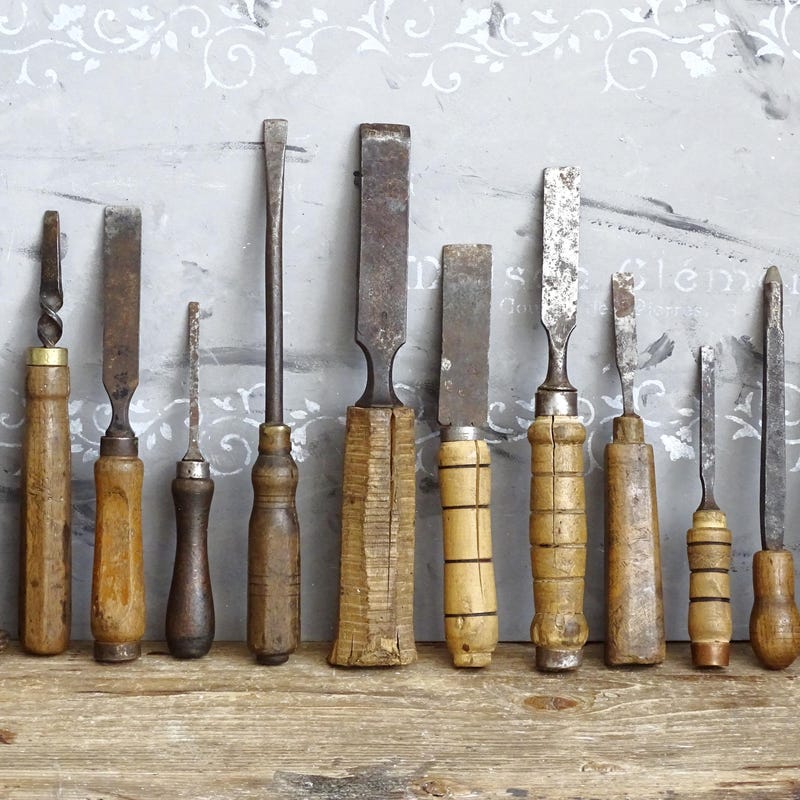
6. Dispose of Tools That Are Unsafe or Contaminated
Dispose of an old tool when it cannot be repaired, donated, sold, or safely recycled. Disposal is the last practical option, not the first.
For ordinary broken metal tools, your local transfer station may accept them as trash or scrap. Some communities have special bulky-metal collection days. Ask your waste provider which option applies.
Use extra care with tools that are:
- Covered in wet chemicals
- Contaminated by unknown substances
- Painted with flaking material from an old work site
- Sharply broken
- Mixed with batteries or electronic parts
- Used in industrial or agricultural chemical work
If you place sharp tools in household trash where local rules allow it, reduce the risk of injury:
- Wrap sharp ends in thick cardboard.
- Tape the cardboard in place.
- Put the tool in a sturdy container.
- Tell the waste facility if the item is unusually heavy or sharp.
Never put loose blades, awls, chisels, or broken metal points into a thin trash bag.
What about old cordless tools?
Cordless drills, impact drivers, and other battery-powered tools need a separate check. Remove the battery if the design allows it. Lithium-ion batteries can cause fires if they are damaged, crushed, or placed in the wrong recycling stream.
Do not place loose lithium-ion batteries in household trash or curbside recycling. Cover exposed terminals with nonmetal tape and use a battery collection program that accepts the battery type. Follow the battery maker’s instructions and your local waste authority’s rules.

7. Use This Decision Guide
This quick guide can help you choose the next step:
| Ask this question | If yes | If no |
|---|---|---|
| Is the tool safe and fully usable? | Keep, donate, or sell | Continue |
| Can a simple repair make it safe? | Repair and retest | Continue |
| Is the tool useful for parts or restoration? | Sell, donate for parts, or recycle | Continue |
| Is it mostly clean metal? | Contact a scrap or metal recycler | Continue |
| Does it have chemical contamination? | Contact household hazardous waste staff | Continue |
| Does it contain a removable battery? | Recycle the battery through an approved program | Follow local disposal guidance |
| Is it sharp or broken? | Package it to prevent injury | Use the local waste program |
The main trade-off is simple: reuse saves the most material, while safe disposal is better than passing along a dangerous tool. Do not donate a tool just to avoid waste if the tool could injure someone.
Common Mistakes to Avoid
Avoid these common errors when clearing out old tools:
- Putting tools in curbside recycling without checking. Many programs do not accept them.
- Assuming rust means a tool is useless. Light rust may be removable.
- Assuming a clean appearance means a tool is safe. Cracks and loose parts may be hidden.
- Giving away incomplete sets without saying so. Missing pieces affect how the tool works.
- Using harsh chemicals without ventilation. Read the label and protect your skin and eyes.
- Mixing batteries with metal scrap. Batteries need their own collection route.
- Burning handles or painted parts. Smoke may contain harmful compounds.
- Calling every old tool an antique. Age does not establish rarity or value.
- Throwing sharp tools loose into a trash bag. Package them to protect workers.
Frequently Asked Questions
Are old hand tools recyclable?
Often, yes. Clean metal tools may be accepted by scrap metal dealers, transfer stations, or local recycling programs. Curbside acceptance is uncommon and depends on the community. Check before you place tools in a recycling bin.
Should I donate rusty hand tools?
Donate rusty tools only if they remain safe and useful, or if the organization clearly accepts items for repair. Remove loose rust, disclose the condition, and do not donate tools with cracked handles, loose heads, or damaged working parts.
Can I throw old tools in the garbage?
Some local waste programs accept ordinary broken tools as trash. Package sharp items and follow local rules. Do not put chemically contaminated tools, loose lithium-ion batteries, or unknown hazardous materials in regular garbage.
How do I know whether an old tool is valuable?
Look for a maker’s mark, model number, unusual design, complete sets, and good condition. Compare recently completed sales for the same tool. Do not rely only on the age of the item or the asking prices in active listings.
Where can I donate tools in the United States?
Try local vocational programs, tool libraries, community repair groups, makerspaces, Habitat for Humanity ReStore locations, and nonprofit housing groups. Contact the location first because each organization sets its own acceptance rules.
Conclusion
The best thing to do with old hand tools is usually to keep, repair, donate, or sell them before considering disposal. Clean and safe tools can serve a new user. Broken tools made of plain metal may be recyclable. Tools with chemical residue, batteries, or serious damage need a more careful route.
Sort the tools today, set aside anything unsafe, and contact your local waste or reuse program before making a trip. That small check can keep useful tools in service and prevent the wrong materials from entering the trash or recycling stream.
Recent Tool Guides
 Hammer
How To Hammer Flowers Onto Paper: Easy Guide
Learn how to hammer flowers onto paper with simple steps, helpful tips, and beautiful results for...
Read Guide → Wrench
How To Use A Hex Wrench: Easy Step-By-Step Guide
Learn how to use a hex wrench correctly with simple steps, helpful tips, and common mistakes...
Read Guide → Hacksaw
How To Cut Curtain Pole With Hacksaw: Easy Guide
Learn how to cut curtain pole with hacksaw safely and neatly. Follow simple steps for accurate...
Read Guide → Wrench
How To Use A Husky Torque Wrench: Easy Guide
Learn how to use a Husky torque wrench correctly with simple steps, torque settings, and safety...
Read Guide → Hammer
How To Hold A Hammer: Safe Grip Guide
Learn how to hold a hammer with the right grip, stance, and technique for safer, more...
Read Guide → Hacksaw
How To Cut Flexible Metal Conduit With Hacksaw: Easy Guide
Learn how to cut flexible metal conduit with hacksaw safely and cleanly. Follow simple steps for...
Read Guide →