How To Fit A Hacksaw Blade: Easy Step-By-Step Guide
Fitting a hacksaw blade is simple: loosen the frame, remove the old blade, place the new blade on the pins with the teeth facing forward, and tighten it until the blade is firm and straight. In the United States, most full-size hacksaws use a 12-inch blade measured from pin to pin, but always check your frame before buying a replacement.
A blade that is fitted the wrong way can cut poorly, snag, or break. The steps below apply to common hacksaws used in American homes, garages, maintenance shops, and construction work.
What You Need Before You Start
You need a compatible replacement blade, the hacksaw frame, and basic eye protection. Work gloves can protect your hands from sharp blade teeth, but do not wear loose gloves near moving machinery.
Check these details before fitting the blade:
- Blade length: Most standard U.S. hacksaw frames take a 12-inch blade.
- Blade type: Choose a blade made for the material you plan to cut.
- Tooth count: Hacksaw blades are rated in teeth per inch, or TPI.
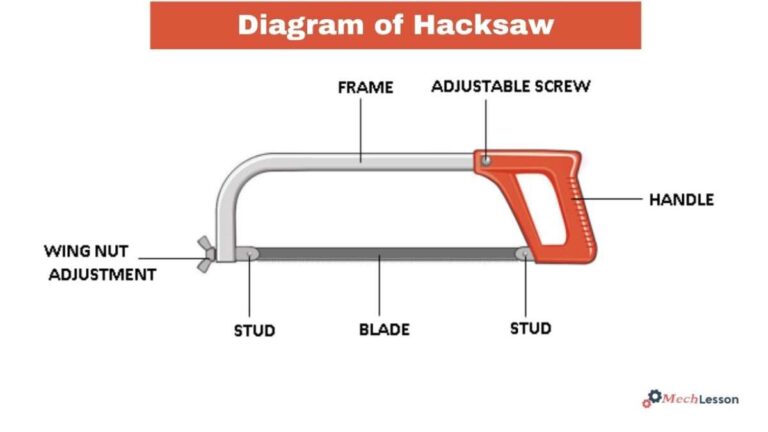
- Frame style: Some frames use a wing nut, while others use a lever or quick-release system.
- Blade condition: Do not fit a blade with cracks, bent teeth, deep rust, or damaged mounting holes.
A hacksaw blade has two small mounting holes, one at each end. These holes fit over pins or hooks on the frame. The blade must sit flat and straight between those points.

Which Way Should a Hacksaw Blade Face?
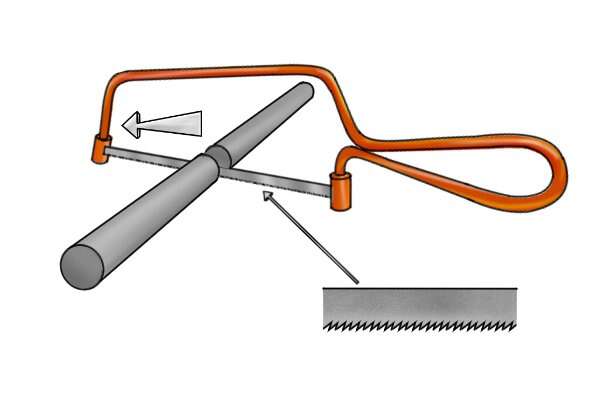
Install a standard hacksaw blade with the teeth pointing away from the handle. A hacksaw normally cuts on the forward push stroke, not when you pull it back.
Hold the frame as you would when cutting. The handle is usually at the back. The blade teeth should point toward the end of the frame, away from your hand.
Some compact saws, specialty frames, and junior hacksaws may work differently. If the frame has an arrow, follow the arrow. If the tool manual gives a different direction, use the manual’s instruction.
A quick direction check
Before tightening the blade, ask:
- Where is the handle?
- Which way will the saw move during the cutting stroke?
- Are the blade teeth pointing in that direction?
If the teeth point toward the handle, turn the blade around. A reversed blade may still move through soft material, but it will not cut as intended and may cause excessive force or tooth damage.
Why tooth direction matters
Hacksaw teeth have a set cutting edge. They remove material when the blade moves in the intended direction. When the blade is reversed, the teeth may skid across the workpiece, catch suddenly, or fail to start a clean cut.

How to Fit a Hacksaw Blade: Step-by-Step
Follow these steps for a standard adjustable hacksaw frame.
1. Put on eye protection
Wear safety glasses before handling or tensioning the blade. Old blades can snap when removed, and new blades can shed small metal fragments during use.
Keep the work area clear. Do not hold the blade near your face, and keep your fingers away from the teeth.
2. Release the old blade
hold the frame away from your body. Loosen the tensioning device until the blade becomes slack.
Depending on the frame, you may need to:
- Turn a wing nut counterclockwise.
- Turn a threaded tension knob.
- Pull back a quick-release lever.
- Press a release button on a compact frame.
Do not force a stuck tension knob with excessive leverage. If it will not move, inspect it for rust or damage and follow the frame maker’s instructions.
3. Remove the old blade
Lift one end of the blade off its mounting pin. Then remove the other end.
Use care even if the blade looks worn. Broken teeth and sharp edges can still cut skin. Place the old blade in a safe container or wrap it before disposal.
4. Check the new blade
Confirm that the replacement blade matches the frame. Compare its length with the old blade and check that both mounting holes are present.
Look at the teeth before installation. For a normal hacksaw, the teeth should point away from the handle when the blade is fitted.
If the blade has a printed label, do not rely on the label alone. The tooth shape and frame direction matter more than the printing.
5. Fit one end onto the frame pin
Place one mounting hole over the pin at the far end of the frame. Keep the blade flat against the frame.
Do not twist the blade to make it reach the pin. If the hole does not line up, the blade may be the wrong length or the frame may not be adjusted enough.
6. Fit the other end
Align the second mounting hole with the pin near the handle. You may need to loosen the frame slightly more to create enough space.
Keep the teeth facing forward as you fit the second end. Make sure both mounting holes sit fully over their pins.
The blade should lie in the same plane as the frame. If it leans sharply to one side, remove it and check the fit.
7. Apply the correct tension
Tighten the tensioning device until the blade is firm and straight. A correctly tensioned blade should not hang loose or twist easily with light finger pressure.
Do not tighten until the frame bends or the threads strain. Excess tension can damage the frame, strip the adjustment threads, or cause the blade to break.
A practical check is to tap the blade lightly with a fingernail. It should feel firm and produce a short, clear sound. This is only a rough check, not a measured tension specification.
8. Inspect the final fit
Before cutting, check all of the following:
- The teeth point away from the handle.
- Both blade holes sit fully on the frame pins.
- The blade is straight.
- The blade does not rub against the frame.
- The tensioning device is secure.
- The blade is not cracked or bent.
Make a light test stroke through the air, away from people and objects. The blade should remain stable and should not wobble.

How Tight Should a Hacksaw Blade Be?
A hacksaw blade should be tight enough to stay straight during a cut, but not so tight that the frame or blade is under excessive strain.
If the blade bends sideways with little finger pressure, it is too loose. If the frame visibly bows, the tension knob becomes hard to turn, or the blade breaks while being tightened, it is too tight.
The right tension depends on the frame design and blade length. A rigid metal frame can usually accept more tension than a lightweight adjustable frame. For this reason, use the manufacturer’s instructions when available.
Signs of too little tension
- The blade wobbles during a stroke.
- The cut wanders.
- The blade twists in the workpiece.
- The blade makes a loose, buzzing sound.
- Teeth strip or catch more easily.
Signs of too much tension
- The frame bends.
- The tension threads feel strained.
- The blade breaks before cutting begins.
- The mounting holes deform.
- The frame becomes difficult to adjust.
Stop and release the tension if the blade breaks repeatedly. Repeated breakage may point to incorrect installation, a damaged frame, excessive force, or a blade that does not match the material.

Choosing the Right Hacksaw Blade
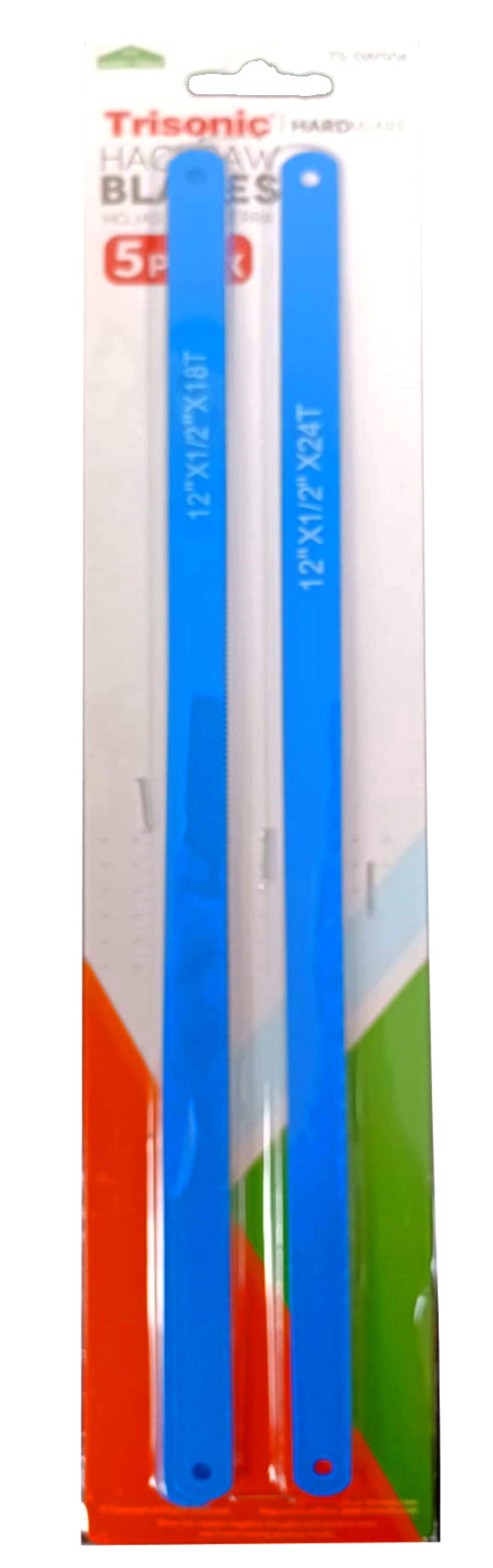
The best blade depends on the material, thickness, and type of cut. Tooth count is usually listed as TPI, or teeth per inch.
| Blade rating | Typical use | Main trade-off |
|---|---|---|
| 14 TPI | Thick metal, aluminum, brass, and larger sections | Fast cutting, rougher finish |
| 18 TPI | General metal cutting and thicker tubing | Good balance of speed and control |
| 24 TPI | Thin-wall tubing, sheet metal, and common hardware | Cleaner cut, slower material removal |
| 32 TPI | Thin sheet metal and small sections | Fine cut, more clogging risk in thick material |
These are general choices, not strict rules. Always check the blade maker’s material guidance.
Match the tooth count to the material
Use a coarser blade for thick material and a finer blade for thin material. The workpiece should engage several teeth at once. If only one or two teeth touch the material, they can catch and break.
For thin sheet metal, a fine blade helps prevent tooth grabbing. For thick steel bar, a coarse blade removes material faster and gives each tooth more room to clear chips.
Use the correct blade material
Common blade types include:
- Carbon steel: Low-cost blades for light work and softer materials.
- High-speed steel: Harder teeth that resist wear.
- Bi-metal: Flexible blade backs with harder cutting teeth. These are useful for general metal work and can tolerate bending better than many basic blades.
Do not assume a harder blade is always better. A very hard blade may still fail if you twist it, use the wrong TPI, or apply too much force.
For wood and plastic
A hacksaw is designed mainly for cutting metal and similar materials. It can cut some plastic, but the teeth may clog or melt the plastic if the stroke is too fast.
Use a hand saw made for wood when cutting lumber. Use a fine-tooth blade and slow strokes for some rigid plastics. Support the workpiece well to prevent vibration.

How to Use the Fitted Blade Safely
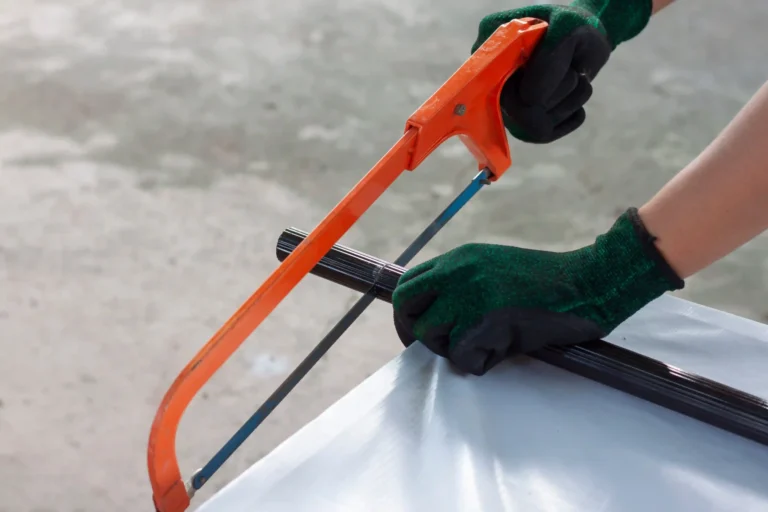
After fitting the blade, secure the workpiece in a vise or with suitable clamps. Do not hold small metal parts in your hand while sawing.
Use long, steady strokes. Let the teeth do the cutting instead of forcing the frame. Apply pressure on the forward stroke and reduce pressure on the return stroke.
Keep the blade square to the workpiece unless the job requires an angle. A tilted blade can bind, wander, or break. Near the end of a cut, reduce pressure so the remaining material does not snap suddenly.
Wear safety glasses throughout the cut. Hearing protection may help during extended work, especially in a metal shop. Keep fingers clear of the cutting path and never test sharpness by running a finger over the teeth.
When cutting metal, watch for hot edges and burrs. Let the workpiece cool if it becomes hot enough to burn you, and deburr the cut edge with a file when finished.

Common Problems After Fitting a Hacksaw Blade
Most fitting problems come from the wrong blade direction, poor tension, a damaged frame, or an unsuitable blade.
| Problem | Likely cause | What to check |
|---|---|---|
| The blade will not fit | Wrong length or damaged mounting hole | Compare blade length and pin spacing |
| The blade keeps falling off | Too little tension or incomplete pin engagement | Confirm both holes are fully on the pins |
| The blade cuts poorly | Teeth facing the wrong way or dull blade | Reverse the blade or replace it |
| The blade wanders | Loose blade, tilted frame, or poor work support | Increase moderate tension and clamp the work |
| Teeth break quickly | Excess force, wrong TPI, or blade twisting | Use steady strokes and a better blade match |
| The blade snaps during fitting | Excess tension or damaged blade | Release tension and inspect the frame |
| The cut clogs with metal | Tooth spacing is too fine for the material | Try a coarser TPI blade |
| The blade bends | Side pressure or an unstable workpiece | Keep the frame straight and secure the material |
If a new blade breaks in the same place, inspect the frame pins. A sharp burr or misaligned pin can damage the blade mounting hole.
Replace a frame that is cracked, badly bent, or unable to hold tension. A faulty frame can make even a correctly fitted blade unsafe.

Fixed-Frame and Adjustable Hacksaws
A fixed-frame hacksaw accepts one blade length and usually has a simple tensioning nut. It is easy to use, but replacement blades must match the frame.
An adjustable hacksaw can accept more than one blade length. It may use a sliding front section or a frame with several mounting positions. Set the frame to the correct length before tensioning the blade.
Some adjustable frames allow the blade to be mounted at 90 degrees to the frame. This can help when making flush cuts or working in a narrow space. Use that position only when the frame and blade are designed for it, and check that the blade remains secure.
A junior hacksaw has a smaller frame and a shorter blade. Do not assume a standard 12-inch blade will fit it. Match the replacement blade to the actual frame and mounting system.
Key Takeaways
- Fit the blade with the teeth pointing away from the handle unless the frame instructions say otherwise.
- Make sure both mounting holes sit fully on the frame pins.
- Tension the blade until it is firm and straight, but do not over-tighten it.
- Match the blade length and TPI to the hacksaw frame and workpiece.
- Wear eye protection and secure the material before cutting.
- Replace a blade that is cracked, bent, badly rusted, or missing teeth.
FAQs About Fitting a Hacksaw Blade
Should the teeth on a hacksaw blade point toward or away from the handle?
They should normally point away from the handle. A standard hacksaw cuts on the forward push stroke. Check the frame instructions if you are using a specialty or compact saw.
How do I know if my hacksaw blade is tight enough?
The blade should feel firm and remain straight when you apply light finger pressure. It should not hang loose or twist easily. Do not tighten it so far that the frame bends or the adjustment threads strain.
Can I fit any hacksaw blade to any hacksaw frame?
No. The blade must match the frame’s length and mounting points. A common full-size frame uses a 12-inch blade, but smaller and specialty frames may use different sizes.
Why does my hacksaw blade keep breaking?
Common causes include too much tension, side pressure, twisting, an unstable workpiece, a damaged frame pin, or the wrong blade for the material. Check the installation first, then reduce force and choose a suitable TPI.
How many teeth should touch the workpiece?
As a general practice, keep several teeth engaged in the material. If the workpiece is thin and only one or two teeth contact it, use a finer-tooth blade. If the material is thick, a coarser blade can clear chips more easily.
Can I reuse a hacksaw blade after removing it?
You can reuse it if the blade is straight, sharp, undamaged, and still suited to the work. Do not reuse a blade with cracks, bent mounting holes, missing teeth, deep rust, or a visibly damaged edge.
Conclusion
To fit a hacksaw blade, release the frame tension, place the blade teeth forward, seat both mounting holes on the frame pins, and tighten the blade until it is firm and straight. The correct blade length, tooth count, and moderate tension matter as much as the installation itself.
Before making the first cut, secure the workpiece, wear eye protection, and check that the blade does not wobble. If it falls off, wanders, or breaks, stop and correct the fit rather than forcing the saw.
Recent Tool Guides
 Hammer
How To Hammer Flowers Onto Paper: Easy Guide
Learn how to hammer flowers onto paper with simple steps, helpful tips, and beautiful results for...
Read Guide → Wrench
How To Use A Hex Wrench: Easy Step-By-Step Guide
Learn how to use a hex wrench correctly with simple steps, helpful tips, and common mistakes...
Read Guide → Hacksaw
How To Cut Curtain Pole With Hacksaw: Easy Guide
Learn how to cut curtain pole with hacksaw safely and neatly. Follow simple steps for accurate...
Read Guide → Wrench
How To Use A Husky Torque Wrench: Easy Guide
Learn how to use a Husky torque wrench correctly with simple steps, torque settings, and safety...
Read Guide → Hammer
How To Hold A Hammer: Safe Grip Guide
Learn how to hold a hammer with the right grip, stance, and technique for safer, more...
Read Guide → Hacksaw
How To Cut Flexible Metal Conduit With Hacksaw: Easy Guide
Learn how to cut flexible metal conduit with hacksaw safely and cleanly. Follow simple steps for...
Read Guide →