

Yes, you can sharpen a hacksaw blade, but success depends on its metal, tooth size, and overall wear.
Many people ask, “Can you sharpen a hacksaw blade?” The honest answer is yes, in some cases—but replacing the blade is often faster, safer, and more reliable. A hacksaw blade has small teeth, a set tooth pattern, and hardened metal that can make sharpening tricky. This guide explains when sharpening makes sense, which tools to use, and how to avoid damaging the blade.
Can You Sharpen a Hacksaw Blade?
You can sharpen a hacksaw blade with a small three-square file, also called a triangular file. However, the blade must have enough metal left on each tooth, and the teeth must not be badly bent, cracked, or worn smooth.
Traditional carbon-steel blades are the easiest to sharpen. Bi-metal and hardened high-speed-steel blades are much harder to file by hand. Their cutting edges are designed to last longer, but that hardness also makes home sharpening less practical.
A simple rule helps:
• Sharpen the blade when only the tooth edges are dull.
• Replace the blade when the teeth are missing, rounded, badly set, or uneven.
• Replace any blade with cracks, deep rust, or a bent body.
So, can you sharpen a hacksaw blade? Yes, but sharpening is best for light workshop use, not for restoring a badly worn blade.

When Sharpening a Hacksaw Blade Makes Sense
Sharpening can be useful when you have a quality blade that is only slightly dull. It may also help when you need to finish a job and do not have a spare blade nearby.
A blade may be worth sharpening if:
• The teeth still have clear points.
• The blade cuts slowly but does not slip across the metal.
• The tooth spacing remains even.
• The blade is straight and free from cracks.
• The blade is made from plain carbon steel.
Sharpening is less useful when the blade has cut through hard steel for a long time. Heat, pressure, and friction can round the teeth and damage their set. Once the tooth shape is gone, a file cannot easily recreate the original cutting pattern.
In my experience with hand tools, the biggest mistake is trying to save a blade that has already reached the end of its life. People often spend 20 minutes filing a blade that costs only a few dollars to replace. The result is usually a slower cut and more effort.

Why Hacksaw Blades Become Dull
A hacksaw blade becomes dull for several reasons. The most common cause is normal wear. Each tooth loses its sharp edge as it rubs against metal.
Other causes include:
• Using the wrong tooth pitch for the material.
• Applying too much downward force.
• Cutting with too few teeth engaged.
• Running the blade too fast during powered use.
• Allowing the blade to overheat.
• Twisting the frame during a cut.
• Cutting dirty, painted, or heavily rusted metal.
A hacksaw works best when several teeth share the load. For thin sheet metal, a fine blade is usually better. For thick steel, a coarse blade gives each tooth more room to clear chips.
If the blade skips, binds, or makes a harsh scraping sound, it may not simply be dull. The blade could have the wrong tension, the wrong tooth pitch, or a damaged tooth set.

Tools You Need to Sharpen a Hacksaw Blade
You do not need a large tool collection to sharpen a basic hacksaw blade. The right file and a stable setup matter more than force.
Gather these items:
• A small three-square file that fits between the teeth.
• A bench vise with soft jaw covers.
• Safety glasses.
• Work gloves for handling the blade.
• A wire brush for removing dirt and filings.
• A permanent marker.
• A small flat file for light burr removal.
The triangular file should fit the tooth gullets without touching too much of the next tooth. If the file is too large, it will flatten the tooth shape. If it is too small, it may create deep grooves and weak points.
Wear eye protection during the entire process. Tiny metal filings can fall from the teeth or fly when you brush the blade clean.

How to Sharpen a Hacksaw Blade by Hand
The process is slow, but it is manageable when the blade is in fair condition. Work carefully and remove only a small amount of metal.
1. Remove and clean the blade
Take the blade out of the hacksaw frame. Brush away dirt, rust, and loose metal particles. Wipe it with a clean cloth so you can inspect each tooth.
Look for cracks, missing teeth, and bent sections. Do not sharpen a damaged blade. It may break during use and cause an injury.
2. Clamp the blade securely
Place the blade in a vise with the teeth facing upward. Clamp it firmly, but do not crush the thin blade body.
Use soft jaw covers if possible. They help prevent scratches and reduce the risk of bending the blade.
3. Mark the starting point
Use a marker to place a small mark near one end of the blade. This helps you keep track of the teeth as you work.
Without a mark, it is easy to sharpen some teeth twice and miss others. A consistent process gives a better cutting edge.
4. Match the original tooth angle
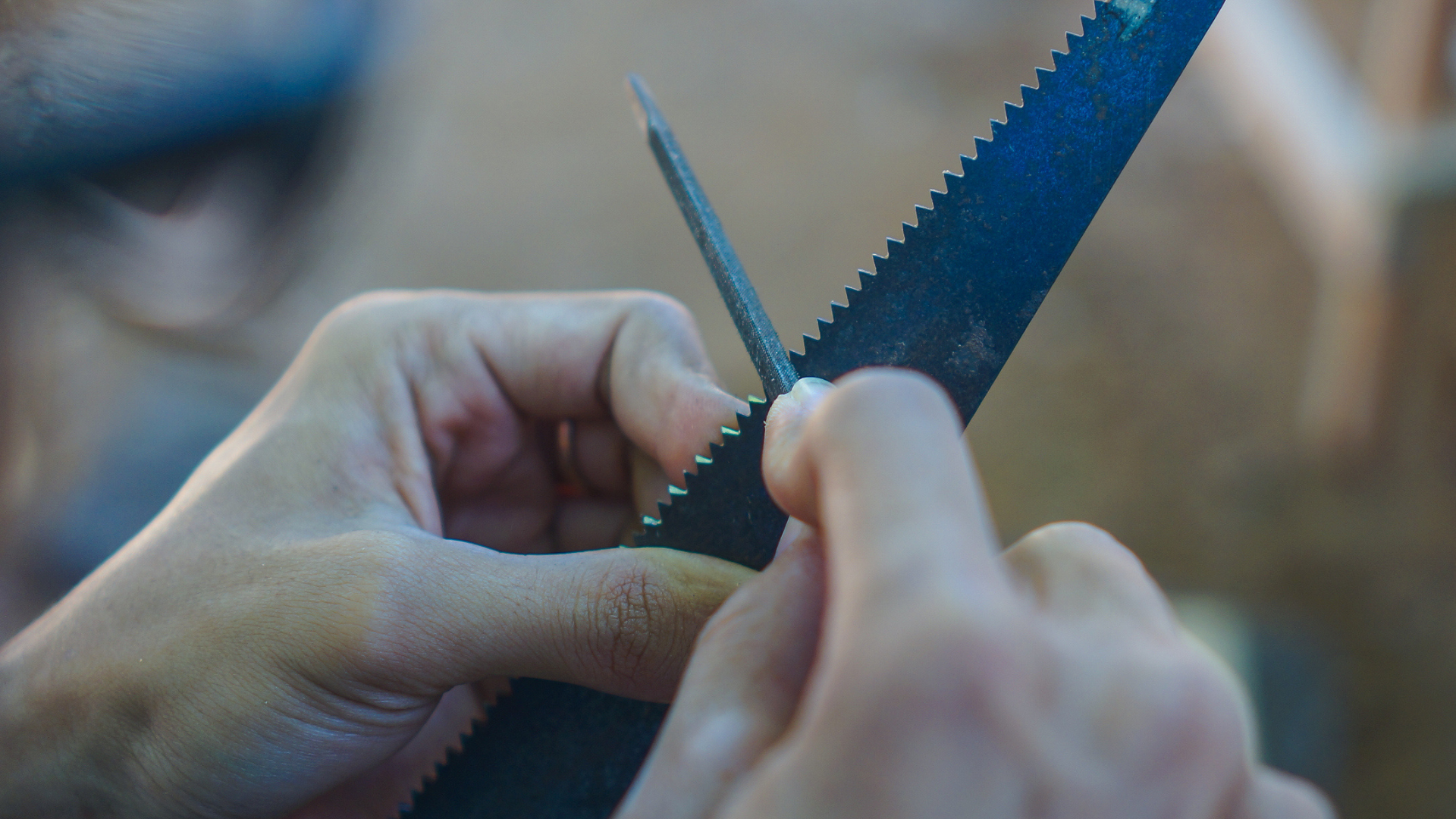
Hold the three-square file at the same angle as the existing tooth faces. Most hacksaw teeth have a regular front angle and a clear space between each tooth.
Do not try to redesign the tooth pattern. Your goal is to restore the sharp edge, not change the blade into a different type of saw.
5. Use light, even strokes
Push the file across the tooth in one direction. Use smooth strokes with light pressure. Lift the file on the return stroke instead of dragging it backward.
Give each tooth the same number of strokes. Two or three light strokes may be enough for a mildly dull blade. Heavy filing can make teeth uneven.
6. Follow the original set
Hacksaw teeth are usually set slightly to alternating sides. This creates a narrow cut called the kerf, which is wider than the blade body.
Do not file away the side set. If you remove it, the blade may pinch in the cut. A pinched blade can bind, buckle, or break.
7. Inspect the entire blade
After filing, brush the blade clean and inspect the teeth under a bright light. The teeth should look even and sharp, with no large burrs.
Install the blade and test it on scrap metal. Use light pressure at first. If it cuts unevenly or pulls to one side, the teeth may not be uniform.
How to Sharpen Different Types of Hacksaw Blades
Not every hacksaw blade responds to sharpening in the same way. Blade construction matters more than many people realize.
Carbon-steel blades
Carbon-steel blades are the most suitable for hand sharpening. Their metal is hard enough to cut well but soft enough for a good file to remove material.
These blades are often inexpensive and may not justify sharpening unless you need them for occasional use.
Bi-metal blades
Bi-metal blades combine a flexible body with a harder cutting edge. They resist breakage and last longer than basic carbon-steel blades.
You can sometimes touch up a bi-metal blade with an abrasive wheel, but hand filing may be slow. The cutting edge may also have a different hardness from the blade body.
High-speed-steel blades
High-speed-steel blades are very hard and wear resistant. A normal hand file may slide over the teeth without removing useful material.
Professional grinding equipment may sharpen them, but the cost often exceeds the price of a new blade. For most home users, replacement is the better choice.
Carbide-grit blades
Carbide-grit blades do not have normal saw teeth. They use abrasive particles to cut materials such as tile, fiberglass, and hardened surfaces.
Do not try to sharpen them with a triangular file. Replace them when their cutting action becomes weak.

Can You Sharpen a Hacksaw Blade With a Grinder?
You can sharpen some hacksaw blades with a small grinding wheel, but it requires care. Excess heat can remove the blade’s hardness and leave the teeth soft.
If you use a grinder:
• Use a fine abrasive wheel.
• Touch the tooth to the wheel for a very short time.
• Keep the blade moving.
• Cool the blade often in clean water.
• Avoid changing the tooth shape.
• Wear eye, face, and hearing protection.
Grinding is more accurate when performed with a dedicated sharpening setup. A freehand grinder can easily make uneven teeth. It can also reduce the tooth set and weaken the blade.
For this reason, a grinder is usually not the best answer to “Can you sharpen a hacksaw blade?” It is possible, but the risk is higher than with careful hand filing.
How to Tell Whether the Blade Is Sharp
A sharp hacksaw blade should start a cut without excessive force. It should produce small, consistent chips and move through the material at a steady rate.
Check for these signs:
• The teeth feel crisp when viewed under bright light.
• The blade does not skate across the workpiece.
• The cut stays fairly straight.
• The blade removes material without heavy pressure.
• The teeth do not make a smooth scraping sound.
Never test sharpness by dragging your finger across the teeth. Even a dull hacksaw blade can cut skin. Visual inspection and a controlled test cut are safer.
A useful test is to cut a small piece of mild steel held firmly in a vise. Let the blade do the work. If you must push hard, the blade may still be dull, or the tooth pitch may not match the material.

Common Mistakes to Avoid
Many poor sharpening results come from technique rather than the file. Small errors can change the tooth shape and make the blade worse.
Avoid these mistakes:
• Filing with a rounded or damaged file.
• Using too much pressure.
• Filing in both directions.
• Sharpening only the largest visible teeth.
• Changing the original tooth angle.
• Removing the alternating tooth set.
• Clamping the blade so tightly that it bends.
• Skipping the final inspection.
Another common mistake is using a fine-tooth blade on thick stock. Fine teeth can clog and heat up. A coarse blade may work better because it clears chips more easily.
The best lesson is simple: sharpen lightly, inspect often, and stop if the blade begins to look uneven.
Sharpening Versus Replacing a Hacksaw Blade
Sharpening costs little if you already have a suitable file. It also reduces waste and can restore a blade for light work.
Replacement offers several benefits:
• It restores the original tooth shape.
• It provides a known cutting performance.
• It saves time.
• It reduces the chance of blade breakage.
• It gives you the correct tooth pitch for the job.
A new blade is usually the better choice for structural steel, stainless steel, thick tubing, or repeated work. A sharpened blade may be fine for soft metal, plastic, or a quick repair.
If the blade is cheap, damaged, or heavily worn, replace it. If it is a specialty blade and only mildly dull, careful sharpening may be worthwhile.
Choosing the Right Replacement Blade
Blade selection often matters more than sharpening skill. Hacksaw blades are commonly described by teeth per inch, or TPI.
Use these general guidelines:
• 14 TPI works well for thick metal and heavy stock.
• 18 TPI suits medium-thickness steel and general repairs.
• 24 TPI works well for thin wall tubing and sheet metal.
• 32 TPI suits thin sheet, small tubing, and delicate cuts.
Try to keep at least three teeth engaged in the material. At the same time, avoid having too many teeth buried in the cut, because that can slow chip removal.
For stainless steel, use a quality bi-metal blade with the correct pitch. Keep the cut steady and avoid forcing the frame. Stainless steel work-hardens when rubbed without cutting, so a dull blade can make the problem worse.
Safe Hacksaw Use After Sharpening
A sharpened blade needs correct tension and handling. Install it with the teeth pointing forward, toward the direction of the cutting stroke.
Tighten the frame until the blade feels firm. Do not overtighten it, because excessive tension can snap the blade or damage the frame.
Keep these safety habits:
• Clamp the work securely.
• Use both hands on the saw frame.
• Make long, steady strokes.
• Keep your fingers away from the cut.
• Do not twist the blade.
• Replace the blade if it begins to crack or bend.
• Store spare blades where they cannot cut someone.
A hacksaw is a simple tool, but it rewards patience. A steady stroke usually cuts faster than a hard stroke.
Frequently Asked Questions About Can You Sharpen a Hacksaw Blade
Can you sharpen a hacksaw blade with a regular file?
Yes, but a small three-square file works best because its shape fits between the teeth. A regular flat file usually cannot reach the tooth gullets or preserve the original tooth form.
How many times can you sharpen a hacksaw blade?
There is no fixed number. You can sharpen the blade as long as the teeth remain full, even, and properly set. Once the teeth become short, rounded, or uneven, replacement is safer.
Can you sharpen a bi-metal hacksaw blade?
Sometimes, but bi-metal blades are difficult to sharpen by hand because their cutting edges are very hard. In most cases, replacing the blade gives a better result with less effort.
What file is best for sharpening a hacksaw blade?
A small three-square file is the usual choice. Select a size that fits the space between the teeth without flattening the tooth points.
Is it worth sharpening a hacksaw blade?
It can be worthwhile when the blade is lightly worn, reusable, and made from carbon steel. For a cheap or badly damaged blade, buying a replacement is usually more practical.
Why does my sharpened hacksaw blade cut poorly?
The teeth may be uneven, the original set may be damaged, or the blade may have the wrong TPI for the material. Incorrect tension and excessive force can also cause poor cutting.
Conclusion
You can sharpen a hacksaw blade when it is straight, lightly worn, and made from a file-friendly steel. Use a small three-square file, match the original tooth angle, preserve the tooth set, and remove as little metal as possible.
Do not try to rescue a cracked, badly worn, or hardened specialty blade. A fresh blade with the right TPI often saves time and produces a cleaner, safer cut. Inspect your blade today, sharpen it carefully if it is suitable, or replace it before your next project—and share your own hacksaw sharpening experience in the comments.
