What’s A Hacksaw Used For: Uses And Cutting Tips
Introduction
In the United States, a hacksaw is a common hand tool found in home garages, plumbing kits, maintenance shops, and construction toolboxes. It is mainly used to cut metal, plastic pipe, threaded rod, bolts, and other hard materials by hand.
A hacksaw is simple, low-cost, and useful when a power saw would be too large, noisy, or unsafe for a small job. The right blade and steady pressure matter more than speed.

What Is a Hacksaw Used For?
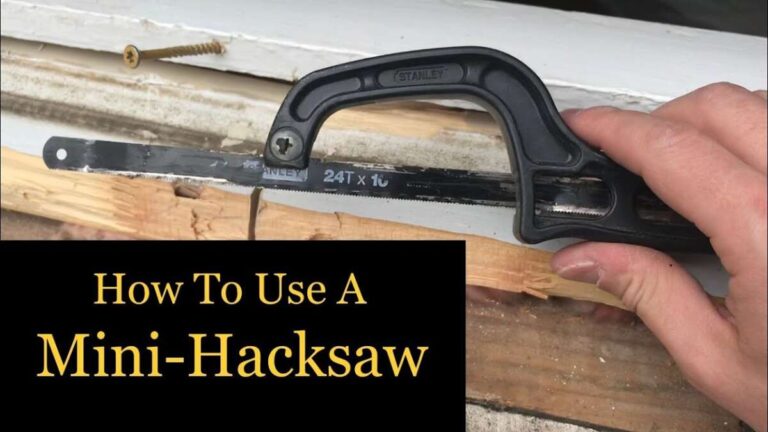
A hacksaw is used to make straight cuts through metal and some rigid plastics. Its thin, toothed blade is held in a metal frame. As you push and pull the frame, the teeth remove small bits of material.
Common uses include:
- Cutting steel, aluminum, copper, and brass
- Cutting metal conduit and tubing
- Shortening threaded rod and bolts
- Cutting nails, screws, and small brackets
- Trimming plastic pipe
- Removing damaged fasteners
- Cutting metal mesh and thin sheet metal
- Making small cuts in automotive parts
- Cutting through chain or cable in some repair tasks
A hacksaw works best on small or medium-size pieces that you can hold firmly. It is not designed for fast cuts through large lumber, thick steel plate, or heavy structural parts.
The tool does not cut by melting or tearing. Its teeth scrape across the material and remove a narrow strip called the kerf. This is why a sharp blade, firm support, and controlled strokes produce a cleaner cut.
Typical materials
A standard hacksaw can cut many materials, but the blade must match the job.
| Material | Can a hacksaw cut it? | Notes |
|---|---|---|
| Mild steel | Yes | Use a fine or medium metal-cutting blade |
| Stainless steel | Yes | Use a sharp, high-quality blade and slow strokes |
| Aluminum | Yes | Clean the teeth often to reduce clogging |
| Copper tubing | Yes | A tubing cutter is often cleaner for round pipe |
| Brass | Yes | Support thin pieces to prevent bending |
| PVC pipe | Yes | A fine-tooth blade can leave a smooth edge |
| ABS pipe | Yes | Remove burrs after cutting |
| Wood | Sometimes | A wood saw is usually faster and better |
| Hardened tool steel | Limited | A hacksaw may not cut it effectively |
| Concrete or masonry | No | Use a masonry blade or specialized tool |
A hacksaw is especially useful when the workpiece is already installed and cannot be moved to a larger saw. For example, a plumber may use one to cut a small section of pipe in a tight space.
How Does a Hacksaw Work?
A hacksaw works through repeated back-and-forth strokes. Most cutting happens during the forward stroke, when the teeth point into the material. The return stroke should use light pressure so the blade can reset without bending.
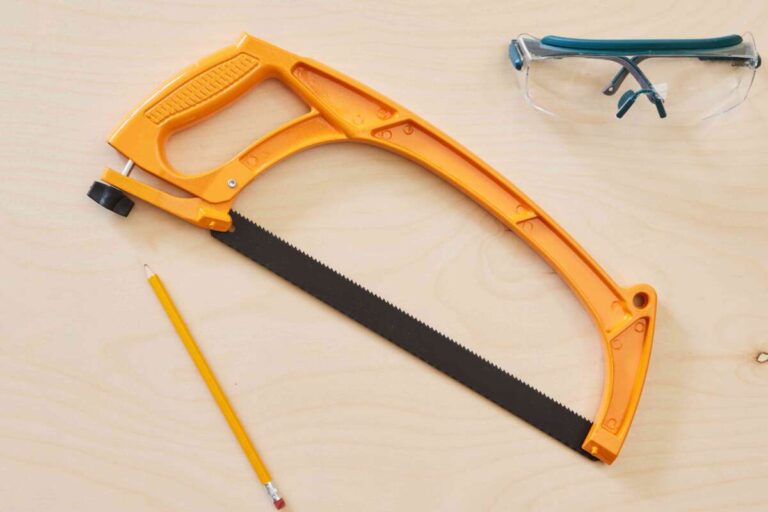
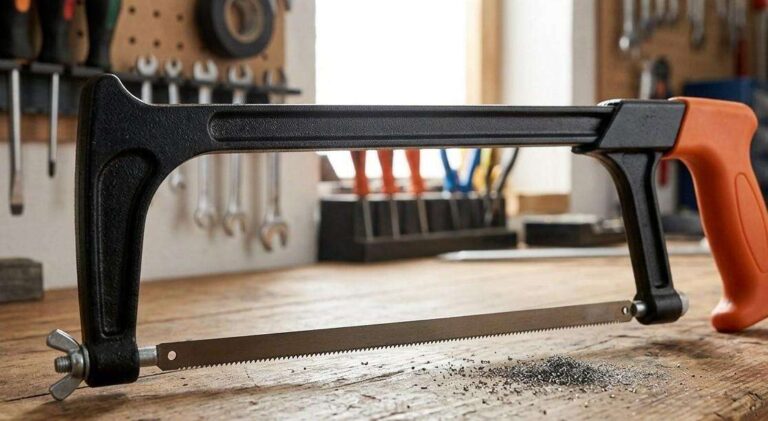
The main parts are:
- Frame: Holds the blade straight and under tension
- Blade: A thin, replaceable strip with small teeth
- Handle: Gives you control and a firm grip
- Blade pins: Fit into holes at each end of the blade
- Tension adjustment: Tightens the blade so it does not bow during use
How to use a hacksaw
Follow these steps for a clean and controlled cut:
-
Choose the correct blade.
Select a blade made for the material. Check its teeth per inch, or TPI. -
Mark the cut line.
Use a marker, pencil, or scribe. A clear line helps you stay on course. -
Secure the workpiece.
Clamp it in a vise or hold it with a suitable clamp. Do not hold small metal parts in your hand while cutting. -
Install the blade correctly.
Most hacksaw teeth should point away from the handle. Check the frame or blade package if unsure. -
Tighten the blade.
The blade should feel firm and straight. Do not tighten it so much that the frame or blade is damaged. -
Start with short strokes.
Begin near the edge of the mark. Short strokes help create a shallow groove called a starting notch. -
Use long, steady strokes.
Once the groove is established, use most of the blade length. Keep the frame level. -
Apply moderate forward pressure.
Let the teeth cut. Pressing too hard can bend or break the blade. -
Slow down near the end.
Support the cut-off piece so it does not fall, twist, or tear the last section. -
Smooth the edge.
Use a file or deburring tool to remove sharp edges and burrs.
Signs of a good cut
A good hacksaw cut usually has:
- A straight path
- No severe blade bowing
- Small, even teeth marks
- Little damage to the surrounding material
- A cut edge that needs only light filing
If the blade drifts, stop and check the workpiece, blade tension, and your cutting angle. Trying to force the saw back to the line can damage the blade or create an uneven cut.

How Do You Choose the Right Hacksaw Blade?
The best hacksaw blade depends on the material’s hardness and thickness. Blade choice is mainly described by teeth per inch, or TPI.
A blade with a higher TPI has smaller teeth and makes a finer cut. A blade with a lower TPI has larger teeth and removes material faster.
General TPI guide
| Blade size | Common use |
|---|---|
| 14–18 TPI | Thick metal, heavy tubing, and larger workpieces |
| 20–24 TPI | General-purpose metal cutting |
| 28–32 TPI | Thin sheet metal, thin-wall tubing, and small parts |
As a basic rule, at least two or three teeth should contact the workpiece at the same time. If too few teeth touch the material, the blade may catch, chatter, or break.
If the material is thick, a very fine blade can cut slowly and clog. If the material is thin, a coarse blade may snag and bend the workpiece.
Blade materials
Hacksaw blades are commonly made from:
- Carbon steel: Low-cost and suitable for light work
- Bi-metal steel: A flexible body with harder cutting teeth; useful for general repairs
- High-speed steel: Hard, wear-resistant teeth for demanding metal work
For occasional household repairs, a general-purpose bi-metal blade is often a practical choice. For repeated work with hard metal, blade quality and correct TPI become more important.
When should you replace the blade?
Replace a hacksaw blade when:
- The teeth look worn or rounded
- The blade slips instead of cutting
- You need much more pressure than before
- The cut wanders even with proper technique
- Teeth are missing
- The blade is bent, cracked, or rusty
A dull blade does not become safer because it cuts more slowly. It usually makes the user push harder, which raises the chance of slipping or breaking the blade.

Hacksaw vs. Other Cutting Tools
A hacksaw is a good choice when you need control, low cost, and portability. It is not always the fastest tool.
Hacksaw vs. reciprocating saw
A reciprocating saw uses a powered blade and can cut much faster. It is useful for demolition, thick pipe, and larger materials. It also creates more noise, vibration, and possible kickback.
Choose a hacksaw when the cut is small, precise, or near finished surfaces. Choose a reciprocating saw when speed matters and you can safely control the tool.
Hacksaw vs. tubing cutter
A tubing cutter is often better for copper, plastic, or thin-wall metal tubing. It makes a clean, square cut and usually leaves less deformation.
A hacksaw is more flexible. It can cut materials and shapes that a tubing cutter cannot, including brackets, bolts, flat bar, and irregular pieces.
Hacksaw vs. angle grinder
An angle grinder can cut thick metal quickly, but it produces sparks, noise, dust, and heat. It also removes more material and can damage nearby surfaces.
Use a hacksaw when you need a cold cut with no sparks. Use an angle grinder only when the work area, wheel, protective equipment, and cutting method are suitable.
Hacksaw vs. bolt cutters
Bolt cutters are designed to shear certain rods, chains, bolts, and wires. They do not create a smooth cut and may crush or deform the material.
A hacksaw takes longer but provides more control and can cut materials that bolt cutters cannot shear cleanly.

How Do You Use a Hacksaw Safely?
Safe hacksaw use starts with control. The tool is simple, but the blade has sharp teeth and can break if it is bent, loose, or forced.
Follow these safety practices:
- Wear safety glasses to protect against metal chips and broken teeth.
- Secure the workpiece before cutting.
- Keep both hands on the tool when the job allows.
- Keep fingers away from the blade path.
- Use a sharp blade with the correct TPI.
- Keep the frame straight during each stroke.
- Do not twist the blade while it is under pressure.
- Keep the cut area clear of wires, hoses, and other hazards.
- File sharp edges after cutting.
- Store spare blades so their teeth are covered or protected.
The Occupational Safety and Health Administration requires employers to keep hand tools in safe condition and remove damaged tools from service. Home users should follow the same basic principle: do not use a cracked frame, bent blade, loose handle, or damaged tension mechanism.
When should you stop and use another tool?
Stop using a hacksaw if:
- The material is too thick for practical hand cutting
- The workpiece cannot be secured
- The cut is near live electrical wiring
- The material may contain asbestos, lead, or another hazardous substance
- The blade keeps breaking
- The required cut must meet a precise engineering tolerance
- The job involves structural steel or a load-bearing component
For electrical, gas, structural, or hazardous-material work, follow the applicable local rules and use a qualified professional when the risk is beyond basic hand-tool work.

Common Hacksaw Problems and Fixes
The blade keeps breaking
A blade may break because it is too tight, too loose, bent during use, or forced through the material.
Try a fresh blade with the correct TPI. Secure the workpiece and use steady strokes. Do not twist the frame at the end of the cut.
The cut is not straight
A wandering cut often comes from starting at an angle or allowing the workpiece to move.
Make a deeper starting notch, keep the frame level, and clamp the material closer to the cut line. Let the blade follow the groove instead of pushing it sideways.
The saw cuts very slowly
The blade may be dull, too fine for thick material, or clogged with chips.
Replace the blade or choose a more suitable TPI. Brush chips away when safe, and reduce pressure. For some metals, a small amount of suitable cutting fluid can improve the cut, but keep liquid away from electrical tools and follow the fluid manufacturer’s instructions.
The blade slips out of the frame
The blade may be installed incorrectly, the pins may not be seated, or the frame may have a damaged tension part.
Release the tension, reinstall the blade on both pins, and tighten it evenly. Replace the frame if it cannot hold the blade securely.
The metal edge is sharp after cutting
A hacksaw leaves burrs. A burr is a thin, sharp ridge left along the cut.
Use a hand file or deburring tool. Run the tool away from your body and wear eye protection. Check the edge with care rather than using your bare hand.

Key Takeaways
- A hacksaw is mainly used to cut metal and rigid plastic by hand.
- It can cut bolts, threaded rod, pipe, tubing, conduit, brackets, and thin sheet metal.
- Choose the blade by material thickness and teeth per inch.
- Secure the workpiece and use steady strokes instead of heavy force.
- Replace blades that are dull, bent, cracked, or missing teeth.
- Use safety glasses and file the sharp edge after cutting.
- Choose a tubing cutter, power saw, grinder, or bolt cutter when that tool better matches the material and job.
FAQs About Hacksaws
Can a hacksaw cut wood?
Yes, a hacksaw can cut thin wood in an emergency, but it is not the right tool for most woodcutting. Its fine metal-cutting teeth remove wood slowly and may clog. Use a hand saw, backsaw, or powered wood saw for cleaner and faster results.
Can a hacksaw cut PVC pipe?
Yes. A hacksaw can cut PVC and ABS pipe. Mark the pipe, secure it, and use a fine-tooth blade. After cutting, remove the inside and outside burrs so they do not interfere with fittings or restrict flow.
Can a hacksaw cut a bolt?
Yes. A hacksaw is commonly used to shorten bolts and threaded rod. Thread a nut onto the bolt before cutting. After the cut, file the end, then remove the nut to help restore the thread near the cut.
Which direction should hacksaw teeth face?
For most standard hacksaws, the teeth face away from the handle. The blade then cuts during the forward stroke. Some specialty frames or blades may differ, so check the tool instructions if the design is unusual.
How tight should a hacksaw blade be?
The blade should be tight enough to stay straight and produce a firm, controlled cut. It should not bow during normal use. Avoid excessive tension, which can damage the blade, frame, or blade pins.
Can a hacksaw cut stainless steel?
Yes, a hacksaw can cut stainless steel with a sharp, suitable blade. Use controlled strokes and avoid excessive pressure. Stainless steel work-hardens when overheated or rubbed without cutting, so forcing a dull blade can make the job harder.
Conclusion
A hacksaw is used for controlled hand cuts in metal, plastic pipe, threaded rod, bolts, conduit, and similar materials. Its main strengths are low cost, portability, and precise control in places where a power tool is not practical.
For the best result, match the blade to the material, secure the workpiece, keep the frame straight, and let the teeth do the work. If the material is too thick, the cut must be highly precise, or the work area creates a serious hazard, choose a more suitable tool or seek qualified help.

Recent Tool Guides
 Hammer
How To Hammer Flowers Onto Paper: Easy Guide
Learn how to hammer flowers onto paper with simple steps, helpful tips, and beautiful results for...
Read Guide → Wrench
How To Use A Hex Wrench: Easy Step-By-Step Guide
Learn how to use a hex wrench correctly with simple steps, helpful tips, and common mistakes...
Read Guide → Hacksaw
How To Cut Curtain Pole With Hacksaw: Easy Guide
Learn how to cut curtain pole with hacksaw safely and neatly. Follow simple steps for accurate...
Read Guide → Wrench
How To Use A Husky Torque Wrench: Easy Guide
Learn how to use a Husky torque wrench correctly with simple steps, torque settings, and safety...
Read Guide → Hammer
How To Hold A Hammer: Safe Grip Guide
Learn how to hold a hammer with the right grip, stance, and technique for safer, more...
Read Guide → Hacksaw
How To Cut Flexible Metal Conduit With Hacksaw: Easy Guide
Learn how to cut flexible metal conduit with hacksaw safely and cleanly. Follow simple steps for...
Read Guide →