When Using A Hacksaw You Should Apply Light Pressure: Why
When using a hacksaw, apply light, steady pressure on the forward cutting stroke. Let the teeth do the work. Do not force the blade, press hard on the return stroke, or twist the frame.
This rule applies to common jobs in the United States, such as cutting steel pipe, threaded rod, bolts, conduit, aluminum stock, and plastic parts. A light touch gives a cleaner cut, reduces blade wear, and lowers the chance of a slip.
Why should you apply light pressure with a hacksaw?
Light pressure helps each tooth remove a small amount of material without bending or stalling the blade. A hacksaw cuts through many small teeth, not through brute force.
Heavy pressure can cause several problems:
- The blade may bend and cut at an angle.
- Teeth may strip, dull, or break.
- The frame may slip from the work.
- The blade may bind in the cut.
- The cut may become rough.
- Your hand and arm may tire faster.
- A broken blade may snap toward your hand or face.
The best pressure is firm enough to keep the teeth engaged, but light enough that the blade moves in a smooth line. Think of the blade as a fine file with a frame. Your job is to guide it, not force it.
Apply pressure on the cutting stroke
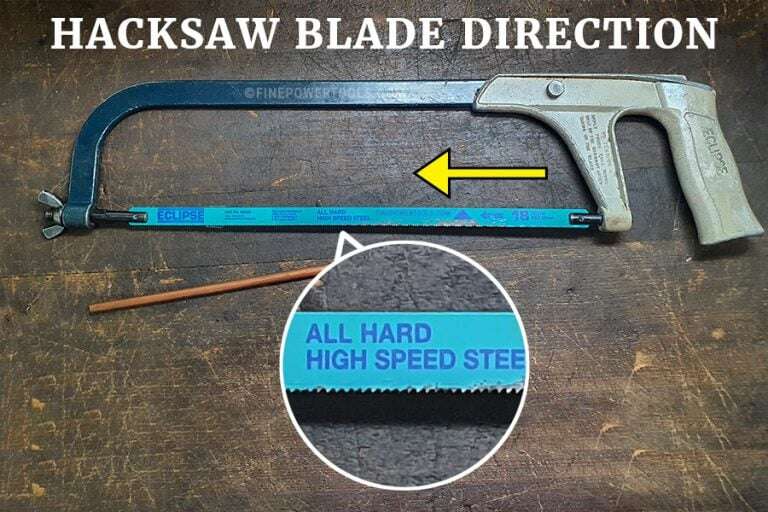
Most hacksaw blades have teeth that point away from the handle. The blade cuts as you push the saw forward.
Use this pattern:
- Push the hacksaw forward with light pressure.
- Release most of the pressure as you pull it back.
- Keep the blade straight.
- Repeat at a steady pace.
The return stroke resets the blade. It does not need strong downward force. Pressing hard on both strokes can wear the teeth and make the blade catch.
Match pressure to the material
The correct pressure depends on the material, blade, and tooth size.
| Material | Useful approach |
|---|---|
| Thin sheet metal | Use very light pressure and a fine-tooth blade |
| Steel pipe or bar | Use steady light-to-moderate pressure |
| Stainless steel | Use controlled pressure and avoid rubbing without cutting |
| Aluminum | Use a suitable blade and clear chips often |
| Plastic | Use light pressure to prevent melting or rough edges |
| Hardened steel | Stop and confirm that the blade is suitable; do not simply push harder |
If the blade stops cutting, more force is not always the answer. The blade may be dull, too fine, too coarse, poorly tensioned, or wrong for the material.
How to use a hacksaw with light pressure
A good cut starts before the first stroke. Secure the work, choose the right blade, and mark the cut clearly.
1. Choose the right blade
Hacksaw blades are commonly described by teeth per inch, or TPI. A higher TPI blade has smaller teeth. A lower TPI blade has larger teeth.
As a general guide:
- Use a fine-tooth blade for thin metal.
- Use a medium-tooth blade for general steel work.
- Use a coarse-tooth blade for thicker metal.
- Use a blade made for plastic when cutting plastic parts.
At least two or three teeth should usually contact the material during the cut. If only one large tooth contacts thin stock, the tooth can snag and break.
Check the blade package for the material range. Blade design varies, so the maker’s guidance should control when it differs from a general rule.
2. Inspect the hacksaw
Before cutting, check these parts:
- The blade has no cracks or missing teeth.
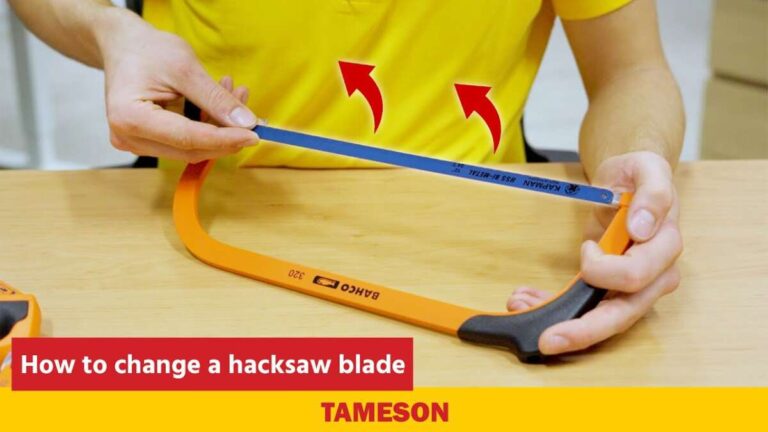
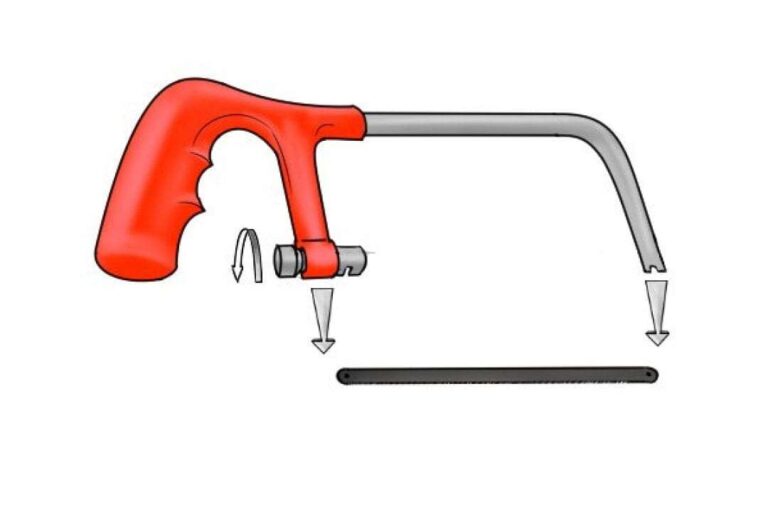
- The blade is tight in the frame.
- The handle is secure.
- The frame is not bent.
- The blade is mounted with the teeth pointing forward.
- The handle and frame are dry and free of oil.
A loose blade may wander. An over-tightened or damaged blade may break. Tighten the blade until it is firm and straight, but do not treat maximum tension as a goal.
3. Secure the workpiece
Clamp the material in a vise whenever possible. Place the cut close to the vise jaws. This reduces vibration and keeps the material from moving.
Do not hold small metal parts in your hand while cutting them. The saw can jump when a tooth catches. Your free hand should guide the frame, not hold the work directly under the blade.
If the workpiece is long, support the far end. Unsupported material can sag, twist, or pinch the blade.
4. Mark and start the cut
Mark the cut with a pencil, marker, scribe, or suitable layout tool. Square the mark around pipe or round stock if the cut must be straight.
Start with short, slow strokes. Keep the blade at a low angle until a shallow groove forms. This groove is called a starting kerf. Once the kerf guides the blade, use longer strokes.
Avoid sawing back and forth across a wide, flat surface with only one corner of the blade. That motion can damage the teeth and produce an uneven cut.
5. Use light pressure on the forward stroke
Hold the hacksaw with one hand on the handle and the other on the front of the frame if the frame design allows it. Keep your wrists straight.
Push forward with light pressure. Use a smooth stroke that engages much of the blade length. Lift pressure on the return stroke.
Do not rock the frame from side to side. Do not twist the blade to widen the cut. If the blade binds, stop and inspect the setup.
6. Slow down near the end
As the blade nears the far side of the material, reduce pressure. The remaining section may break suddenly. Heavy pressure at this point can make the saw jump.
Support the cut-off piece if it could fall. Keep your fingers away from the kerf and blade path.
How much pressure is “light” pressure?
There is no universal pound-force value for hacksaw pressure. The needed force changes with the blade, material, tooth size, stroke length, and condition of the saw.
A practical test is more useful than a fixed number:
- The blade should remove material on each forward stroke.
- The frame should stay straight.
- The teeth should not chatter or skip.
- The blade should not buckle.
- The saw should move without a sudden jerk.
- The user should not need to lean their body weight onto the frame.
If the blade makes dust-like debris but no clear kerf, the pressure or blade choice may be wrong. If the blade catches and jumps, reduce pressure and check the setup.
A simple pressure guide
| What you observe | Likely response |
|---|---|
| The blade cuts smoothly | Keep the same light pressure |
| The blade chatters | Reduce pressure and check blade tension |
| The blade bends | Reduce pressure and improve alignment |
| The blade skips over the surface | Start a deeper kerf or use a suitable blade |
| The cut takes too long | Check blade sharpness, TPI, and material |
| The blade binds | Stop, secure the work, and inspect alignment |
| Teeth break quickly | Use less force and confirm the blade is correct |
A hacksaw should feel controlled. If the cut requires great force, treat that as a warning rather than a challenge.
What happens if you press too hard?
Pressing too hard increases the load on the thin blade. The blade may deflect, which means it bends away from the intended line. When the pressure changes, the blade can spring back or jump.
Heavy pressure also increases friction. More friction can heat the blade and workpiece. Heat may soften some plastics, damage a blade, or make the cut harder to control.
A hard push can also force the teeth to take a chip that is too large. The tooth may strip or break. This is especially likely when the blade is too coarse for thin stock or when the material is not secured.
Signs of excessive pressure
Stop and reset the cut if you notice:
- The blade bows during the stroke.
- The frame vibrates sharply.
- The cut line wanders.
- The teeth scrape instead of cutting.
- The blade becomes hot.
- The workpiece moves in the vise.
- Your grip becomes tense.
- The saw jumps at the end of a stroke.
These signs point to a control problem, not a need for more force.
What if the hacksaw is not cutting?
If a hacksaw does not cut well, check the simple causes first. Do not solve a poor cut by pushing harder.
The blade is installed backward
Most standard hacksaw blades cut on the forward stroke. If the teeth point toward the handle, the saw may not cut as intended.
Turn the blade around if the frame design and blade instructions require forward-facing teeth.
The blade is dull
A dull blade needs more pressure and creates more heat. Replace it when the teeth are rounded, missing, or no longer remove material.
Do not keep using a damaged blade. A replacement blade usually gives better control than extra force.
The blade has the wrong TPI
A coarse blade may snag thin metal. A very fine blade may clog or cut slowly in thick stock.
Choose a tooth size that suits the material thickness. For thin work, use enough teeth in the material to prevent a single tooth from taking the full load.
The material is moving
Movement wastes each stroke and can cause the blade to bind. Tighten the vise and support long pieces.
For round stock, place the work so the blade does not immediately slide off the curved surface. A shallow starting groove helps.
The blade is loose
A loose blade can flex and wander. Check the tension and frame condition. The blade should feel firm, but it should not be forced beyond the frame’s design.
The blade is rubbing without cutting
This may happen when the pressure is too light for the selected blade, when the blade is dull, or when the teeth are too fine for the task. First check the blade condition and selection. Then use slightly firmer forward pressure while keeping the stroke smooth.
When should you use a different tool?
A hacksaw is useful for controlled cuts in small or moderate stock. It is not the best tool for every job.
Consider another tool when:
- The material is too thick for the available blade.
- You need many identical cuts.
- The workpiece cannot be secured safely.
- The material is hardened and the blade is not rated for it.
- The cut must meet a strict production tolerance.
- The job would place your hands near an unsafe blade path.
- A powered tool is available and you have been trained to use it safely.
A powered saw can cut faster, but it creates different hazards. Follow the tool maker’s instructions, use the required guard, and wear suitable eye protection. Do not use a powered tool simply because the hacksaw feels slow.
For a one-off cut, patience is often safer than force.
Hacksaw safety rules for home and shop use
Wear safety glasses when cutting metal. Small chips and broken teeth can become airborne.
Use gloves only when they will not create a snag hazard. Gloves can protect against sharp edges, but loose gloves near moving equipment can create risk. Keep clothing, hair, and jewelry away from powered tools.
After the cut, deburr the edge with a file or deburring tool. Freshly cut metal can be sharp enough to cause a serious cut. Handle the workpiece by its safe areas, not by the cut edge.
Keep the blade pointed away from your body. Use a stable stance. Do not extend the cut beyond a position where you can control the frame.
General hand-tool guidance is available from the Occupational Safety and Health Administration and from the instructions supplied with the hacksaw and blade. Those sources cover broad safety practices; the blade maker’s instructions control for a specific blade.
Common mistakes to avoid
Pushing hard on every stroke
This is the most common mistake. Push lightly on the cutting stroke and ease off on the return stroke.
Using a bent blade
A bent blade rarely produces a straight cut. Replace it rather than trying to straighten it by hand.
Cutting without clamping
A moving workpiece makes the saw unpredictable. Clamp the material whenever possible.
Starting with long, fast strokes
Long strokes work better after the kerf is established. Start slowly so the blade does not skid across the surface.
Using too few teeth in thin material
If the stock is thin, use a finer blade. A single large tooth can catch the edge and tear the material.
Twisting the blade
A hacksaw blade is thin. Side force can bend or break it. Keep the frame aligned with the cut.
Ignoring the last few strokes
The cut-off piece may fall or snap free. Reduce pressure near the end and support the piece if needed.
Quick checklist before cutting
Use this short checklist:
- Is the material clamped securely?
- Is the blade sharp and free of damage?
- Do the teeth point away from the handle?
- Is the blade suitable for the material thickness?
- Is the blade tension firm?
- Can you keep the saw straight?
- Will light forward pressure make the cut?
- Are your eyes protected?
- Can the cut-off piece fall safely?
- Can you stop without placing your hand in the blade path?
If the answer to any safety question is no, correct the setup before cutting.
Frequently asked questions
Should you apply pressure on the return stroke of a hacksaw?
No. Apply most of the cutting pressure on the forward stroke when the teeth point away from the handle. Use little or no pressure on the return stroke.
How fast should you move a hacksaw?
Use a steady pace that keeps the teeth cutting. Slow strokes help when starting the kerf or cutting hard material. Fast strokes can increase heat and reduce control.
Why does my hacksaw blade keep breaking?
Common causes include excessive pressure, side-to-side twisting, poor blade tension, a damaged frame, or an incorrect blade for the material. Check those causes before installing another blade.
Should a hacksaw blade be tight?
The blade should be firm and straight in the frame. It should not sag or move during a stroke. Do not over-tighten it beyond the frame maker’s instructions.
Can you use a hacksaw to cut wood?
A hacksaw is made mainly for metal and some plastic cutting. A wood saw is usually better for wood because its tooth shape and spacing are designed for wood fibers.
Final answer
When using a hacksaw, apply light pressure on the forward cutting stroke and release pressure on the return stroke. Keep the blade straight, use the correct tooth size, clamp the work securely, and slow down near the end of the cut.
If the saw needs heavy force, stop and check the blade, material, alignment, and workholding. A controlled hacksaw cut should come from sharp teeth and steady strokes—not from body weight.
Recent Tool Guides
 Hammer
How To Hammer Flowers Onto Paper: Easy Guide
Learn how to hammer flowers onto paper with simple steps, helpful tips, and beautiful results for...
Read Guide → Wrench
How To Use A Hex Wrench: Easy Step-By-Step Guide
Learn how to use a hex wrench correctly with simple steps, helpful tips, and common mistakes...
Read Guide → Hacksaw
How To Cut Curtain Pole With Hacksaw: Easy Guide
Learn how to cut curtain pole with hacksaw safely and neatly. Follow simple steps for accurate...
Read Guide → Wrench
How To Use A Husky Torque Wrench: Easy Guide
Learn how to use a Husky torque wrench correctly with simple steps, torque settings, and safety...
Read Guide → Hammer
How To Hold A Hammer: Safe Grip Guide
Learn how to hold a hammer with the right grip, stance, and technique for safer, more...
Read Guide → Hacksaw
How To Cut Flexible Metal Conduit With Hacksaw: Easy Guide
Learn how to cut flexible metal conduit with hacksaw safely and cleanly. Follow simple steps for...
Read Guide →