
Introduction
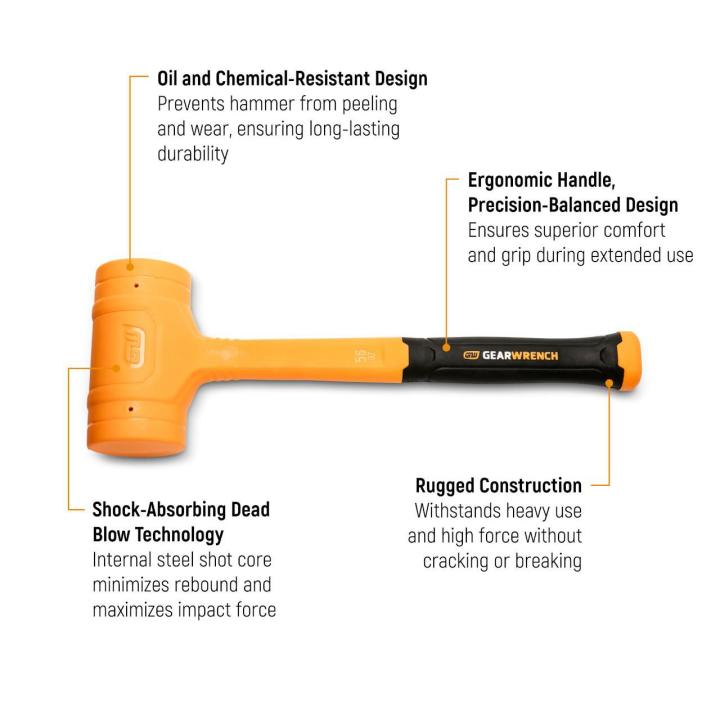
A dead blow hammer is a U.S.-made or U.S.-sold hand tool designed to deliver a controlled strike with little rebound. It has a hollow head filled with loose shot, sand, or another weight. When the head hits a surface, the fill shifts forward and absorbs much of the return force.
This design makes a dead blow hammer useful in American auto shops, home garages, factories, construction work, and equipment repair. It can move parts, seat bearings, align panels, and adjust machinery while helping reduce bounce, noise, and surface damage.

What Is a Dead Blow Hammer?
A dead blow hammer is a hammer with a weighted, hollow head that limits rebound after impact. Its head often has a soft face made from rubber, urethane, nylon, or another replaceable material.
The word “dead” refers to the way the hammer stops after the strike. A normal steel hammer can bounce back from a hard surface. A dead blow hammer transfers force with less spring-back.
The basic parts are:
- Outer head: Holds the internal weight and supports the striking faces.
- Internal fill: Loose steel shot, lead-free shot, sand, or another dense material.
- Striking face: The part that contacts the work.
- Handle: Gives the user control and leverage.
- Grip: Often made from rubber or molded plastic to improve comfort.
A dead blow hammer is not truly rebound-free. The amount of rebound depends on the hammer design, face material, striking angle, and target surface.
Main Characteristics of a Dead Blow Hammer
The most important characteristics are low rebound, controlled force, a weighted head, reduced surface damage, and improved user control.
1. Low rebound
Low rebound is the defining feature of a dead blow hammer.
When the hammer strikes, the internal shot moves inside the head. This movement absorbs some of the energy that would otherwise push the hammer back toward the user. The hammer therefore stays closer to the work surface after impact.
This helps when:
- Space is tight
- The workpiece must stay in place
- The user needs repeated, accurate strikes
- A bouncing hammer could damage nearby parts
- The hammer must be used near a hand or delicate assembly
Low rebound does not mean the tool is safe to swing carelessly. The head can still slip, and the face can still damage a part if the wrong hammer is used.
2. Controlled impact
A dead blow hammer gives a firm strike without the sharp rebound of a solid metal hammer. The internal weight adds force, while the soft face helps spread the impact.
This makes the tool useful for tasks such as:
- Seating a bushing
- Aligning a metal panel
- Adjusting a machine part
- Removing a stuck component
- Fitting a joint
- Tapping a bearing into position with a suitable driver
- Closing or opening a tight assembly
The hammer does not create force from the fill alone. The user still supplies most of the energy through the swing. The internal weight mainly changes how the hammer behaves at impact.
3. A hollow, weighted head
A dead blow hammer usually has a hollow head. The cavity contains loose material that can move when the hammer strikes.
Common fill materials include:
- Steel shot
- Iron shot
- Lead-free metal shot
- Sand
- Other dense granular materials
The exact fill differs by model. Steel or iron shot gives a firm, weighted feel. Sand may produce a softer response. Product labels and manufacturer data should be checked before buying because the fill affects weight, balance, and impact behavior.
The fill must stay sealed inside the head. If the head cracks or opens, stop using the hammer. Loose material can become a hazard, and the tool may no longer work as designed.
4. Reduced rebound and vibration
The moving fill can reduce the sharp shock that travels back through the handle. This may make the hammer more comfortable than a solid steel hammer during repeated light or medium strikes.
The reduction is not the same for every design. A large hammer with a heavy head may still create strong vibration. A soft face may also reduce the feel of impact more than a hard nylon face.
A dead blow hammer can help reduce shock, but it is not a substitute for safe work habits. Use a secure grip, keep your wrist in line with the handle, and take breaks during long jobs.
5. Non-marring or less-marring faces
Many dead blow hammers use faces made from materials that are less likely to leave marks than bare steel.
Common face materials include:
| Face material | Typical benefit | Main limitation |
|---|---|---|
| Rubber | Soft contact and low marking | Can wear or tear |
| Urethane | Good balance of toughness and surface protection | May not suit high heat |
| Nylon | Firm strike with less marking than steel | Can chip or crack |
| Plastic | Light contact on finished parts | Often wears faster |
| Rawhide | Gentle contact for some specialty work | Needs proper care |
| Steel | High impact and long wear | Can mark or deform parts |
“Non-marring” does not mean “cannot damage.” Dirt, metal chips, a worn face, or excessive force can still scratch a surface. A soft face can also leave residue on some materials.
6. Better control in tight spaces
A dead blow hammer is often easier to control than a claw hammer or ball-peen hammer for close fitting work. Its low rebound can reduce unwanted movement after the strike.
This matters when working around:
- Vehicle suspension parts
- Machine housings
- Press-fit components
- Finished aluminum parts
- Cabinet and sheet-metal assemblies
- Plumbing fittings
- Industrial equipment
The right size still matters. A large head may be too bulky for a narrow space. A small head may not deliver enough force.
7. Lower noise than many metal hammers
A soft-faced dead blow hammer often makes less noise than a steel hammer striking steel. The head design and face material both affect sound.
Noise is not eliminated. Striking metal, stone, or another hard surface can still produce a loud impulse. In a shop or work area, hearing protection may still be needed.
8. Durable construction, with replaceable parts on some models
A good dead blow hammer may use a tough plastic or metal shell, a sealed head, and a strong handle. Some models have replaceable faces. This can extend the useful life of the tool if the body and internal fill remain sound.
Inspect the tool before each use. Look for:
- Cracks in the head
- A loose handle
- A damaged grip
- Split or missing face material
- Bulges in the head
- Loose face inserts
- Evidence of leaking internal fill
A damaged dead blow hammer should be removed from service. Do not try to repair a cracked head with tape, glue, or a homemade plug.
How Does a Dead Blow Hammer Work?
A dead blow hammer works by combining a moving internal weight with a protective striking face.
During a normal strike:
- The user swings the hammer toward the work.
- The head contacts the target.
- The internal fill moves toward the impact side.
- The fill absorbs and spreads part of the impact energy.
- The hammer produces less rebound than a solid head.
- The soft face transfers force across a wider contact area.
The result is a controlled push or tap rather than a sharp bounce.
A useful way to think about it is a small weight moving inside a container. The weight still adds impact, but it does not act like one rigid block. Its movement changes the timing and feel of the strike.
A dead blow hammer works best when the face is square to the target. A glancing blow can reduce force, damage the face, or cause the tool to slide.
Dead Blow Hammer vs. Regular Hammer
A dead blow hammer is not a replacement for every type of hammer. Each design suits a different task.
| Feature | Dead blow hammer | Steel hammer | Rubber mallet |
|---|---|---|---|
| Rebound | Low | Often high | Low to moderate |
| Impact force | Moderate to high, based on size | High | Low to moderate |
| Surface protection | Usually good with the right face | Poor on finished parts | Usually good |
| Precision | Good for controlled fitting | Good for forceful work | Good for light adjustment |
| Typical use | Seating, alignment, repair | Nails, chisels, heavy strikes | Assembly and gentle movement |
| Risk of marking | Low to moderate | High | Low, but varies by rubber |
Choose a dead blow hammer when you need force with control. Choose a steel hammer when the work requires a hard face and high impact. Choose a rubber mallet when the task needs softer, lighter contact.
Do not use a dead blow hammer as a substitute for a soft drift, brass hammer, or specialty press when the job requires exact force or alignment.
What Are the Advantages of a Dead Blow Hammer?
The main advantage is controlled force with less unwanted movement.
Protects finished surfaces
A suitable soft face can help protect painted metal, aluminum, plastic, trim, and other finished parts. This is useful in auto repair and equipment maintenance.
Helps prevent bounce
Low rebound makes repeated strikes easier to control. It also reduces the chance that the hammer will hit a nearby part after the first impact.
Supports precise fitting
A dead blow hammer can move a part a small amount at a time. This is useful when aligning holes, seating joints, or adjusting panels.
Reduces hand shock
The internal fill and soft face may reduce some shock that travels through the handle. The benefit depends on the model, weight, and target.
Works well for assembly and repair
The tool can serve many jobs without the sharp contact of a steel hammer. It is common in repair bays, fabrication areas, and maintenance shops.
What Are the Limitations of a Dead Blow Hammer?
A dead blow hammer also has limits.
It may not deliver enough force for heavy demolition
The soft face and internal design make it less suitable for breaking concrete, driving large wedges, or striking hardened tools. A purpose-built sledgehammer or steel hammer may be more suitable when the manufacturer allows that use.
It can be too soft for some materials
A plastic, rubber, or urethane face may deform when used against sharp edges, hot surfaces, or rough steel. The face may wear quickly if used on abrasive work.
It can hide internal damage
The outside may look acceptable while the internal fill has shifted or the head seal has weakened. Any bulge, crack, rattle that seems unusual, or leak is a reason to stop using the tool.
It is not always ideal for striking punches
Some punches and chisels require a hammer rated for that purpose. A soft-faced dead blow hammer may not transfer enough force. More importantly, a tool manufacturer may prohibit striking certain hardened tools with a soft mallet.
Check both the hammer instructions and the instructions for the part or accessory being struck.
It is not a precision press
A hammer can help seat a part, but it cannot replace a press when controlled alignment or steady pressure is required. Excessive hammering can damage bearings, threads, seals, or housings.

How to Choose the Right Dead Blow Hammer
Choose the hammer by task, face, weight, handle, and working conditions.
Select the correct weight
A heavier head can deliver more force, but it may be harder to control. A lighter head suits small parts and delicate work.
Use the smallest hammer that can complete the job without repeated, excessive swings. Repeated heavy blows can damage both the tool and the workpiece.
Choose the right face
Use a softer face for finished or easily marked surfaces. Use a harder plastic or nylon face when you need more force and better wear resistance.
If one hammer has interchangeable faces, check that the replacement face is approved for that model.
Check handle comfort and grip
A handle should feel secure without forcing the wrist into an awkward position. A textured grip can help when gloves or oil are present, but it does not make an unsafe grip safe.
Consider the work area
For tight spaces, a compact head may work better. For large assemblies, a longer handle may provide more reach, but it can also reduce control.
Inspect the specifications
Before purchase, check:
- Overall weight
- Head diameter
- Face diameter
- Face material
- Replaceable-face availability
- Handle material
- Temperature limits
- Chemical resistance
- Intended use
- Warranty and repair terms
Manufacturer specifications are model-specific. Do not assume that all dead blow hammers have the same fill, face strength, or temperature range.

How to Use a Dead Blow Hammer Safely
Use a dead blow hammer only when the tool and face match the job.
- Read the tool instructions. Check approved uses and limits.
- Inspect the hammer. Do not use it if the head, face, handle, or grip is damaged.
- Secure the workpiece. Clamp or support the part when movement could cause injury.
- Wear eye protection. Chips can come from the hammer face, the workpiece, or nearby metal.
- Keep your other hand away. Do not hold a small part beside the strike zone.
- Use a square blow. Keep the face flat against the target.
- Start with light strikes. Increase force only as needed.
- Stop if the face slips or deforms. Recheck the tool and the workpiece.
- Keep the tool clean and dry. Oil and debris can reduce grip and control.
- Store it where the face will not be crushed. Avoid placing heavy tools on soft faces.
Never strike a dead blow hammer with another hammer. Do not use it as a pry bar, wedge, or lever. Do not use a damaged hammer, even for a quick tap.
For workplace use in the United States, follow your employer’s tool rules, personal protective equipment requirements, and applicable Occupational Safety and Health Administration guidance.
Common Mistakes to Avoid
Using the wrong face
A rubber face may not withstand sharp steel edges. A nylon face may mark a soft plastic part. Match the face to the target.
Hitting at an angle
An angled strike can make the hammer slide. It can also cause uneven wear and send the workpiece in an unexpected direction.
Striking too hard
A dead blow hammer reduces rebound, but it does not prevent damage from excessive force. Use light strikes first.
Ignoring a loose face
A face that moves, cracks, or begins to separate can fail during use. Replace it if the design allows replacement. Otherwise, remove the hammer from service.
Treating “non-marring” as a guarantee
No hammer face protects every surface. Test the tool on scrap material when the finish matters.
Using it on hot work
Many synthetic faces have temperature limits. Heat can soften, melt, or weaken the face. Check the manufacturer’s limit before striking hot parts.

Frequently Asked Questions
Is a dead blow hammer better than a rubber mallet?
It depends on the job. A dead blow hammer usually provides more controlled force and less rebound. A rubber mallet may be better for very light contact or broad surface work.
Can a dead blow hammer damage metal?
Yes. A soft face lowers the risk of marks, but heavy force can bend, dent, or distort metal. Dirt or damaged face material can also scratch it.
Can you use a dead blow hammer on a bearing?
You may use one for some bearing installation tasks when the force is applied through a correctly sized driver or installation sleeve. Do not strike the bearing directly unless the bearing maker permits it. Force applied through the wrong ring can damage the bearing.
Why is my dead blow hammer not rebounding?
Low rebound is normal. The internal fill absorbs and spreads impact energy. A small amount of bounce can still occur, especially on hard surfaces or with a firm face.
How long does a dead blow hammer last?
Service life depends on use, impact force, face material, storage, and exposure to heat or chemicals. Replace the tool when the head, handle, grip, or face is damaged. Do not judge service life by age alone.
Can a dead blow hammer drive nails?
It may drive a nail poorly and may damage the face. A claw hammer is designed for nails and is the better choice.
Conclusion
The key characteristics of a dead blow hammer are its hollow weighted head, moving internal fill, low rebound, controlled impact, and protective face. These features make it useful for alignment, assembly, vehicle repair, machinery work, and other tasks where a steel hammer may mark or bounce from the surface.
Choose the correct weight and face for the job. Inspect the tool before use, wear eye protection, and stop when the head or face shows damage. For the safest result, use a dead blow hammer as a controlled striking tool—not as a pry bar, press, demolition hammer, or replacement for a task-specific tool.