Can A Hacksaw Cut Concrete: Safe Methods And Alternatives
A standard hacksaw is not a practical tool for cutting cured concrete in a U.S. home, garage, or job site. Its thin steel blade is made for metal, plastic, and similar materials. Concrete is hard, abrasive, and often contains sand, stone, and steel reinforcement. The blade will usually dull, bind, break, or make little progress.
A hacksaw can cut exposed rebar after concrete is removed around it. It may also cut soft masonry products with a special carbide-grit blade. For ordinary concrete, however, use a masonry blade, diamond blade, concrete saw, rotary hammer, or chisel instead.

Why a Standard Hacksaw Struggles With Concrete
A hacksaw cuts by using small teeth to remove material. Concrete does not respond well to this type of cutting because it is a hard mineral composite rather than a soft, fibrous, or ductile material.
Concrete usually contains:
- Cement paste
- Sand
- Gravel or crushed stone
- Water
- Steel reinforcement in some slabs, walls, and footings
The small teeth on a hacksaw are designed to form chips in metal or plastic. Against concrete, the teeth tend to wear down instead of making a clean cut. Loose grit can also clog the tooth spaces and increase friction.
A hacksaw frame is another limitation. It provides only a short stroke, and the blade is thin. That makes it difficult to keep the cut straight when the blade meets coarse aggregate or embedded steel.
What happens if you try?
You may see one of these results:
- The blade becomes dull after a short time.
- The blade skips across the surface.
- The blade bends or snaps.
- The cut fills with abrasive dust.
- Progress stops when the blade reaches gravel or rebar.
- The frame becomes difficult to control.
A hacksaw also does not remove enough material to make a useful kerf, which is the slot created by a cutting tool. A wider, stronger masonry blade is better suited to concrete because it can grind through the cement and aggregate.
Can a Hacksaw Cut Any Type of Concrete or Masonry?
A hacksaw may work on some soft, thin, or cement-based materials, but that does not make it suitable for normal cured concrete.
| Material | Can a standard hacksaw cut it? | Better option |
|---|---|---|
| Cured concrete slab | No, not practically | Diamond-blade saw or concrete saw |
| Concrete foundation wall | No | Professional concrete-cutting equipment |
| Concrete paver | Usually no | Masonry saw or angle grinder with diamond blade |
| Cinder block | Poorly and slowly | Masonry blade or block saw |
| Aerated concrete block | Sometimes, with the right blade | Specialized handsaw |
| Mortar joint | Sometimes, for a small repair | Mortar saw or joint raker |
| Exposed rebar | Yes | Hacksaw, reciprocating saw, or bolt cutter where suitable |
| PVC pipe in concrete | The hacksaw may cut the pipe, not the concrete | Carefully expose the pipe first |
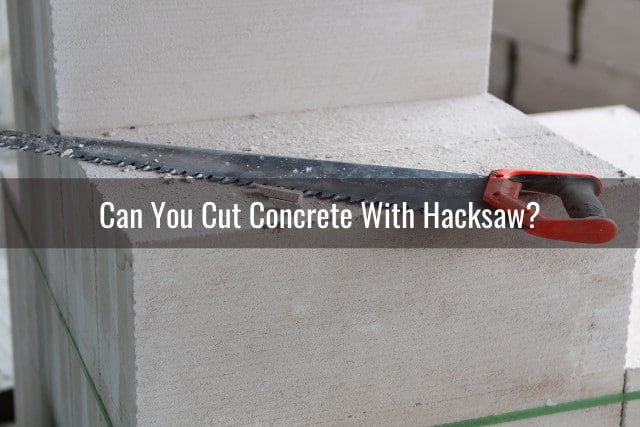
Aerated concrete, also called autoclaved aerated concrete, is much softer and lighter than standard concrete. A coarse carbide-grit blade or a purpose-made aerated-concrete saw can cut it. A normal metal-cutting hacksaw blade is still a poor choice.
Concrete block can seem easier to cut because it is hollow and less dense than a solid slab. Even then, a hacksaw is slow and may produce a rough, uneven cut.

What Tool Should You Use Instead?
The right tool depends on the thickness, location, and purpose of the cut.
For a shallow groove
Use an angle grinder fitted with a diamond masonry blade. This works well for a small control groove, tile work, or a shallow channel. It is not automatically suitable for deep structural cutting.
For a thin paver or block
Use a masonry saw or wet-cut tile saw with a diamond blade. A wet saw helps control dust and keeps the blade cooler, but water and electricity require careful handling.
For a deeper cut in a slab
Use a walk-behind concrete saw or a suitable handheld concrete saw. The blade must match the material and cutting depth.
For a small hole or broken section
Use a rotary hammer with a masonry bit, chisel, or scaling attachment. This is often better than trying to make a narrow hacksaw-style cut.
For exposed reinforcement
Use a hacksaw only after the surrounding concrete has been safely removed. A reciprocating saw with a metal-cutting blade may be faster, but the tool must be suitable for the bar size and location.
Never assume that a concrete cut is harmless because it is small. A slab may contain post-tensioning cables, electrical conduit, plumbing, or structural reinforcement.

How to Cut Concrete Safely
Concrete cutting can create several hazards at once. The main concerns are silica dust, flying fragments, noise, kickback, hidden utilities, and damage to structural parts.
The U.S. Occupational Safety and Health Administration identifies respirable crystalline silica as a serious workplace hazard during concrete cutting, drilling, and grinding. The National Institute for Occupational Safety and Health also recommends dust-control methods for tasks that disturb concrete and masonry.
If the cut is necessary, follow this basic process:
-
Confirm that cutting is allowed.
Check whether the slab, wall, step, or foundation is structural. Get approval before cutting a rental property, shared building, sidewalk, or public feature. -
Locate hidden services.
Check for electrical cables, plumbing, gas lines, and heating systems. A utility locator or qualified contractor may be needed. -
Check for reinforcement and post-tensioning.
Do not cut a structural slab or beam until you know what is inside it. Post-tensioned concrete can contain high-tension cables that create a severe hazard if cut. -
Choose a tool with dust control.
Wet cutting or a tool connected to a suitable dust-extraction system is generally better than dry cutting. Follow the tool maker’s instructions. -
Wear proper protection.
Use safety glasses or a face shield, hearing protection, sturdy gloves, long sleeves, and suitable work footwear. Use respiratory protection only as part of a proper hazard-control plan and in line with its instructions. -
Secure the work.
Keep the material stable. Mark the cut line clearly. Keep bystanders away from dust, noise, fragments, and the tool’s path. -
Stop if conditions change.
Stop when you find steel, wiring, pipe, an unexpected void, or excessive dust. Do not force the blade.
Do not dry sweep concrete dust. Use approved cleanup methods, such as wet cleanup or a suitable vacuum system, rather than spreading fine dust into the air. OSHA’s construction silica standard, 29 C.F.R. § 1926.1153, provides requirements for covered workplaces and specific dust-control methods.

When Is a Hacksaw Still Useful?
A hacksaw is useful when the concrete is no longer the material being cut.
For example, you may expose a short section of rebar with a chisel or concrete-removal tool. Once the bar is accessible, a hacksaw can cut it if:
- The bar is small enough for the blade.
- There is enough space to move the frame.
- The bar is not carrying a structural load that must remain.
- The cut does not create a safety or stability problem.
A hacksaw can also cut a small metal bracket, threaded rod, or plastic pipe located near concrete. Take care not to confuse “cutting near concrete” with “cutting concrete.”
A carbide-grit hacksaw-style blade is a different product from a normal toothed metal blade. It may cut some soft masonry or cement board. It will still be slow for solid cured concrete and can wear quickly on coarse aggregate.

Common Mistakes to Avoid
Using a metal-cutting blade on concrete
A blade labeled for steel or general metal work is not a concrete blade. Its teeth may survive contact with a small amount of mortar, but they are not designed to grind through aggregate.
Adding water to a hand hacksaw
Water will not turn a hacksaw into a concrete saw. It may make the work slippery and can create an electrical hazard if powered tools or cords are nearby.
Cutting without checking the slab
A concrete floor may hide wiring, plumbing, reinforcement, or post-tensioning. A shallow-looking cut can still damage an important part of the building.
Working dry in a closed room
Concrete dust can remain airborne and spread through a home. Open windows alone do not provide reliable dust control.
Using a small tool for a structural job
Do not use a hacksaw, grinder, or small rotary tool to improvise a cut in a beam, column, foundation, load-bearing wall, or post-tensioned slab. Ask a qualified concrete-cutting or structural professional.
Forcing a stuck blade
A stuck blade can break or make the tool jump. Release pressure, stop the tool, inspect the cut, and identify the obstruction before continuing.

Hacksaw vs. Concrete-Cutting Tools
The simplest decision is based on the material and the depth of the cut.
| Job | Recommended tool | Main reason |
|---|---|---|
| Cut exposed small rebar | Hacksaw or metal-cutting saw | The material is steel, not concrete |
| Cut a shallow line in a paver | Angle grinder with diamond blade | Creates a controlled abrasive cut |
| Cut a concrete paver through | Masonry saw or wet saw | Handles aggregate more efficiently |
| Remove a small chunk | Rotary hammer and chisel | Breaks concrete instead of sawing it |
| Cut a thick slab | Concrete saw | Designed for depth and dust control |
| Cut a structural member | Qualified concrete-cutting contractor | Requires inspection and hazard control |
| Cut aerated concrete block | Purpose-made carbide or masonry saw | The block is softer than normal concrete |
The best tool is not simply the strongest one. It must also match the material, cutting depth, access, dust-control needs, and risk of hidden hazards.
Frequently Asked Questions
Can a hacksaw cut through a concrete block?
Usually not in a practical way. A hacksaw may scratch or slowly work through a soft, hollow block, but a masonry saw, diamond blade, or block saw is much more effective. A specialized saw may work on aerated concrete blocks.
Can I use a hacksaw to cut concrete rebar?
Yes, if the rebar is fully exposed and the cut is approved. A hacksaw cuts steel reinforcement, not the concrete around it. Do not cut rebar in a structural member without professional guidance.
Can a hacksaw cut mortar?
It may cut a small or soft mortar joint, but the blade will wear quickly. A mortar saw, grout saw, or oscillating tool with a masonry blade is usually more suitable for repair work.
Will a carbide hacksaw blade cut concrete?
A carbide-grit blade may cut soft masonry, cement board, or aerated concrete. It is not an efficient choice for solid cured concrete with coarse aggregate. Use a diamond blade or concrete-cutting tool for that work.
Is cutting concrete at home safe?
It can be safe for a small, nonstructural task when the tool, dust controls, and protective equipment are appropriate. Do not cut until you have checked for utilities, reinforcement, and structural risks. Hire a qualified professional for foundations, beams, columns, post-tensioned slabs, and load-bearing walls.
Bottom Line
A standard hacksaw generally cannot cut ordinary cured concrete in a useful or efficient way. It is the wrong blade and the wrong cutting action for a hard, abrasive material.
Use a diamond or masonry blade for concrete, a rotary hammer for small removal work, and a hacksaw only for exposed metal such as rebar. Before cutting any concrete in a U.S. home or building, check for hidden utilities, reinforcement, structural concerns, and silica-dust hazards.
Recent Tool Guides
 Hammer
How To Hammer Flowers Onto Paper: Easy Guide
Learn how to hammer flowers onto paper with simple steps, helpful tips, and beautiful results for...
Read Guide → Wrench
How To Use A Hex Wrench: Easy Step-By-Step Guide
Learn how to use a hex wrench correctly with simple steps, helpful tips, and common mistakes...
Read Guide → Hacksaw
How To Cut Curtain Pole With Hacksaw: Easy Guide
Learn how to cut curtain pole with hacksaw safely and neatly. Follow simple steps for accurate...
Read Guide → Wrench
How To Use A Husky Torque Wrench: Easy Guide
Learn how to use a Husky torque wrench correctly with simple steps, torque settings, and safety...
Read Guide → Hammer
How To Hold A Hammer: Safe Grip Guide
Learn how to hold a hammer with the right grip, stance, and technique for safer, more...
Read Guide → Hacksaw
How To Cut Flexible Metal Conduit With Hacksaw: Easy Guide
Learn how to cut flexible metal conduit with hacksaw safely and cleanly. Follow simple steps for...
Read Guide →