
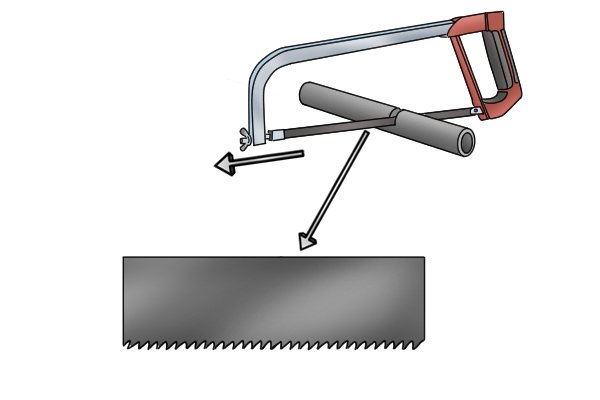
For a standard hacksaw, the teeth should face forward, away from the handle. This setup lets the blade cut as you push the saw forward. On the return stroke, apply little or no pressure.
This rule applies to common hacksaws used in U.S. garages, workshops, job sites, and home repair projects. If the blade has an arrow, follow the arrow first. Some specialty blades may have different instructions, but a normal hacksaw blade cuts on the forward stroke.
Why Do Hacksaw Teeth Face Forward?
Hacksaw teeth face forward because most hacksaws are designed to cut on the push stroke. When you move the saw away from your body, the teeth bite into the metal. When you pull the saw back, the blade resets for the next cut.
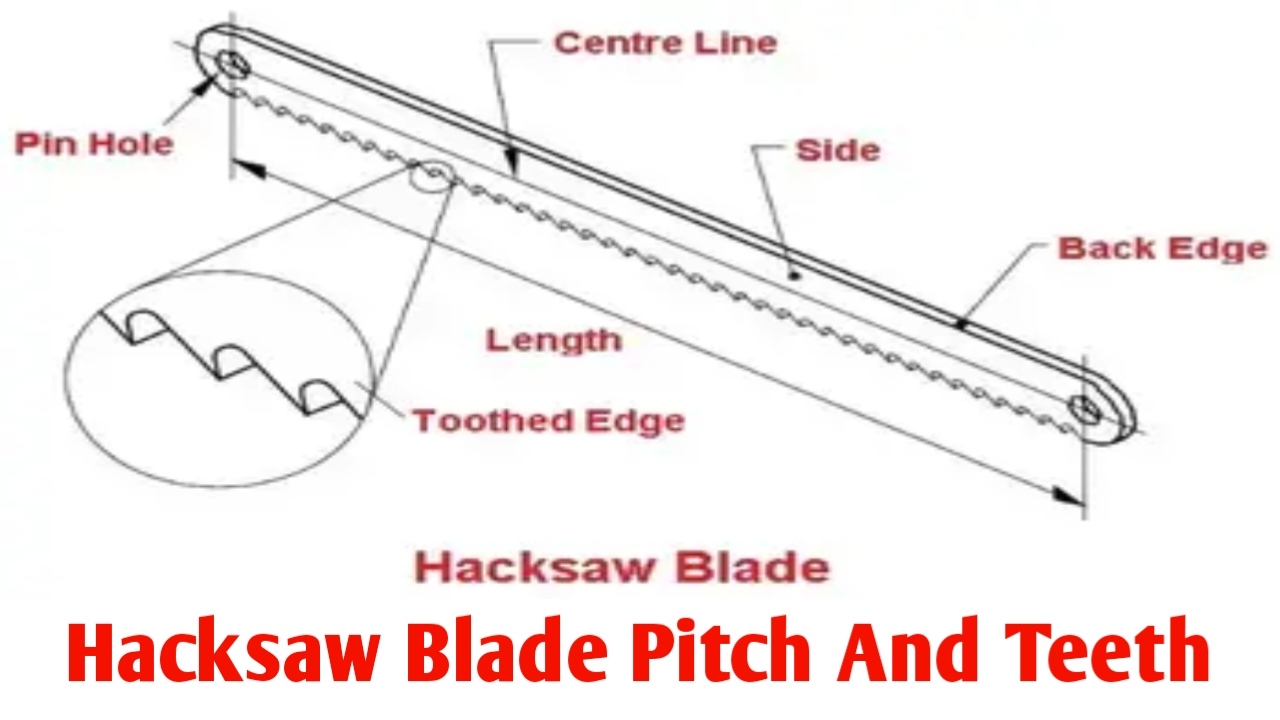
The teeth work much like small chisels. Each tooth removes a small amount of material. Forward-facing teeth place the cutting edge in the correct direction for this motion.
If you install the blade backward, the saw may still move across the workpiece, but it will not cut well. You may notice these problems:
- The blade slides instead of biting.
- Cutting takes much longer.
- The blade may bend or slip.
- You may use too much force.
- The teeth may become dull or break.
A hacksaw blade is not normally meant to cut in both directions. Reversing the blade changes the way the teeth meet the workpiece.
How to Install a Hacksaw Blade Correctly
Follow these steps to install a standard hacksaw blade:
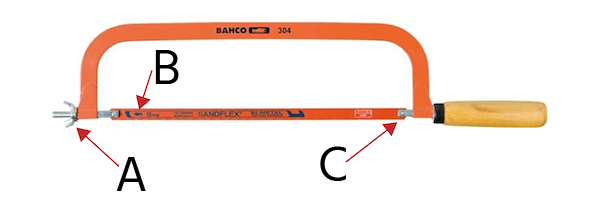
Release the blade tension.
Turn the tension knob or lever until the old blade becomes loose.Remove the old blade.
Lift the blade from the mounting pins or slots. Wear gloves if the blade has sharp or broken teeth.Check the new blade.
Look for an arrow or printed marking. If one is present, point it toward the front of the hacksaw, away from the handle.Face the teeth forward.
The sharp points should point toward the end of the frame, not toward the handle.Fit both mounting holes.
Place each end of the blade over the pins or into the blade slots.Tighten the blade.
Turn the tension knob until the blade is firm and straight.Check the tension by hand.
Lightly pluck or press the side of the blade. It should feel tight, not loose or floppy.
Do not overtighten the blade. Excess tension can damage the hacksaw frame, strip the tension screw, or cause the blade to snap. A properly tensioned blade should stay straight during a light cutting test.
A quick direction check
Hold the hacksaw as you would use it. The handle should be behind the blade. The teeth should point in the direction the frame will travel during the cutting stroke.
If the teeth point toward your hand, the blade is backward.

How to Use a Hacksaw After Installing the Blade
Secure the material before you start. Use a vise or another suitable clamp so the workpiece cannot move. A moving pipe, rod, or metal strip can bend the blade and cause the saw to jump.
Place the blade on the cut line. Start with a few short, light strokes. This creates a small groove that helps guide the blade.
After the groove forms, use smooth strokes across most of the blade length. Keep the blade straight and let the teeth do the work. Press during the forward stroke, then reduce pressure while pulling the saw back.
Use these basic techniques:
- Keep the blade at about a right angle to the workpiece.
- Use steady strokes rather than fast, jerky movements.
- Keep both hands on the saw when the work requires added control.
- Avoid twisting the frame during the cut.
- Slow down near the end of the cut.
- Support the loose section so it does not tear away suddenly.
A hacksaw cuts best with steady pressure, not brute force. If the blade skips, stop and check the blade direction, tension, and workpiece support.
What If the Hacksaw Blade Has an Arrow?
If the blade has an arrow, point the arrow away from the handle unless the blade maker gives different instructions.
The arrow usually shows the intended cutting direction. It is more reliable than guessing from the tooth shape, especially on blades with unusual tooth patterns.
Some blades have markings on only one side. The printed side may face outward for visibility, but the key issue is still tooth direction. The teeth must match the saw’s intended cutting stroke.
If the arrow and tooth direction appear to conflict, do not use the blade until you check the blade packaging or manufacturer instructions. A specialty blade may not follow the normal pattern.
Which Hacksaw Blade Should You Use?
Tooth direction is the first setup issue, but blade choice also affects cutting speed and quality.
Hacksaw blades are commonly described by teeth per inch, or TPI. A higher TPI blade has smaller teeth. A lower TPI blade has larger teeth.
| Workpiece | Common blade choice | Reason |
|---|---|---|
| Thin sheet metal | About 24–32 TPI | Smaller teeth reduce snagging |
| Thin-wall tubing | About 24–32 TPI | Helps keep several teeth in the cut |
| General steel stock | About 18–24 TPI | Balances speed and control |
| Thick steel bar or pipe | About 14–18 TPI | Larger teeth clear material faster |
| Aluminum or soft metal | Often 14–24 TPI | Depends on thickness and tooth design |
| Plastic | Blade-specific | Too much heat can melt the material |
The correct TPI depends on the thickness of the material. As a practical rule, try to keep at least two or three teeth engaged in the workpiece during the cut. If only one tooth contacts thin material, it can catch and break. If the teeth are too fine for thick stock, cutting becomes slow and the gullets can fill with chips.
Always check the blade maker’s instructions when cutting stainless steel, hardened steel, plastics, or other unusual materials.
Common Hacksaw Blade Problems
The blade will not cut
Check these items in order:
- Confirm that the teeth face forward.
- Make sure the blade is tight.
- Check that the teeth are not worn or missing.
- Confirm that the blade is suitable for the material.
- Increase pressure slightly on the forward stroke.
- Make sure the workpiece cannot move.
A dull blade can feel like a backward blade. If the teeth look rounded, polished, or damaged, replace the blade.
The blade keeps bending
A blade may bend when you twist the frame, push too hard, or start the cut at an angle. It can also bend when the workpiece moves in the vise.
Start the cut with light strokes. Keep the frame aligned with the cut line. Replace a blade that has developed a permanent bend.
The teeth break quickly
Tooth breakage often comes from using too few teeth on thin material, forcing the saw, or allowing the blade to catch at the end of the cut.
Choose a finer blade for thin metal. Reduce pressure as the blade nears the far side of the workpiece. Support the cut-off piece so it does not pull on the remaining teeth.
The saw cuts slowly
Slow cutting may result from a dull blade, an unsuitable TPI, low blade tension, or clogged teeth. Clear chips from the cut and check the blade. For metal, a suitable cutting lubricant may reduce friction and heat, but follow the lubricant and material instructions.
Safety Tips for Using a Hacksaw
Wear safety glasses whenever you cut metal. Small metal chips and broken teeth can travel several feet.
Use gloves when handling blades, but keep loose glove material away from the teeth and the workpiece. Gloves do not replace safe control of the tool.
Before cutting, check that:
- The blade is installed in the correct direction.
- The blade is tight and undamaged.
- The workpiece is clamped securely.
- Your hands are clear of the blade path.
- The frame and handle are not cracked.
- The cut will not contact hidden wires, pipes, or other hazards.
Do not use a hacksaw blade as a scraper, pry bar, or knife. Do not continue using a blade that is cracked, badly bent, or missing several teeth.
For large, heavy, energized, pressurized, or structural materials, use the correct equipment and follow the applicable workplace procedure. A hand hacksaw is not a substitute for professional work on hazardous systems.
Can You Put a Hacksaw Blade in Backward?
Yes, a blade can physically fit backward in many hacksaw frames, but it is usually the wrong setup. A backward blade will not cut as intended because its teeth face away from the normal push stroke.
The main exception is a blade that the manufacturer specifically identifies as reversible or designed for a different cutting action. Check the blade marking before assuming the usual direction does not apply.
Can a Hacksaw Cut on the Pull Stroke?
A standard hacksaw is designed to cut on the push stroke. Some specialty hand saws use pull-stroke blades, but those are not ordinary hacksaw blades.
If you want a pull-stroke tool, use a saw designed for that motion. Do not assume that reversing a standard hacksaw blade will make it work well as a pull saw.
Do You Push or Pull a Hacksaw?
Push the hacksaw forward while applying light to moderate pressure. Use little pressure on the return stroke.
The forward stroke is the cutting stroke because the teeth face away from the handle. Smooth, full-length strokes usually work better than short, hard strokes.
How Tight Should a Hacksaw Blade Be?
The blade should be tight enough to stay straight and resist light finger pressure from the side. It should not sag, rattle, or twist during normal use.
Avoid maximum tension unless the tool maker specifically calls for it. Too much tension can damage the frame or cause a broken blade to release sharply.
What Is the Correct Hacksaw Tooth Direction?
The correct direction is:
Teeth forward, away from the handle; cut on the push stroke.
Before using the saw, confirm the direction with any arrow or marking on the blade. Then secure the material, use steady strokes, and replace the blade if it bends or becomes dull.
Key Takeaways
- Standard hacksaw teeth face away from the handle.
- The saw cuts on the forward push stroke.
- Follow a blade arrow if one is present.
- Use light pressure on the return stroke.
- Match the blade’s TPI to the material thickness.
- Keep the workpiece secure and wear safety glasses.
- Replace blades that are dull, bent, cracked, or missing teeth.
Conclusion
Install a normal hacksaw blade with the teeth pointing forward, away from the handle. This lets the teeth bite during the push stroke and keeps the tool working as designed.
If the saw does not cut well, first check the tooth direction, blade tension, blade condition, workpiece stability, and TPI. Those simple checks solve most hacksaw cutting problems.