

Sharpening lathe tools by hand means grinding the right angles, keeping the edge cool, and testing it carefully.
Learning how to sharpen lathe tools by hand can make turning safer, smoother, and far less costly. With a bench grinder, a few simple gauges, and steady practice, you can restore a dull tool in minutes. This guide explains the method used by many experienced wood and metal turners, including tool angles, grinding wheels, common mistakes, and safety steps.
Why Sharp Lathe Tools Matter
A sharp lathe tool does more than make a clean cut. It helps control the work, reduces vibration, and lowers the force needed to remove material. A dull tool often rubs instead of cuts, which can damage the workpiece and make the lathe feel difficult to control.
Sharp tools also improve surface finish. On a wood lathe, a keen edge can leave a smoother surface with fewer torn fibers. On a metal lathe, a correctly ground cutting tool can produce a more even cut and reduce chatter.
A dull edge may show these signs:
• The tool needs extra pressure to cut.
• The workpiece develops burn marks or rough fibers.
• The tool begins to vibrate or chatter.
• Chips become uneven or difficult to control.
• The cutting edge reflects light instead of looking crisp.
The goal of sharpening is not to remove as much steel as possible. The goal is to create a clean, even cutting edge with the correct shape and relief.

Tools and Equipment You Need
Before learning how to sharpen lathe tools by hand, prepare the right equipment. A simple setup is enough for most home shops, but each item has a clear purpose.
Bench grinder
A bench grinder is the most common tool for sharpening high-speed steel, carbon steel, and many woodturning tools. A slow-speed grinder is helpful because it produces less heat and gives you more control.
A standard grinder can work well, but you must use a light touch. Heavy pressure can overheat the cutting edge and change the hardness of the steel.
Grinding wheels
For high-speed steel tools, an aluminum oxide wheel is a common choice. A medium or fine wheel often gives better control than a very coarse wheel.
Use a wheel that is:
• Rated for the speed of your grinder.
• Free from cracks or deep damage.
• Properly dressed and reasonably flat.
• Suitable for the type of steel you are sharpening.
Never use a wheel that is cracked, loose, or badly glazed. Stand to one side when starting the grinder, since a damaged wheel can fail during startup.
Tool rest
The tool rest should support the tool close to the wheel. A large gap can trap the tool and pull it downward.
Keep the gap small, often around one-eighth inch or less, while following the grinder manufacturer’s instructions. Check the gap often because it changes as the wheel wears.
Cooling container
Keep a container of clean water near the grinder. Dip the tool often to control heat.
Water cools the tool, but it does not replace a light grinding touch. If the tool becomes too hot to hold, stop and cool it before continuing.
Safety equipment
Use:
• Safety glasses or a full face shield.
• Hearing protection.
• A dust mask when grinding creates fine dust.
• Close-fitting clothing.
• Closed-toe shoes.
Do not wear loose gloves near a rotating wheel. A glove can catch and pull your hand toward the grinder.

Understand Tool Angles Before Grinding
The most important part of how to sharpen lathe tools by hand is understanding the tool’s geometry. A cutting tool has more than one angle, and each angle affects how it behaves.
Cutting edge
The cutting edge is the sharp line that contacts the work. It should be even, clean, and free from chips.
Bevel
The bevel is the ground surface beneath the cutting edge. On woodturning tools, the bevel often rests against the wood as the tool cuts.
A smooth bevel helps you control the tool. If the bevel is uneven, the tool may rock or catch.
Clearance angle
Clearance, or relief, creates space behind the cutting edge. Without enough clearance, the tool rubs instead of cutting.
Too little clearance causes heat and friction. Too much clearance weakens the edge and makes the tool harder to control.
Rake angle
Rake affects how aggressively the tool cuts. More rake can produce a sharper-feeling cut, but it may also make the edge weaker.
For many general-purpose tools, a moderate rake is a safe starting point. Exact angles vary by tool type, material, and machine setup.
Common starting ranges include:
• Woodturning bowl gouge: about 40 to 60 degrees for the bevel, depending on the grind.
• Woodturning spindle gouge: about 30 to 45 degrees.
• Woodturning scraper: a flat or slightly angled top edge, often with a small burr.
• Metal lathe high-speed steel tool: about 5 to 15 degrees of side and end relief, depending on the tool and work material.
These are starting points, not strict rules. Follow the shape of the tool and use the cutting result as feedback.
How to Sharpen Lathe Tools by Hand
The basic method is simple. Inspect the tool, set the grinder, grind with light contact, cool the steel, and check the edge. The quality comes from control, not speed.
Step 1: Inspect and clean the tool
Remove oil, pitch, rust, and loose burrs from the tool. Look for cracks, deep chips, or a badly damaged edge.
If the tool has a large chip, do not try to fix it with one heavy pass. Grind small amounts from both sides and keep the tool cool.
Step 2: Prepare the grinder
Check the wheel, guard, spark shield, and tool rest. Make sure the wheel runs smoothly and does not wobble.
Dress the wheel if its surface is glazed or uneven. A clean wheel cuts more freely and creates less heat.
Adjust the tool rest so the tool is supported close to the wheel. Keep the grinding area well lit.
Step 3: Mark the bevel
For beginners, a marker is a useful guide. Color the bevel with a permanent marker, then make a light pass against the wheel.
The removed marker shows where the wheel is touching. If only one part disappears, adjust your hand position or tool angle.
This small trick is one of the easiest ways to learn how to sharpen lathe tools by hand without guessing.
Step 4: Hold the tool securely
Hold the tool with both hands when its size allows. Keep your wrists steady and use your arms to guide the movement.
Place the tool on the rest before touching it to the wheel. Do not bring a loose tool toward the side of a spinning wheel.
Step 5: Use light pressure
Touch the tool to the wheel gently. You should hear a light, even grinding sound.
Do not force the tool into the wheel. Heavy pressure creates heat, removes too much steel, and makes it harder to hold the correct angle.
Step 6: Move the tool evenly
Sweep the tool across the wheel when shaping a curved edge. This helps prevent grooves and flat spots.
For a straight metal lathe tool, keep the tool steady and grind each face with controlled movement. Try to make each pass similar to the last.
Step 7: Cool the tool often
Dip the tool in water after a few seconds of grinding, or sooner if the steel begins to heat.
High-speed steel can tolerate more heat than carbon steel, but repeated overheating can still damage the edge. Carbon steel should be cooled even more often.
If the steel turns blue, purple, or straw-colored, it may have been overheated. The color does not always mean the entire tool is ruined, but the overheated section may no longer hold an edge well.
Step 8: Check the edge
Look at the edge under a bright light. A sharp edge usually does not reflect a broad, shiny line.
Check both sides for:
• A continuous edge.
• Matching bevels.
• No visible chips.
• No blue heat marks.
• No wire edge that can easily fold over.
You can also test the edge by lightly touching it to a piece of scrap wood or by making a controlled test cut. Never drag a finger along the edge to test sharpness.
Step 9: Remove the burr
Some tools develop a small burr after grinding. Remove it with a fine stone, diamond hone, or suitable abrasive.
Use light strokes that follow the edge. Avoid rounding the cutting edge, since a rounded edge will not cut cleanly.
Step 10: Make a test cut
Install the tool correctly and take a light cut on scrap material. Listen to the cut and watch the surface.
A good edge usually cuts with less force and produces a more controlled result. If the tool rubs, chatters, or leaves a poor finish, inspect the angles again.

How to Sharpen Woodturning Tools
Woodturning tools often need shaped grinds rather than simple flat bevels. The most common examples are bowl gouges, spindle gouges, parting tools, skew chisels, and scrapers.
Bowl gouges
A bowl gouge usually has a curved flute and a swept-back or fingernail grind. The exact profile depends on the work.
To sharpen a bowl gouge by hand:
Rest the tool firmly on the grinder support.
Touch the bevel to the wheel.
Rotate the gouge slowly as you move it from one side of the edge to the other.
Keep the flute orientation consistent.
Cool the tool often.
Do not twist the gouge quickly or change the angle during each pass. Small changes create an uneven profile.
Spindle gouges
Spindle gouges often use a shorter bevel and a more pointed profile than bowl gouges. They are useful for beads, coves, and other spindle shapes.
Keep both wings even. If one wing is longer, the tool may cut differently on each side and become difficult to control.
Skew chisels
A skew chisel has a long, straight edge set at an angle. Grind both bevels evenly and keep the edge straight.
The skew is highly sensitive to its edge shape. A small hollow or rounded section can cause catches and poor surface control.
Parting tools
A parting tool should have two straight, matching sides. Keep the cutting edge centered and avoid grinding one side more than the other.
For thin parting tools, overheating is a common problem. Use short passes and cool the tool often.
Scrapers
A scraper may use a small burr at the edge rather than a finely honed knife edge. Grind the top and bottom surfaces evenly, then raise a controlled burr with a burnishing tool if the design requires it.
A large, rough burr can catch the wood. A small, consistent burr usually gives better control.

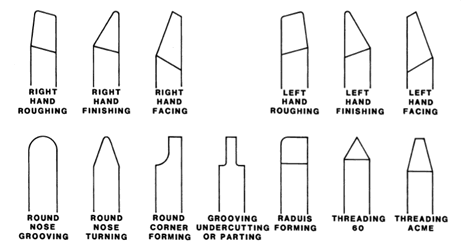
How to Sharpen Metal Lathe Tools by Hand
Metal lathe tools made from high-speed steel are often ground from square, rectangular, or round blanks. The shape depends on the cut, workpiece material, and tool position.
A general-purpose right-hand turning tool may include:
• A top rake face.
• A side relief face.
• An end relief face.
• A side cutting edge.
• An end cutting edge.
• A nose radius.
Grind the relief faces first, then shape the cutting edges and nose. Keep the nose slightly rounded rather than pointed. A small radius can improve finish, but a large radius may increase cutting pressure and cause chatter.
When learning how to sharpen lathe tools by hand for metalworking, use a tool gauge or printed angle guide. A gauge helps you repeat the same shape after several sharpening sessions.
Take light test cuts in mild steel or another suitable scrap. If the tool produces a long, continuous chip, cuts smoothly, and leaves a clean surface, the geometry is likely close to correct.
Do not assume one grind works for every metal. Aluminum, brass, stainless steel, and mild steel may respond better to different rake angles and edge shapes.

Common Mistakes to Avoid
Most sharpening problems come from heat, poor support, or inconsistent movement. These mistakes are easy to correct once you know what to watch for.
Pressing too hard
Heavy pressure feels fast, but it often creates more work. It overheats the edge and removes steel unevenly.
Use several light passes instead. The wheel should do the cutting.
Letting the tool rock
Rocking changes the bevel angle and creates a rounded edge. Keep both hands steady and maintain contact with the tool rest.
If you cannot hold the tool safely, stop and adjust the support.
Grinding only one part of the edge
This creates a short edge on one side and a long edge on the other. Use a marker and inspect the tool often.
For curved tools, move smoothly across the wheel so the entire edge receives similar attention.
Skipping cooling
A tool may look fine after overheating, but its edge can become soft. This is especially important with carbon steel.
Make cooling part of every sharpening cycle rather than waiting until the tool is visibly hot.
Using the wrong wheel
A badly chosen or poorly maintained wheel can make sharpening slow and unsafe. Check the wheel rating and material before use.
Never grind on the side of a standard wheel unless the wheel is specifically designed for side grinding.
Creating a wire edge
A wire edge is a thin strip of metal that folds over the cutting edge. It may feel sharp at first, but it can break away during cutting.
Remove it with a fine hone or stone. Use gentle pressure so you do not round the edge.
Chasing perfection
Many beginners keep grinding long after the tool is ready. This shortens the tool and increases the chance of mistakes.
Aim for a clean, repeatable edge that performs well. You can refine the shape over time.

How to Improve Consistency
Good hand sharpening is a skill of repeatable movement. You do not need perfect hands, but you do need a clear process.
Use these habits:
• Sharpen at the same grinder position each time.
• Mark the bevel when learning a new tool shape.
• Count light passes on each side.
• Use a simple angle gauge.
• Keep the tool rest clean and close to the wheel.
• Compare both sides under bright light.
• Record useful angles for your most-used tools.
A sharpening jig can help with bowl gouges and other curved tools. It does not replace skill, but it can make the same motion easier to repeat.
In my own shop work, the biggest improvement came from slowing down. I used to make long passes and check the edge only at the end. That approach often produced a decent edge on one side and an uneven profile on the other. Short passes, frequent cooling, and early inspection solved the problem.
Another lesson was to sharpen before the tool became completely dull. Restoring a slightly dull edge takes much less time than repairing a large chip.

Honing and Finishing the Edge
Grinding creates the main shape, but honing can improve the final edge. A fine diamond hone or oilstone can remove small burrs and polish the bevel.
Honing is especially useful for skew chisels, scrapers, and fine metal lathe tools. Use a few controlled strokes rather than pressing hard.
The honing method depends on the tool:
• Hone a skew chisel along its bevel while keeping the original angle.
• Hone a metal cutting edge lightly to remove the burr.
• Use a burnisher on a scraper when a raised burr is part of the tool design.
Do not over-hone a roughing tool or heavy cutting tool. A polished edge is not always better if the tool needs a strong, durable cutting profile.

Safety Rules for Hand Sharpening
Grinding wheels can cause serious injury. Treat the grinder with the same care you would give the lathe.
Follow these basic rules:
• Inspect the wheel before each use.
• Keep guards in place.
• Wear eye protection every time.
• Keep the tool rest close to the wheel.
• Stand clear during startup.
• Do not grind on the side of an unsuitable wheel.
• Keep water away from electrical parts.
• Avoid loose sleeves, jewelry, and hair near the wheel.
• Let the wheel stop fully before leaving the grinder.
Work in a bright, clean area. Good lighting helps you see the bevel and also reduces mistakes.
If the grinder vibrates, makes a new noise, or shows wheel damage, stop using it. Disconnect power before making adjustments.
How Often Should You Sharpen Lathe Tools?
Sharpening frequency depends on the tool, material, cutting depth, and your expectations. There is no single schedule that fits every shop.
You may need to sharpen:
• After a tool hits a nail, screw, or hard inclusion.
• When the tool needs more pressure.
• When the surface finish becomes rough.
• When the edge reflects light.
• When chips change shape or become difficult to control.
Experienced turners often make quick touch-ups during a project. A light refresh can take less than a minute and helps keep the tool predictable.
Avoid waiting until the tool is damaged. Regular sharpening saves steel, reduces effort, and makes the work more enjoyable.
Frequently Asked Questions About How to Sharpen Lathe Tools by Hand
What is the best grinding wheel for sharpening lathe tools?
An aluminum oxide wheel is a common choice for high-speed steel and many general-purpose lathe tools. Choose the correct wheel grade and speed rating for your grinder, and keep the wheel dressed and free from cracks.
Can you sharpen lathe tools without a grinder?
Yes. A diamond hone, sharpening stone, or abrasive belt can sharpen some lathe tools by hand. These methods are slower for major repairs but work well for light touch-ups and final honing.
How do you know when a lathe tool is sharp?
A sharp tool has a clean, continuous edge and does not show a wide reflective line along the cutting edge. A controlled test cut should require less force and leave a smoother surface.
How do you stop a lathe tool from overheating?
Use light pressure, make short passes, and dip the tool in clean water often. If the tool becomes too hot to hold or changes color, stop grinding and let it cool.
Should you use a sharpening jig?
A jig is helpful for repeatable angles, especially with bowl gouges and complex woodturning grinds. It is not required, but it can shorten the learning curve and reduce uneven bevels.
What angle should a lathe tool have?
The correct angle depends on the tool and material. Many woodturning tools use bevel angles around 30 to 60 degrees, while metal lathe tools often use modest relief and rake angles suited to the workpiece.
Conclusion
Learning how to sharpen lathe tools by hand is mostly about control. Use the right wheel, support the tool, grind lightly, cool the steel, and check the edge often. Understand the bevel, relief, rake, and profile so you can shape the tool for its intended cut.
Start with one simple tool and practice on scrap material. With steady habits, how to sharpen lathe tools by hand becomes a quick shop skill rather than a frustrating task. Keep your grinder safe, sharpen before the edge is badly damaged, and share your results or questions in the comments.