

For most hacksaws used in the United States, the teeth should face away from the handle. This makes the blade cut on the forward push stroke. The blade should feel smooth when you move it toward the handle and should bite into the material when you push it away.
This rule applies to the common manual hacksaw used for cutting metal pipe, threaded rod, bolts, conduit, plastic pipe, and similar materials. A few specialty blades may work differently, so always check the blade package or tool instructions when the design is unusual.
Why do hacksaw teeth face forward?
Hacksaw teeth face forward because a standard hacksaw is built to cut during the push stroke. Your hand moves the frame away from your body, and the teeth remove material as they travel across the workpiece.
The return stroke should use little pressure. Lift the blade slightly or release pressure as you pull the saw back. This reduces tooth wear and helps prevent the blade from bending.
A hacksaw blade has small teeth set along one edge. Each tooth acts like a tiny cutting point. When the teeth point away from the handle, the frame places force behind the teeth during the cutting stroke.
The handle is the key reference point:
- Teeth pointing away from the handle: Standard setup for most hacksaws.
- Teeth pointing toward the handle: The blade cuts on the pull stroke.
- Teeth pointing in both directions: Some specialty blades can cut on both strokes.
Most blades sold for a standard American-style hacksaw are intended for forward cutting. The printed arrows on the blade or package provide the final check.
How to install a hacksaw blade correctly
Install the blade with the teeth pointing away from the handle, then tension it until it is straight and firm. Do not overtighten it.
Use these steps:
Release the old blade.
Turn the tension knob or lever until the blade becomes loose. Some frames use a quick-release lever.Check the mounting holes.
Most full-size hacksaw blades have a hole at each end. Each hole fits over a peg or pin on the frame.Face the teeth forward.
Place the blade so the teeth point away from the handle. On most frames, the handle sits at the rear.Fit both ends onto the frame.
Make sure each hole rests fully on its mounting peg. A blade that sits on only one peg can slip or break.Apply tension.
Turn the tension knob until the blade is straight and firm. It should not sag or twist.Check the blade by hand.
With the saw away from the workpiece, lightly pluck or press the blade. It should feel tight, but not excessively rigid.Test the first stroke.
Place the blade on the workpiece and push gently. The teeth should cut on the forward stroke.
If the teeth slide over the material while you push and cut when you pull, the blade is facing the wrong way. Remove it and turn it around.
How tight should the blade be?
The blade should be tight enough to stay straight during a cut. It should not bow, twist, or move sideways under light finger pressure.
Excessive tension can damage the frame, bend the blade, or increase the chance of breakage. A broken blade can create a sharp edge or cause the frame to jerk.
Many hacksaw manufacturers give a specific tension range for their frames. Follow that instruction when available. If no value is provided, use firm hand tension rather than forcing the knob with pliers or another tool.
What happens if the hacksaw blade faces the wrong way?
A backward blade will usually still touch the workpiece, but it will not cut as intended. The saw may drag, chatter, or remove very little material.
Common signs include:
- The blade cuts only when you pull the saw toward the handle.
- The teeth skid across smooth metal.
- The saw makes noise but creates little progress.
- You must use more force than normal.
- The blade bends during the cut.
- The teeth become dull after a short job.
Using the blade backward is not always immediately dangerous, especially if the blade is designed for either direction. However, it makes the tool harder to control and can encourage excessive force.
Stop and inspect the setup if the saw does not cut on the push stroke. Confirm the tooth direction, blade tension, frame alignment, and condition of the teeth before continuing.
Does every hacksaw blade cut on the push stroke?
No. Most standard hacksaw blades cut on the push stroke, but some specialty blades are made for pull cutting or cutting in both directions.
A few examples include:
- Standard hand hacksaw blades: Usually cut on the push stroke.
- Bi-directional blades: Have tooth geometry that allows cutting during both strokes.
- Pull-cut or flush-cut blades: May be designed to cut mainly on the pull stroke.
- Reciprocating saw blades: Follow the tooth direction marked by the manufacturer and are not installed like a normal hacksaw blade.
The blade packaging should show an arrow or installation diagram. If it does not, inspect the tooth profile. The cutting edge usually slopes toward the direction of travel.
Do not assume that every saw with a narrow metal blade uses the same setup. A manual hacksaw, coping saw, bow saw, and reciprocating saw have different blade systems.
How to choose the right hacksaw tooth pitch
Tooth direction tells you how the blade cuts. Tooth pitch tells you how well it cuts a particular material and thickness.
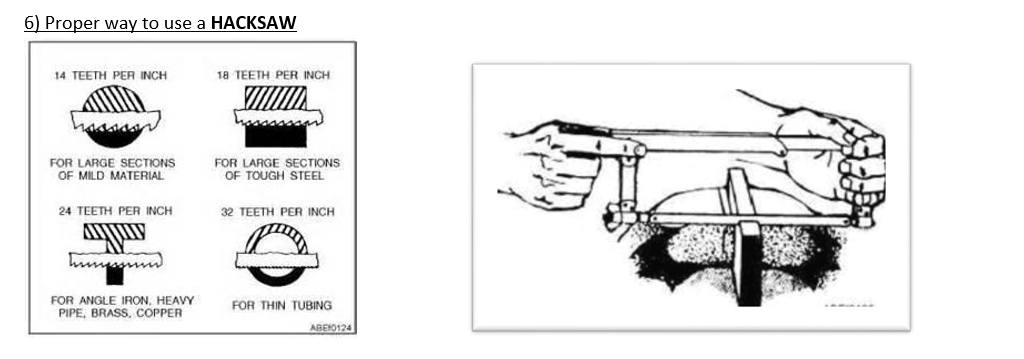
Tooth pitch is often listed as teeth per inch, or TPI. Common hacksaw blades include 14, 18, 24, and 32 TPI.
| Blade pitch | Typical use |
|---|---|
| 14 TPI | Thick metal, heavy stock, and larger sections |
| 18 TPI | General cutting of medium-thickness metal |
| 24 TPI | Thin-wall tubing, sheet metal, and many household jobs |
| 32 TPI | Thin metal, small tubing, and fine cuts |
The blade should have at least two or three teeth in contact with the workpiece at all times. If too few teeth touch the material, the blade may catch and break. If the pitch is too fine, the blade can clog and cut slowly.
For example, a thin steel tube usually needs a finer blade than a thick steel bar. A 32-TPI blade can work well on thin material, while a 14-TPI blade is more suitable for thick stock.
Use a blade made for the material. A blade for steel may not be the best choice for aluminum, copper, plastic, or stainless steel.
How to use a hacksaw after installing the blade
Secure the workpiece before cutting. Then use long, steady strokes with light pressure.
Mark the cut.
Use a marker, scriber, or wraparound tape for a straight guide.Clamp the material.
Hold it in a vise or with a suitable clamp. Keep the cut close to the support point to reduce vibration.Start with short strokes.
Begin at a low angle to create a small groove. This keeps the blade from sliding across the surface.Keep the blade straight.
Use the full length of the blade when possible. Short, fast strokes wear one small area and create more heat.Use light to moderate pressure.
Let the teeth do the work. Heavy pressure can bend the blade or strip its teeth.Slow down near the end.
Support the cut-off piece so it does not fall and twist the blade.Inspect the cut.
A steady cut should produce a narrow groove and fairly even teeth marks.
A small amount of cutting fluid can help on some metals. Use a fluid suitable for the material and follow its label. Do not use liquid near electrical equipment unless the setup is designed for it.
Common hacksaw mistakes and their fixes
The teeth face the handle
Problem: The blade cuts on the pull stroke.
Fix: Turn the blade around unless the manufacturer specifically designed it for pull cutting.
The blade is too loose
Problem: The blade bows, wanders, or twists.
Fix: Increase tension gradually. Replace the blade if it remains bent.
The blade is too tight
Problem: The frame or blade may bend or break.
Fix: Reduce tension. Tighten the blade only enough to keep it straight.
The blade has too few teeth in the cut
Problem: The blade catches or strips teeth.
Fix: Choose a finer pitch so at least two or three teeth engage the material.
The wrong part of the blade is being used
Problem: The saw cuts slowly even with the correct tooth direction.
Fix: Check whether the blade is suitable for the material and its thickness.
The workpiece moves
Problem: The cut wanders and the blade may bind.
Fix: Clamp the work firmly and support both sides of the cut when possible.
The blade is dull or damaged
Problem: You need more pressure, and the cut produces excess heat.
Fix: Replace the blade. Hacksaw blades are inexpensive compared with the time and control lost when using a worn blade.
Hacksaw safety for home and workshop use
Wear safety glasses when cutting metal. Small chips and broken teeth can travel from the cut.
Keep both hands on the tool only when you can maintain control. Do not place a finger near the blade path. Clamp the workpiece instead of holding it in your hand.
Inspect the frame and blade before use. Do not use a blade with missing teeth, cracks, severe rust, or a bent edge. A damaged blade can break under tension.
Keep the cut area clear. Do not force the saw if the blade binds. Stop, release pressure, and check the workpiece position.
When cutting painted, coated, or unknown materials, consider the dust and fumes that the material may produce. Use ventilation and suitable protective equipment. If the job involves asbestos, lead paint, or another hazardous substance, stop and follow applicable U.S. safety rules or consult a qualified professional.
The Occupational Safety and Health Administration provides general guidance on hand and portable power tools, including keeping tools in safe condition and using appropriate personal protective equipment. The tool maker’s instructions remain the best source for a particular frame or blade.
Frequently asked questions
Should hacksaw teeth face up or down?
For a normal hand hacksaw, tooth direction is described from the handle, not from the floor. The teeth should point away from the handle. Depending on how you hold the tool, that may look like the teeth point up, down, or forward.
Which way should a mini hacksaw blade face?
A mini hacksaw blade normally follows the same rule: the teeth face away from the handle and cut on the push stroke. Check the small frame’s markings because some mini saws use a different blade mount.
Can I use a hacksaw blade backward?
You can physically install many blades backward, but that is not the normal setup. It may cut poorly and encourage excessive force. Use the direction marked on the blade or package.
Why does my hacksaw cut on the pull stroke?
The blade may be installed backward, or it may be a specialty pull-cut blade. Check the tooth direction and the manufacturer’s instructions. A standard blade should normally cut when pushed away from the handle.
How do I know when to replace a hacksaw blade?
Replace it when the teeth are dull, missing, clogged, or uneven. Also replace a blade that is bent, cracked, badly rusted, or no longer cuts straight after you correct the setup.
Can I sharpen a hacksaw blade?
Most disposable hacksaw blades are not worth sharpening. Their teeth are small and often hardened. Replacing the blade gives more predictable cutting and reduces the risk of a tooth breaking during use.
Final answer
For a standard manual hacksaw, install the blade with the teeth pointing away from the handle. It should cut as you push the saw forward and glide back with little pressure.
If the saw cuts on the pull stroke, inspect the blade direction first. Then check tension, tooth pitch, material choice, and workpiece support. Those five checks solve most hacksaw cutting problems.
