What Does A Hacksaw Look Like: Visual Guide
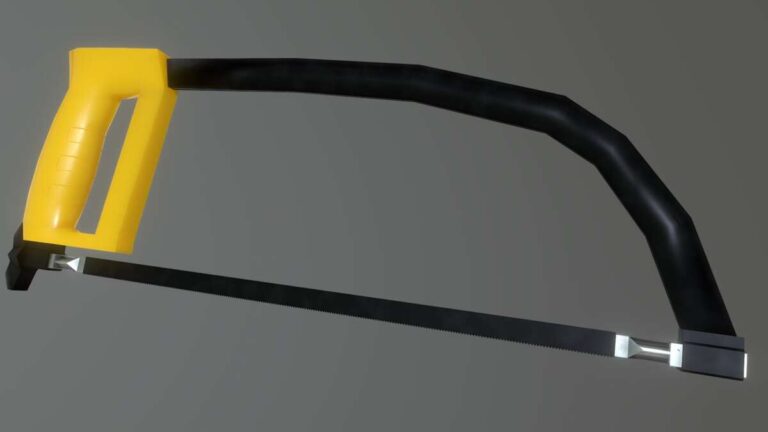
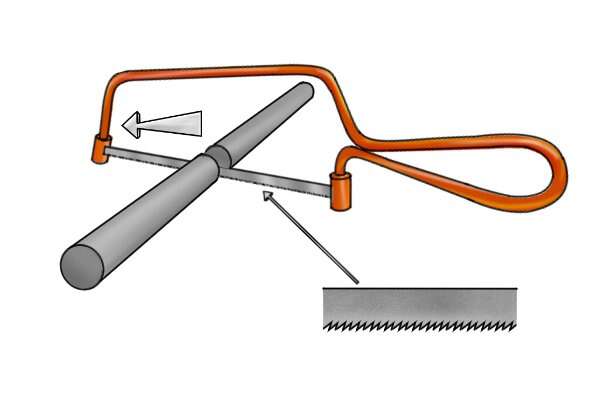
A hacksaw is a small hand saw with a thin, straight blade held in a rigid metal frame. In the United States, you will often see one in hardware stores, home workshops, plumbing trucks, and school shop rooms. It usually has a handle at one end, a bow-shaped frame, and a replaceable blade stretched between two posts.
The blade has many small teeth. Those teeth face forward and cut when you push the saw away from your body. A hacksaw is made mainly for cutting metal, but it can also cut plastic pipe, conduit, bolts, screws, and other thin materials when you use the right blade.
What Does a Hacksaw Look Like?
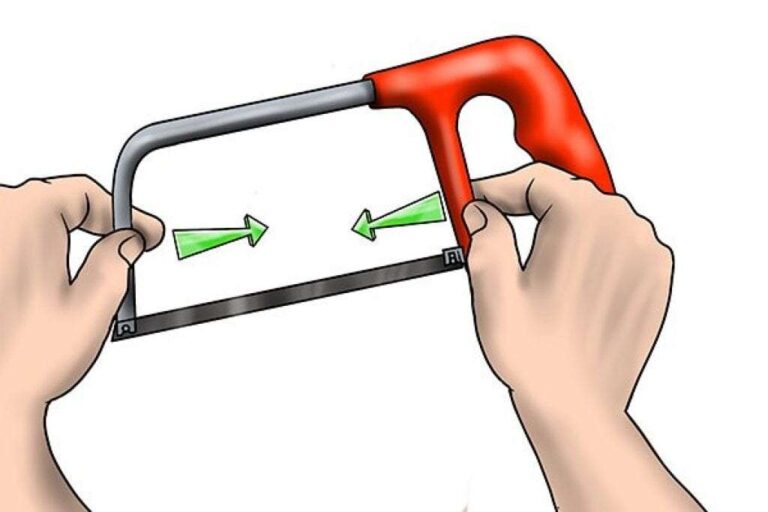
A standard hacksaw looks like a narrow metal rectangle with a handle attached to one side. The frame may look like a shallow bow or an elongated oval. The blade runs in a straight line across the open center of the frame.
Most hacksaws have these visible features:
- A curved or straight metal frame
- A hand grip, often made of plastic or rubber
- Two blade mounts, one at each end
- A thin, toothed blade
- A tension screw, lever, or knob
- Small pins or holes that lock the blade in place
The frame keeps the blade straight while you cut. The tension system pulls the blade tight so it does not bend easily.
A typical full-size hacksaw uses a blade about 12 inches long. In the United States, replacement blades are also sold in shorter sizes, such as 10 inches. Always check the frame before buying a blade, because blade length and mounting style can vary.
Simple visual description
Imagine a small metal bow with a straight line stretched across it. Add a handle at the lower end and a row of fine teeth along the straight line. That is the basic shape of a hacksaw.
A hacksaw is not shaped like:
- A kitchen knife
- A wood hand saw with a wide blade
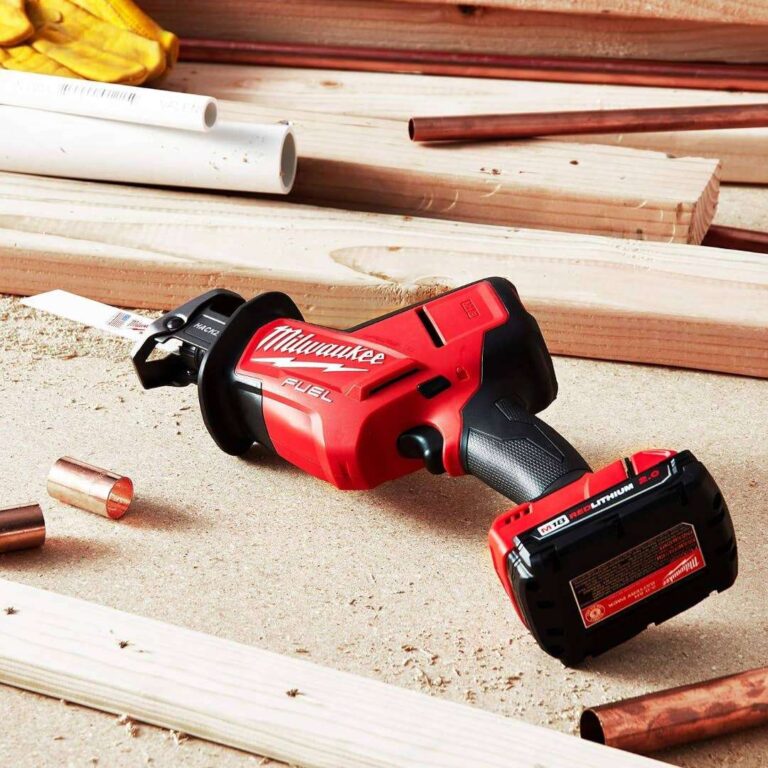
- A powered reciprocating saw
- A circular saw with a round blade
Its thin blade and open frame are the easiest ways to recognize it.
The Main Parts of a Hacksaw
Each part of a hacksaw has a clear job. Knowing the parts helps you choose a blade, install it correctly, and spot a problem.
Frame
The frame supports the blade. It may be fixed in one size or adjustable to accept different blade lengths.
Common frame styles include:
- Fixed-frame hacksaw: Holds one blade length. It is simple and often more rigid.
- Adjustable-frame hacksaw: Changes length to fit more than one blade size.
- Junior hacksaw: Has a smaller frame and shorter blade for light work.
- High-tension hacksaw: Uses a stronger frame and lets you apply more blade tension.
The frame should remain firm during a cut. If it twists or flexes too much, the blade may wander, bind, or break.
Handle
The handle gives you a secure grip. Many modern handles use molded plastic or rubber. Older models may have a simple metal or wooden grip.
A good handle should let you hold the saw without squeezing too hard. A smooth, loose, or cracked handle can make the tool harder to control.
blade
the blade is narrow and flexible. It has a line of teeth along one edge. Most hacksaw blades are made from hardened steel or a combination of flexible and hardened metals.
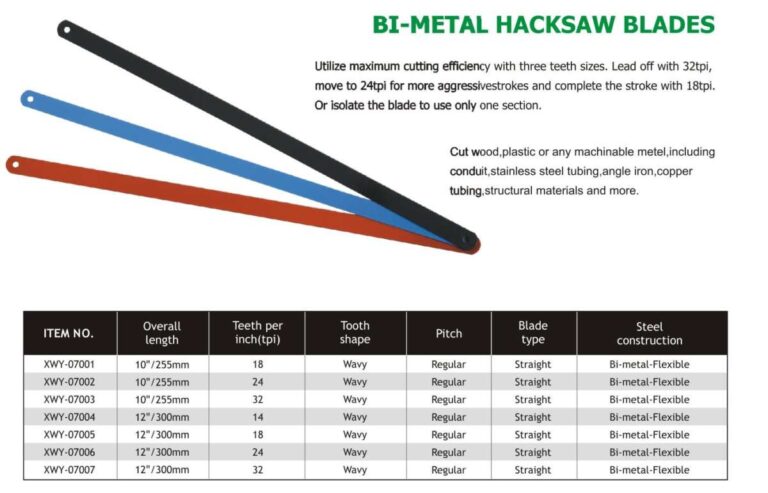
The blade may have teeth with different spacing. This spacing is described as TPI, or teeth per inch.
Common hacksaw blade tooth counts include:
- 14 TPI for thick metal or heavy stock
- 18 TPI for general-purpose cutting
- 24 TPI for thinner metal
- 32 TPI for very thin metal, tubing, and small parts
A higher TPI blade has smaller teeth. It usually gives a smoother cut but may remove material more slowly.
Blade mounts and pins
The ends of a hacksaw blade usually have small holes. Pins on the frame fit through those holes.
The pins stop the blade from sliding during use. If the blade does not sit fully on both pins, it can shift or break.
Tension screw or lever
The tension system holds the blade tight. One common design uses a threaded screw and wing nut. Another uses a quick-release lever.
The blade should feel firm, but do not force the tension system beyond its design. Too little tension can cause a crooked cut. Excessive tension can damage the frame or snap the blade.
How to Identify a Hacksaw in a Toolbox
Look for the blade and frame first. A hacksaw usually has a narrow blade stretched inside an open metal frame, while most wood saws have a wide blade with no surrounding frame.
Use these clues:
| Feature | Standard hacksaw | Wood hand saw | Reciprocating saw |
|---|---|---|---|
| Power source | Hand-powered | Hand-powered | Electric or battery-powered |
| Blade shape | Thin and narrow | Wide and flat | Narrow and long |
| Frame | Open metal frame | No surrounding frame | No fixed frame |
| Blade replacement | Small blade with end holes | Varies by saw | Shank-mounted blade |
| Main use | Metal and plastic | Wood | Fast powered cutting |
| Cutting motion | Push and pull by hand | Push and pull by hand | Motor-driven back-and-forth motion |
A hacksaw may also have a compact pistol-style frame. This design still counts as a hacksaw if it uses a tensioned, toothed blade held between two ends.
Do not confuse a hacksaw with a mini hacksaw. A mini hacksaw has a smaller handle and may hold only part of the blade. It works well in tight spaces but usually offers less control and cutting depth than a full-size frame.
What Can a Hacksaw Cut?
A hacksaw can cut many thin, hard materials. Its best-known use is cutting metal by hand.
Typical materials include:
- Steel bolts and threaded rod
- Copper and brass tubing
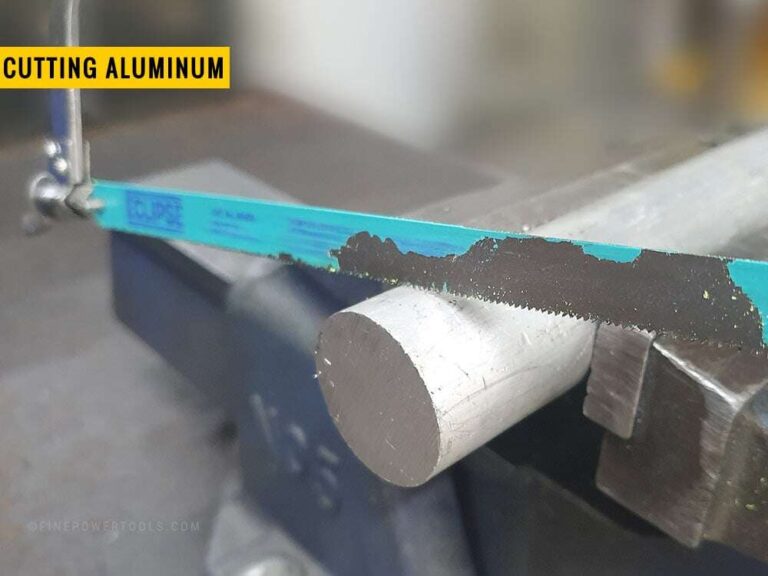
- Aluminum stock
- Metal conduit
- Plastic pipe
- PVC trim
- Screws and small brackets
- Wire mesh and light sheet metal
The material must be held firmly. A loose workpiece can move, pinch the blade, or produce a rough cut.
A hacksaw is not the best tool for thick structural steel, large logs, heavy castings, or long production cuts. Those jobs may need a powered saw, a metal-cutting band saw, or another tool designed for the material.
The blade matters as much as the frame. A fine blade can cut thin tubing with less risk of catching. A coarser blade can clear chips more easily in thick stock.
How Does a Hacksaw Blade Face?
The teeth should usually point away from the handle. In normal use, a hacksaw cuts on the forward stroke as you push it away from your body.
To check the direction, hold the saw as you would use it. The sharp points should face toward the front of the frame, away from the handle.
Some special blades may have different cutting directions, so follow the blade maker’s instructions when they differ. For a standard hacksaw blade, backward installation often causes poor cutting and may damage the teeth.
How to install a hacksaw blade
- Loosen the tension screw or release the blade lever.
- Place one blade hole over the mounting pin.
- Fit the other blade hole over the second pin.
- Check that the teeth face forward.
- Tighten the tension system until the blade is firm.
- Confirm that the blade sits straight in the frame.
Wear eye protection when handling a blade. A damaged blade can have sharp edges even when its teeth look dull.
How to Choose the Right Hacksaw Blade
Choose the blade by matching its tooth size to the material thickness. A useful rule is to keep at least three teeth in contact with the workpiece during the cut.
| Workpiece | Often suitable blade range |
|---|---|
| Thick steel or heavy stock | 14–18 TPI |
| General metal work | 18–24 TPI |
| Thin-wall tubing | 24–32 TPI |
| Small screws and sheet metal | 24–32 TPI |
| Plastic pipe | Often 14–24 TPI, depending on thickness |
These ranges are starting points, not universal rules. The blade maker’s instructions and the actual shape of the material also matter.
Use a coarser blade when:
- The material is thick
- The cut is long
- You need faster chip removal
Use a finer blade when:
- The material is thin
- The workpiece is hollow
- The cut must be smooth
- Coarse teeth might catch on the edge
If the blade has too few teeth in the cut, it may snag or strip teeth. If it has too many teeth, it may cut slowly and clog with chips.
How to Use a Hacksaw Safely
A hacksaw is simple, but its blade can cause cuts and eye injuries. Safe use starts with a stable workpiece and controlled strokes.
- Mark the cut. Use a pencil, marker, or scribe suitable for the material.
- Secure the material. Clamp it in a vise or use another stable holding method.
- Choose the blade. Match the TPI to the material thickness.
- Install the blade correctly. Make sure the teeth face forward.
- Start with a shallow groove. Use short, light strokes until the blade tracks on the mark.
- Use steady strokes. Keep the blade aligned and let the teeth do the cutting.
- Avoid twisting. Side pressure can bend or break the blade.
- Slow down near the end. Support the cut-off piece so it does not tear away.
- Smooth the edge. Use a file or deburring tool if the finished edge is sharp.
Wear safety glasses or other suitable eye protection. Keep fingers away from the blade path, and do not hold a small workpiece in your hand while cutting it.
Do not use a hacksaw with a cracked frame, loose handle, badly bent blade, or missing blade pin. Replace the damaged part before cutting. The Occupational Safety and Health Administration advises that hand tools should be kept in safe condition and used for their intended purpose. Its hand and power tools guidance is available at OSHA.gov.
Common Hacksaw Problems and Fixes
A hacksaw that feels hard to use may have the wrong blade, poor tension, or an unstable workpiece.
The blade keeps bending
Possible causes include:
- The workpiece is not clamped firmly
- You are pushing sideways
- The blade is too loose
- The blade is dull
- The cut line is difficult to reach
Tighten the blade, reduce side pressure, and let the frame stay in line with the cut.
The blade breaks
A blade may break because of too much tension, twisting, sudden force, or a damaged blade. Inspect the frame and mounting pins before installing a new blade.
The cut is rough
A rough cut may result from coarse teeth, a loose workpiece, or a blade that is nearing the end of its life. Select a finer blade when the material is thin and support the workpiece close to the cut.
The saw cuts very slowly
Check whether the blade is dull or has too many teeth for thick material. A finer blade is not always better. Thick stock often needs larger teeth and a longer, steady stroke.
The blade slips out
The blade may not be seated on both pins. It may also be too loose, or the frame may have a damaged mounting point. Stop cutting and inspect the blade before continuing.
Hacksaw vs. Reciprocating Saw
A hacksaw is a hand tool. A reciprocating saw is a powered tool that moves its blade rapidly back and forth.
Choose a hacksaw when you need:
- Quiet operation
- Fine control
- A low-cost hand tool
- Work in a place without power
- A clean approach to a small cut
Choose a reciprocating saw when you need:
- Faster cutting
- Repeated cuts
- More power
- Work on thicker materials, with the correct blade
A powered saw can remove material much faster, but it also creates more noise, vibration, and dust or debris. The right choice depends on the material, cut size, available space, and need for control.
Frequently Asked Questions
Is a hacksaw only for metal?
No. A hacksaw can cut some plastics, PVC pipe, conduit, bolts, screws, and light materials. Use a blade with tooth spacing suited to the workpiece.
What color is a hacksaw?
There is no standard color. Frames may be painted blue, red, yellow, black, or another color. Color does not identify the tool as reliably as its thin toothed blade and open frame.
Are hacksaw blades universal?
Many standard blades use similar end holes, but not every blade fits every frame. Check the required blade length, mounting style, and frame design before buying a replacement.
Can a hacksaw cut wood?
It can cut some wood, but it is usually a poor choice. A wood saw has a wider blade and tooth shape designed to clear wood chips. Use a wood-cutting saw for regular wood work.
How do I know when to replace the blade?
Replace it when the teeth look worn, the saw slips, the cut becomes unusually slow, or the blade bends during normal use. Also replace any blade with cracks, kinks, or missing teeth.
Final Answer: The Quick Way to Recognize a Hacksaw
A hacksaw looks like a small metal frame with a handle and a thin, toothed blade stretched across its open center. The blade is replaceable and usually points forward so the saw cuts on the push stroke.
If you are identifying one in a toolbox, look for the combination of an open frame, narrow blade, blade tension system, and fine teeth. To use it well, secure the workpiece, select the right TPI, keep the blade straight, and wear eye protection.
Recent Tool Guides
 Hammer
How To Hammer Flowers Onto Paper: Easy Guide
Learn how to hammer flowers onto paper with simple steps, helpful tips, and beautiful results for...
Read Guide → Wrench
How To Use A Hex Wrench: Easy Step-By-Step Guide
Learn how to use a hex wrench correctly with simple steps, helpful tips, and common mistakes...
Read Guide → Hacksaw
How To Cut Curtain Pole With Hacksaw: Easy Guide
Learn how to cut curtain pole with hacksaw safely and neatly. Follow simple steps for accurate...
Read Guide → Wrench
How To Use A Husky Torque Wrench: Easy Guide
Learn how to use a Husky torque wrench correctly with simple steps, torque settings, and safety...
Read Guide → Hammer
How To Hold A Hammer: Safe Grip Guide
Learn how to hold a hammer with the right grip, stance, and technique for safer, more...
Read Guide → Hacksaw
How To Cut Flexible Metal Conduit With Hacksaw: Easy Guide
Learn how to cut flexible metal conduit with hacksaw safely and cleanly. Follow simple steps for...
Read Guide →