What Size Wrench For 5 8 Bolt: Find The Right Fit
For a standard 5/8-inch hex-head bolt in the United States, use a 15/16-inch wrench or socket.
This size fits the bolt head, not the bolt’s threaded shaft. A 5/8-inch bolt usually has a 5/8-inch thread diameter, while its hex head measures 15/16 inch across the flats. This is common for standard SAE hex bolts made to U.S. fastener dimensions.

Quick Answer: Use a 15/16-Inch Wrench
A standard 5/8-inch bolt normally takes a:
- 15/16-inch open-end wrench
- 15/16-inch box-end wrench
- 15/16-inch combination wrench
- 15/16-inch socket
The bolt size refers to the diameter of the threaded part. The wrench size refers to the distance across two opposite flat sides of the bolt head.
For example, a standard 5/8-11 hex bolt has a 5/8-inch body diameter and a 15/16-inch head. A 5/8-18 bolt usually uses the same head size. The difference between these two bolts is the thread pitch, not the wrench size.
Why a 5/8-Inch Bolt Uses a 15/16-Inch Wrench
The bolt’s name and wrench size describe two different parts.
- 5/8 inch refers to the nominal bolt diameter.
- 15/16 inch refers to the hex head width.
- 11 or 18 refers to the thread count per inch.
A standard hex bolt needs a head larger than its threaded body. This gives the wrench enough contact area to turn the bolt without damaging the threads.
Here is the common size relationship:
| Bolt diameter | Typical thread examples | Standard hex-head wrench size |
|---|---|---|
| 1/4 inch | 1/4-20, 1/4-28 | 7/16 inch |
| 5/16 inch | 5/16-18, 5/16-24 | 1/2 inch |
| 3/8 inch | 3/8-16, 3/8-24 | 9/16 inch |
| 1/2 inch | 1/2-13, 1/2-20 | 3/4 inch |
| 5/8 inch | 5/8-11, 5/8-18 | 15/16 inch |
| 3/4 inch | 3/4-10, 3/4-16 | 1-1/8 inches |
These are typical dimensions for standard U.S. hex-head fasteners. Actual head size can change with the bolt style, grade, and manufacturing standard.

How to Check the Wrench Size
If you are unsure whether the bolt is standard, check the head before applying force.
1. Measure across the flats
Measure from one flat side of the hex head straight across to the opposite flat side. Do not measure from one corner to the opposite corner.
For a standard 5/8-inch bolt, this measurement should be close to 15/16 inch.
A caliper gives the best reading. You can also test known SAE sockets until one fits fully over the head.
2. Try a 15/16-inch socket
Push the socket completely onto the bolt head. The socket should:
- Sit flat on the head
- Reach the bottom of the hex
- Have very little side-to-side movement
- Turn the bolt without slipping
Do not use a socket that fits only partway. Dirt, paint, rust, or a damaged head can prevent a proper fit.
3. Confirm the fit by hand
Before using a ratchet or breaker bar, turn the socket by hand. If the socket rocks, feels loose, or slips over the corners, stop and check the size.
A loose socket can round the bolt head. Once the corners are damaged, removal becomes much harder.

Standard, Heavy-Hex, and Flange Bolt Differences
The most common answer is 15/16 inch, but not every 5/8-inch bolt has the same head.
Standard hex bolt
A standard 5/8-inch hex bolt usually takes a 15/16-inch wrench. This is the size found on many general-purpose machine bolts, equipment fasteners, and hardware-store bolts in the United States.
Heavy-hex structural bolt
A 5/8-inch heavy-hex bolt may require a 1-1/16-inch wrench. Heavy-hex bolts have a larger head and are often used in structural steel work and other applications that follow structural fastener specifications.
Do not assume that a heavy-hex bolt uses the standard head size. Measure the head or check the bolt markings and product specification.
Flange-head bolt
A flange-head bolt has a built-in washer-like flange under the head. Its wrench size may be smaller or larger than the size used on a standard hex bolt.
The correct wrench depends on the flange bolt’s design. Use the size stamped in the product data or measure the head.
Square-head bolt
A square-head bolt does not use the same wrench size as a hex-head bolt. Measure across the square’s flat sides and choose a wrench that fits that measurement.
Carriage bolt
A carriage bolt has a round head and a square shoulder below it. You do not turn the head with a wrench. Instead, hold the nut with the correct wrench while the square shoulder prevents the bolt from spinning.

SAE Versus Metric Wrench Sizes
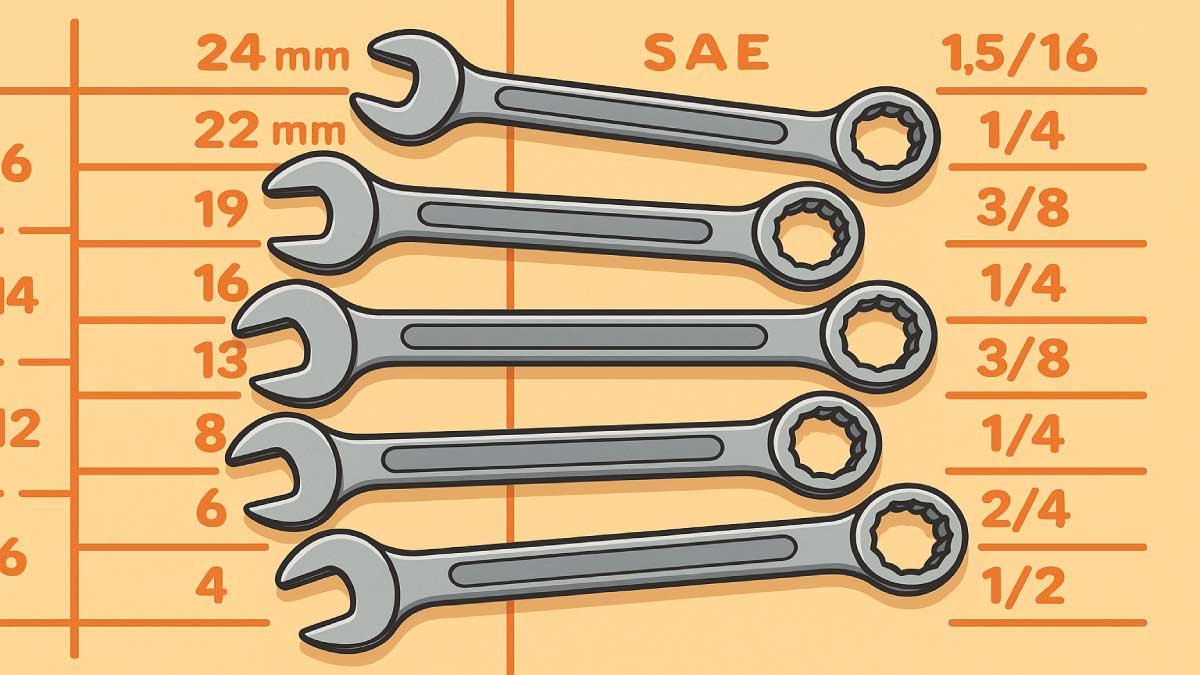
A 5/8-inch bolt is an SAE fastener, not a metric fastener. The closest common metric wrench sizes are 23 mm and 24 mm, but neither is the correct replacement for a 15/16-inch wrench in every situation.
The conversions are:
- 5/8 inch bolt diameter = 15.875 mm
- 15/16 inch wrench size = 23.8125 mm
- 15/16 inch is commonly labeled as 24 mm in rounded conversion charts
A 24 mm socket may fit some 15/16-inch bolt heads closely. However, the fit can vary because of manufacturing tolerances, wear, plating, and the shape of the socket. Use a true 15/16-inch SAE socket when possible.
A 23 mm socket is too small for most standard 5/8-inch bolt heads. Do not force it onto the fastener.

What to Do If a 15/16-Inch Wrench Does Not Fit
If the expected wrench does not fit, check the fastener instead of forcing the tool.
If the wrench is too small
Possible causes include:
- The bolt is a heavy-hex style with a different head size
- The bolt is not actually 5/8 inch
- The head has rust, paint, or dirt on it
- The fastener uses metric dimensions
- The wrench size is marked incorrectly or is damaged
Clean the head with a wire brush. Then measure across the flats again.
If the wrench is too loose
A loose fit may indicate:
- A worn wrench or socket
- Rounded bolt corners
- The wrong SAE size
- A metric fastener
- A thin-wall or specialty bolt head
Try a new, high-quality socket. If it still fits poorly, measure the head with calipers rather than guessing.
If the bolt head is rounded
Do not keep turning it with a loose wrench. That can remove the remaining corners.
Safer options may include:
- Apply penetrating oil if rust is present.
- Clean the head.
- Use a tight six-point socket.
- Tap the socket fully onto the head with light hammer strikes if appropriate.
- Use a bolt-extraction socket if the head is badly damaged.
Wear eye protection. If the bolt is part of a vehicle suspension, pressure vessel, lifting system, structural connection, or other safety-critical assembly, follow the service manual or get qualified help before cutting or heating the fastener.
How to Remove or Tighten a 5/8-Inch Bolt
Use the correct tool and keep it square to the bolt head.
To loosen the bolt
- Choose a 15/16-inch socket for a standard hex bolt.
- Clean dirt and rust from the head.
- Push the socket fully onto the bolt.
- Turn counterclockwise when viewed from the bolt head.
- Use steady force instead of sudden twisting.
- Stop if the head begins to round.
Most standard bolts use right-hand threads. Some special equipment uses left-hand threads, so check the manual if the bolt will not loosen normally.
To tighten the bolt
- Start the bolt by hand to avoid cross-threading.
- Seat the washer and nut correctly.
- Place the 15/16-inch socket fully on the head or nut.
- Tighten to the manufacturer’s torque specification.
- Use a calibrated torque wrench when the assembly requires a specified torque.
A wrench size does not tell you the correct tightening torque. Torque depends on the bolt grade, thread type, lubrication, washer use, and the joint design.
Bolt Markings, Grade, and Thread Pitch
The bolt head markings can help identify the fastener, but they do not always identify the wrench size.
Common U.S. bolt markings include:
- No radial lines: often a lower-grade commercial bolt
- Three radial lines: commonly associated with Grade 5
- Six radial lines: commonly associated with Grade 8
These markings are general identification clues. They are not a substitute for the manufacturer’s specification.
A 5/8-inch bolt may also have either coarse or fine threads:
- 5/8-11: 11 threads per inch, coarse thread
- 5/8-18: 18 threads per inch, fine thread
Both can use a 15/16-inch standard hex head. Thread pitch matters when replacing the bolt because a coarse-thread bolt and a fine-thread bolt are not interchangeable.

Common Mistakes to Avoid
Confusing bolt diameter with wrench size
A 5/8-inch bolt does not normally take a 5/8-inch wrench. The 5/8-inch measurement describes the bolt body, not the head.
Using an adjustable wrench when a socket is available
An adjustable wrench can work in a pinch, but it may slip if it is not adjusted tightly. A six-point 15/16-inch socket usually gives better contact and reduces the risk of rounding.
Using a 12-point socket on a damaged head
A 12-point socket is useful when access is limited, but a six-point socket generally gives stronger contact on a stubborn or partly damaged hex head.
Guessing between SAE and metric
A nearly correct metric socket can damage an SAE bolt. Confirm the size before applying high force.
Ignoring the bolt style
A standard hex bolt, heavy-hex bolt, flange bolt, and square-head bolt may all have different wrench requirements even when each has a 5/8-inch nominal diameter.

Frequently Asked Questions
Is a 15/16-inch wrench the same as a wrench for a 5/8-inch bolt?
For a standard U.S. hex-head 5/8-inch bolt, yes. A 15/16-inch wrench is the usual match. The answer changes if the bolt has a heavy-hex, flange, or specialty head.
What size socket fits a 5/8-11 bolt?
A standard 5/8-11 hex bolt usually takes a 15/16-inch socket. The “11” identifies 11 threads per inch and does not normally change the standard head size.
What size wrench fits a 5/8-18 bolt?
A standard 5/8-18 hex bolt also usually takes a 15/16-inch wrench or socket. The 18 means the bolt has 18 threads per inch.
Can I use a 24 mm socket on a 5/8-inch bolt?
A 24 mm socket may fit a standard 15/16-inch bolt head because the sizes are close. However, a 15/16-inch SAE socket is the better choice. Do not use the 24 mm socket if it feels loose.
Does a 5/8-inch heavy-hex bolt use a 15/16-inch wrench?
Not always. A 5/8-inch heavy-hex bolt may use a 1-1/16-inch wrench. Measure across the head or check the fastener specification.
Key Takeaways
- A standard 5/8-inch hex bolt usually needs a 15/16-inch wrench.
- The 5/8-inch measurement refers to the bolt’s nominal diameter.
- The wrench size measures across the bolt head’s flat sides.
- A heavy-hex bolt may need a different wrench, often 1-1/16 inches.
- Use a six-point socket when the bolt is tight or slightly damaged.
- Never guess the tightening torque from the wrench size alone.
Final Answer
For a standard 5/8-inch bolt sold under common U.S. fastener dimensions, start with a 15/16-inch wrench or socket. If it does not fit correctly, clean and measure the bolt head, then check whether the fastener is heavy-hex, metric, flange-style, or damaged.
Recent Tool Guides
 Hammer
How To Hammer Flowers Onto Paper: Easy Guide
Learn how to hammer flowers onto paper with simple steps, helpful tips, and beautiful results for...
Read Guide → Wrench
How To Use A Hex Wrench: Easy Step-By-Step Guide
Learn how to use a hex wrench correctly with simple steps, helpful tips, and common mistakes...
Read Guide → Hacksaw
How To Cut Curtain Pole With Hacksaw: Easy Guide
Learn how to cut curtain pole with hacksaw safely and neatly. Follow simple steps for accurate...
Read Guide → Wrench
How To Use A Husky Torque Wrench: Easy Guide
Learn how to use a Husky torque wrench correctly with simple steps, torque settings, and safety...
Read Guide → Hammer
How To Hold A Hammer: Safe Grip Guide
Learn how to hold a hammer with the right grip, stance, and technique for safer, more...
Read Guide → Hacksaw
How To Cut Flexible Metal Conduit With Hacksaw: Easy Guide
Learn how to cut flexible metal conduit with hacksaw safely and cleanly. Follow simple steps for...
Read Guide →