Can A Regular Drill Be Used As A Hammer Drill: Explained
Introduction
For homeowners in the United States, the short answer is yes, a regular drill can sometimes make holes in brick, block, or light concrete—but it cannot fully replace a hammer drill. A standard drill only spins the bit. A hammer drill spins the bit and adds rapid forward blows that help break masonry.
You may be able to drill a small hole with a regular drill and a masonry bit. The work will be slower, the bit may heat up, and dense concrete may stop the job altogether. For repeated holes, large anchors, or hard concrete, use a hammer drill or rotary hammer instead.
Regular Drill vs. Hammer Drill: What Is the Difference?
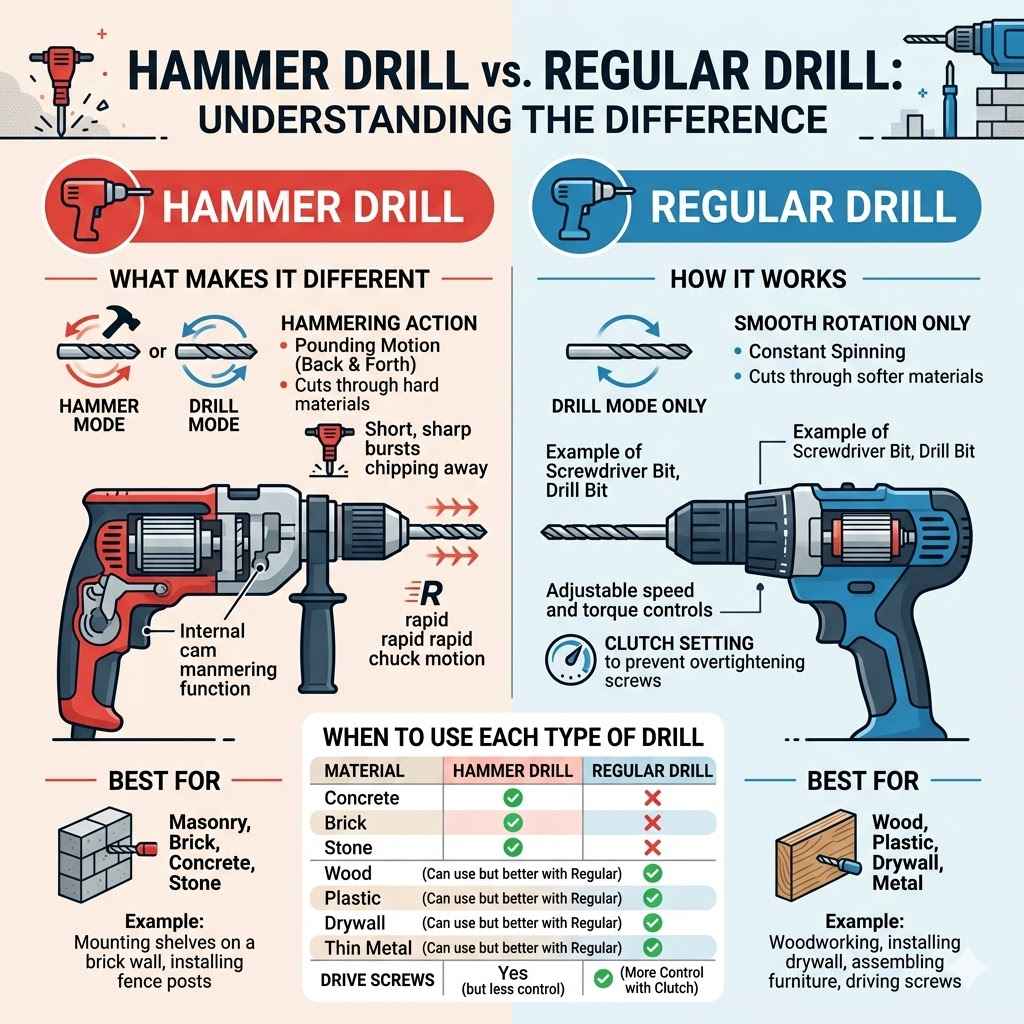
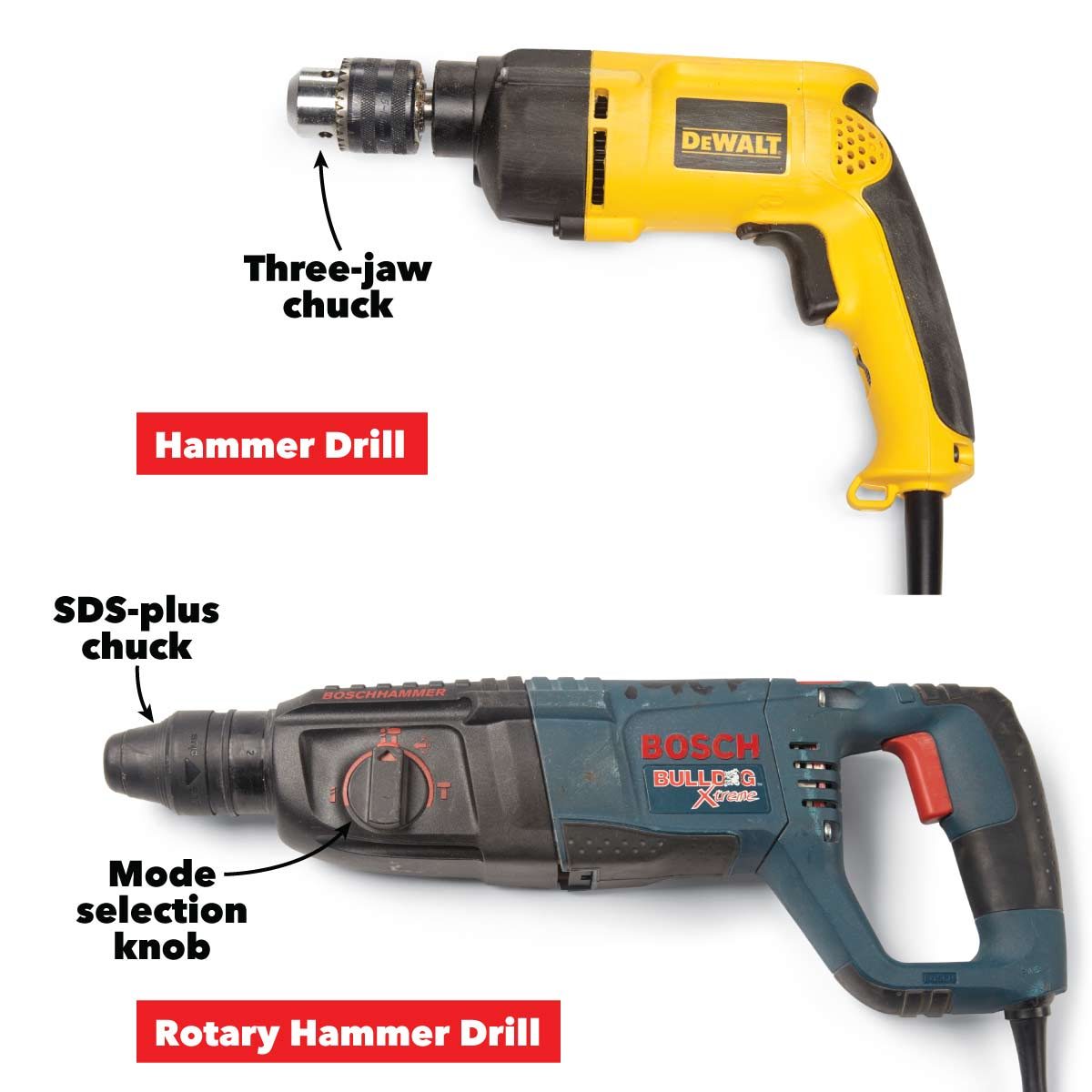
A regular drill uses rotary force. The chuck turns the bit, which cuts or grinds through the material. It does not push the bit forward with an impact action.
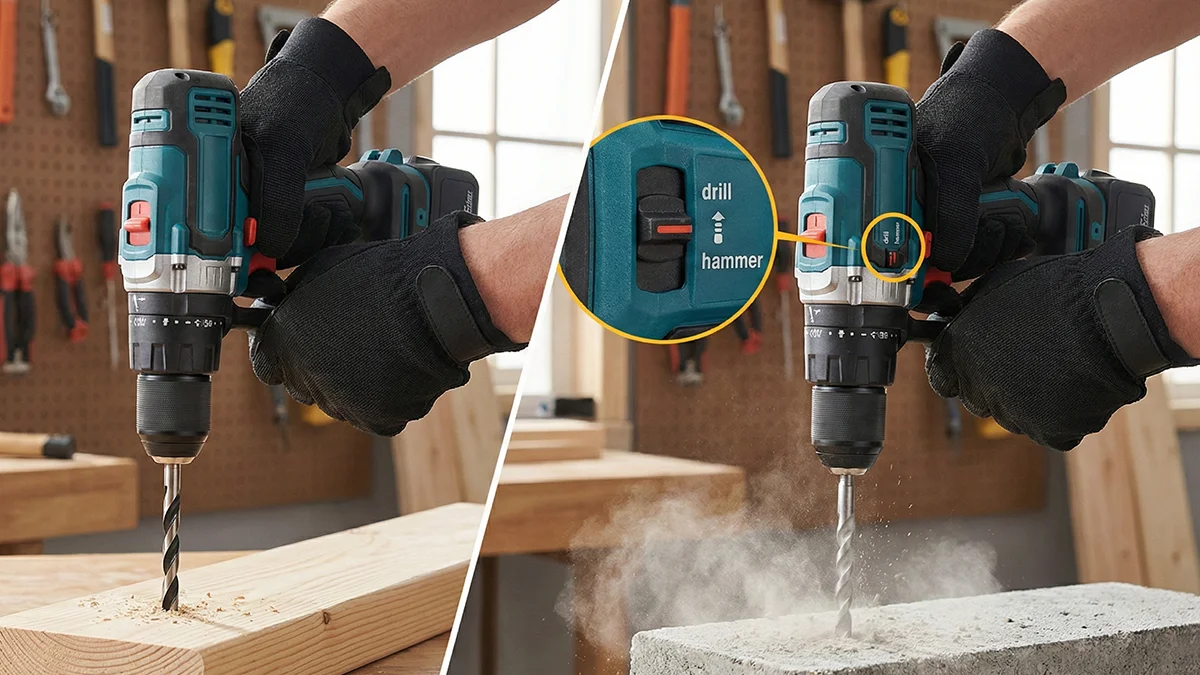
A hammer drill adds a second movement. Two toothed discs or a similar mechanism create small, rapid blows along the bit’s length. These blows help crack and break masonry as the bit turns.
A rotary hammer uses a stronger piston system. It is made for heavy work in concrete, brick, stone, and block. Some rotary hammers also have a chisel-only mode.
| Tool type | Main action | Best use |
|---|---|---|
| Regular drill | Rotation only | Wood, metal, plastic, and small masonry holes |
| Hammer drill | Rotation plus light axial blows | Brick, block, mortar, and occasional concrete holes |
| Rotary hammer | Rotation plus strong piston blows | Hard concrete, large holes, anchors, and demolition |
The key difference is not just motor power. It is the impact mechanism. A regular drill can have a powerful motor, but motor power alone does not create hammer action.
What does “hammer mode” mean?
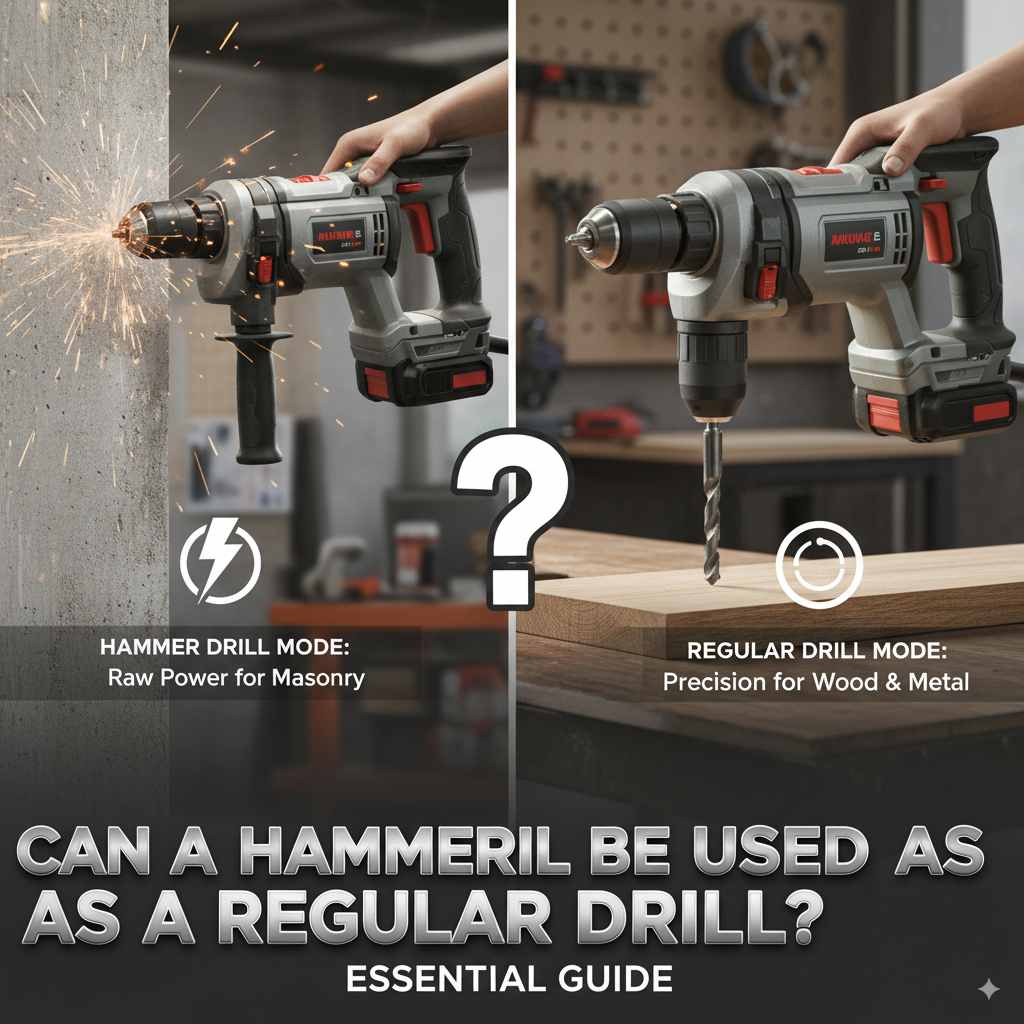
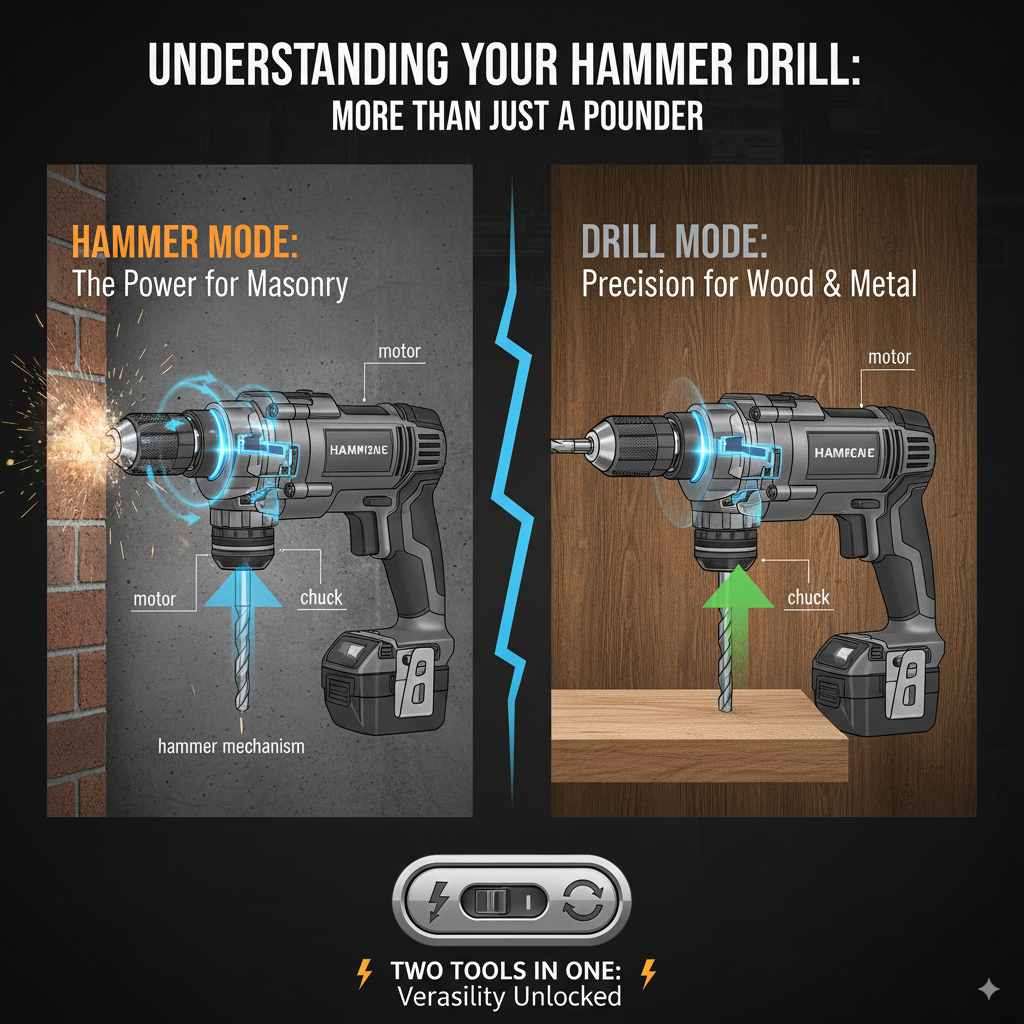
On a hammer drill, hammer mode activates the impact system. A regular drill usually has settings for speed, torque, or clutch control, but those settings do not create true hammer action.
A drill with a clutch marked from 1 to 20 does not become a hammer drill. The clutch controls how much torque reaches the chuck. It does not strike the bit.

When Can You Use a Regular Drill for Masonry?
A regular drill can work for small holes in soft masonry, such as brick, mortar, cinder block, or some lightweight concrete. It is most useful when you need one or two holes and do not want to buy or borrow another tool.
This method may work for:
- Small plastic wall anchors
- Pilot holes for masonry screws
- Holes in mortar joints
- Light-duty work in soft brick
- A few holes in concrete block
It becomes a poor choice when the material is dense or the hole is large. A regular drill may struggle with structural concrete, reinforced concrete, stone, or thick brick.
Situations where a regular drill is not enough
Use a hammer drill or rotary hammer when you need to:
- Drill many masonry holes
- Install concrete anchors
- Drill holes larger than about 1/4 inch
- Work in hard or reinforced concrete
- Drill deep holes
- Drill overhead for long periods
– Remove tile, mortar, or concrete - Finish the job quickly and with less strain
The 1/4-inch guideline is a practical starting point, not a universal limit. The exact limit depends on the drill, bit, material, hole depth, and required accuracy.

How to Drill Masonry With a Regular Drill
Before starting, confirm that the hole is not near electrical wires, plumbing, gas lines, or structural reinforcement. In the United States, wall construction varies by home age and region. Do not rely only on a stud finder. Check the area with suitable detection tools and follow local safety rules.
What you need
Gather:
- A regular drill
- A carbide-tipped masonry bit
- Safety glasses
- Hearing protection
- A dust mask or respirator suitable for masonry dust
- A pencil
- A depth stop or tape
- A vacuum or brush for dust removal
- The correct wall anchor or screw
A wood or metal drill bit is not a safe substitute for a masonry bit. Masonry bits have a carbide cutting tip that can withstand abrasive material better than a standard twist bit.
Step-by-step method
-
Read the drill manual.
Check the manufacturer’s limits and make sure the chuck can hold the masonry bit securely. -
Mark the hole.
Use a pencil or marker. Avoid placing the hole close to the edge of a brick, block, or concrete section. -
Choose the correct bit size.
Match the bit to the anchor or screw instructions. A hole that is too large may not hold the anchor. -
Set the drill to low speed.
Low speed gives you better control and reduces heat. Do not use the clutch as a substitute for hammer action. -
Start straight.
Hold the drill at a 90-degree angle to the surface. Begin with light pressure so the bit does not skid. -
Apply steady pressure.
Let the bit cut. Do not force the drill so hard that the motor stalls. -
Clear dust often.
Pull the bit out every few seconds. This removes dust from the hole and lets the bit cool. -
Check the depth.
Use tape on the bit as a simple depth guide. Stop before the bit reaches an unsafe area or passes through the material. -
Clean the hole.
Remove loose dust with a vacuum or brush. A dusty hole may reduce anchor grip. -
Install the anchor or screw.
Follow the anchor maker’s instructions. Do not overtighten, especially in soft brick or block.
Signs the method is working
The bit should make steady progress. You should see fine masonry dust, and the drill should maintain a stable speed. The bit should not glow, smoke, or smell strongly of overheated insulation.
If the bit stops cutting after a short time, the material may be too hard for a standard drill. Stop rather than forcing the tool.
What If the Regular Drill Will Not Drill the Hole?
A drill that makes no progress usually has one of four problems: the wrong bit, too much heat, excessive pressure, or material that needs impact action.
Use this troubleshooting order:
| Symptom | Likely cause | Safer response |
|---|---|---|
| Bit skids on the surface | High speed or poor alignment | Start slowly and hold the drill straight |
| Little or no progress | Wrong bit or hard material | Use a carbide masonry bit; switch to a hammer drill if needed |
| Bit becomes very hot | Too much speed or continuous drilling | Stop, let it cool, and drill in short intervals |
| Motor slows sharply | Too much pressure or a weak drill | Reduce pressure or use a stronger tool |
| Hole is loose or oversized | Worn bit or side-to-side movement | Replace the bit and keep the drill square |
| Dust packs in the hole | No dust clearing | Withdraw the bit often and clean the hole |
| Bit gets stuck | Binding or hidden obstruction | Release the trigger and remove the bit carefully |
Do not keep drilling if the bit is smoking or the drill housing becomes unusually hot. Unplug a corded drill or remove the battery before inspecting a stuck bit.
If the hole location may contain a wire or pipe, stop immediately. Do not “push through” an unexpected obstruction.
Can You Add a Hammer Attachment to a Regular Drill?
Most attachments that claim to add hammer action are not a true substitute for a hammer drill. Some accessories can help with specific jobs, but they do not usually create the same controlled impact system built into a hammer drill.
A masonry bit is an accessory, not a hammer mechanism. A drill chuck adapter may let you use a different bit, but it does not change how the drill operates.
Avoid forcing a regular drill to accept SDS or other rotary-hammer bits unless the tool and adapter are specifically designed for that use. An improvised adapter can cause wobble, bit release, damage, or injury.
The practical choices are:
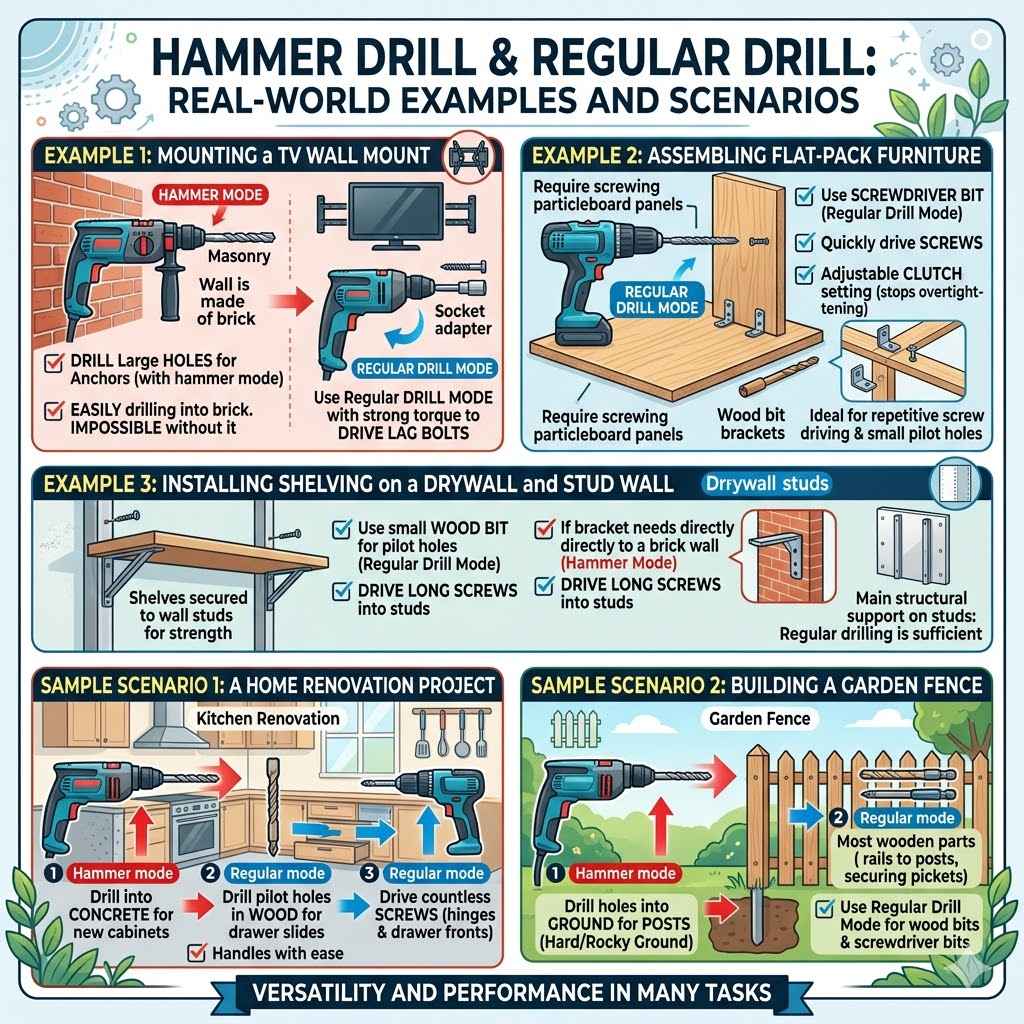
- Use your regular drill for a few small holes in soft masonry.
- Borrow or rent a hammer drill for occasional heavier work.
- Buy a hammer drill if masonry work is a regular task.
- Use a rotary hammer for hard concrete, large holes, or demolition.
Regular Drill, Hammer Drill, or Rotary Hammer?
Choose the tool based on the material, hole size, number of holes, and required speed.
| Project | Best choice | Why |
|---|---|---|
| One small hole in soft brick | Regular drill with masonry bit | May be adequate for light work |
| Several holes in brick or block | Hammer drill | Faster and easier |
| Small holes in hard concrete | Hammer drill | Impact helps break dense material |
| Large concrete anchor holes | Rotary hammer | More impact and better performance |
| Tile drilling | Regular drill with the proper tile bit | Hammer action can crack tile |
| Chiseling or removing mortar | Rotary hammer with chisel mode | Designed for impact-only work |
| Wood or metal | Regular drill | Hammer action is not needed |
A hammer drill is not automatically better for every material. Do not use hammer mode on tile, glass, wood, or metal unless the tool and bit instructions specifically allow it. The impact can chip, crack, or damage those materials.
A simple decision rule
Use this rule:
- Soft material and one small hole: a regular drill may work.
- Hard masonry or several holes: use a hammer drill.
- Large, deep, or demanding concrete work: use a rotary hammer.
- Fragile surface: use a regular drill and the correct specialty bit.
Safety Tips for Drilling Masonry
Masonry drilling creates dust and can produce flying chips. Wear safety glasses even when drilling a small hole. Use hearing protection when operating a hammer drill or rotary hammer.
Silica dust is a serious workplace hazard. Concrete, brick, mortar, and stone can release respirable crystalline silica when drilled. The Occupational Safety and Health Administration provides controls for silica exposure, including methods such as water delivery or dust collection for applicable work. Review OSHA’s silica resources and the tool manufacturer’s instructions.
Follow these basic precautions:
- Inspect the bit before use.
- Keep the drill’s vents clear.
- Use a side handle when the tool provides one.
- Keep both hands on the tool when needed.
- Do not wear loose clothing or jewelry.
- Secure the workpiece when possible.
- Keep cords and batteries away from water.
- Do not use a damaged bit or cracked accessory.
- Let the bit cool before touching it.
- Disconnect power before changing bits.
- Do not drill into a surface you have not checked for hidden services.
For commercial work, follow the applicable OSHA requirements, site rules, and employer safety plan. For unusual structural work, ask a qualified contractor or engineer before drilling.
Common Mistakes to Avoid
The most common mistake is assuming that a strong regular drill can produce hammer action. It cannot. A high-wattage motor may spin the bit well, but it does not provide the forward blows that help break concrete.
Other mistakes include:
- Using a wood bit on brick or concrete
- Running the drill at top speed
- Pressing so hard that the motor stalls
- Drilling without clearing dust
- Using a worn masonry bit
- Making a hole too close to a masonry edge
- Ignoring smoke, heat, or unusual noise
- Using hammer mode on tile
- Choosing an anchor before choosing the hole size
- Relying on an attachment that is not approved for the drill
A slow, controlled start is usually better than aggressive pressure. The bit should do the cutting while you guide the tool.
Key Takeaways
- A regular drill can drill a few small holes in soft masonry.
- It does not have the impact mechanism of a hammer drill.
- Use a carbide-tipped masonry bit, low speed, steady pressure, and frequent cooling breaks.
- Choose a hammer drill for repeated holes or hard masonry.
- Choose a rotary hammer for large, deep, or demanding concrete work.
- Wear eye protection and control masonry dust.
- Stop if the bit overheats, the drill stalls, or you meet an unexpected obstruction.
Frequently Asked Questions
Can a regular drill drill into concrete?
Yes, sometimes. A regular drill may make a small hole in soft or moderate concrete with a sharp carbide masonry bit. Hard or reinforced concrete may stop the drill or cause excessive heat. A hammer drill is the better tool for regular concrete work.
Can I use a hammer drill as a regular drill?
Usually, yes. Most hammer drills include a rotation-only setting. Turn hammer action off when drilling wood, metal, plastic, or other materials that could be damaged by impact. Use the correct bit for the material.
Is a masonry bit required for a regular drill?
Yes, for masonry. A masonry bit has a carbide tip designed for brick, block, mortar, and concrete. A standard wood or metal bit may become dull quickly and can create excess heat.
Will a regular drill work for brick?
It often will, especially with soft brick and a small hole. Drill slowly and keep the tool straight. Old, hard, or dense brick may require a hammer drill. Avoid drilling too close to the brick edge because brick can crack.
Should I use water while drilling masonry?
Water can reduce dust and cool the bit in some professional drilling systems, but it can create an electrical hazard with tools that are not designed for wet drilling. Do not spray or pour water near a standard corded or cordless drill unless the tool and method specifically support it. Dry drilling with suitable dust control is often safer for basic home work.
What should I rent for a few concrete holes?
A hammer drill is usually suitable for small holes. Rent a rotary hammer when the concrete is hard, the holes are large or deep, or you need many holes. Confirm the required bit type and size before renting.
Conclusion
A regular drill can handle a small masonry job when the material is soft, the hole is small, and you use the right bit. It cannot become a hammer drill through a clutch setting, a stronger motor, or a basic bit attachment.
For one or two light-duty holes, try the regular drill carefully. For hard concrete, repeated holes, large anchors, or faster work, use a hammer drill or rotary hammer. The correct tool reduces heat, effort, bit wear, and the risk of damaging the surface or the drill.
Recent Tool Guides
 Hammer
How To Hammer Flowers Onto Paper: Easy Guide
Learn how to hammer flowers onto paper with simple steps, helpful tips, and beautiful results for...
Read Guide → Wrench
How To Use A Hex Wrench: Easy Step-By-Step Guide
Learn how to use a hex wrench correctly with simple steps, helpful tips, and common mistakes...
Read Guide → Hacksaw
How To Cut Curtain Pole With Hacksaw: Easy Guide
Learn how to cut curtain pole with hacksaw safely and neatly. Follow simple steps for accurate...
Read Guide → Wrench
How To Use A Husky Torque Wrench: Easy Guide
Learn how to use a Husky torque wrench correctly with simple steps, torque settings, and safety...
Read Guide → Hammer
How To Hold A Hammer: Safe Grip Guide
Learn how to hold a hammer with the right grip, stance, and technique for safer, more...
Read Guide → Hacksaw
How To Cut Flexible Metal Conduit With Hacksaw: Easy Guide
Learn how to cut flexible metal conduit with hacksaw safely and cleanly. Follow simple steps for...
Read Guide →