
Putting on a hacksaw blade is simple once you know which way the teeth should face and how tight the blade should be. In most standard U.S. hacksaw frames, the teeth point away from the handle because the saw cuts on the forward push stroke.
Start by loosening the blade tension, remove the old blade, hook the new blade onto both frame pins, and tighten it until it is straight and firm. Do not overtighten it. A blade that is too tight can break during use.
This guide explains how to install a hacksaw blade, choose the right blade direction, set proper tension, and fix common problems.

What You Need Before You Start
Gather these items before changing the blade:
- A hacksaw frame
- A replacement hacksaw blade
- Safety glasses
- Work gloves, if suitable for the task
- A stable work surface
- The frame’s instruction manual, if its design is unfamiliar
Most hacksaw blades used in the United States are made to fit a standard frame with pins at each end. These pins fit into small holes in the blade. Some compact, junior, adjustable, or specialty frames use a different mounting system.
Check the new blade before installing it. Look for:
- A blade length that matches the frame
- Two mounting holes, if the frame uses pins
- A tooth count suited to the material
- A blade with no bends, cracks, or missing sections
A common full-size hacksaw blade is about 12 inches long, but frames may use other lengths. Measure the old blade or check the frame markings if you are unsure.
Choose the right teeth per inch
Hacksaw blades are sold by teeth per inch, or TPI. A higher TPI blade has smaller teeth and usually works better on thin metal. A lower TPI blade has larger teeth and is better for thicker stock.
| Material or workpiece | Common blade choice |
|---|---|
| Thin sheet metal or tubing | 24–32 TPI |
| Small steel, aluminum, or copper parts | 18–24 TPI |
| Thick metal bar or pipe | 14–18 TPI |
| Plastic or soft material | Often 14–24 TPI, depending on thickness |
As a basic rule, at least two or three teeth should contact the workpiece at all times. If only one tooth engages the material, the blade may catch, chatter, or lose teeth.
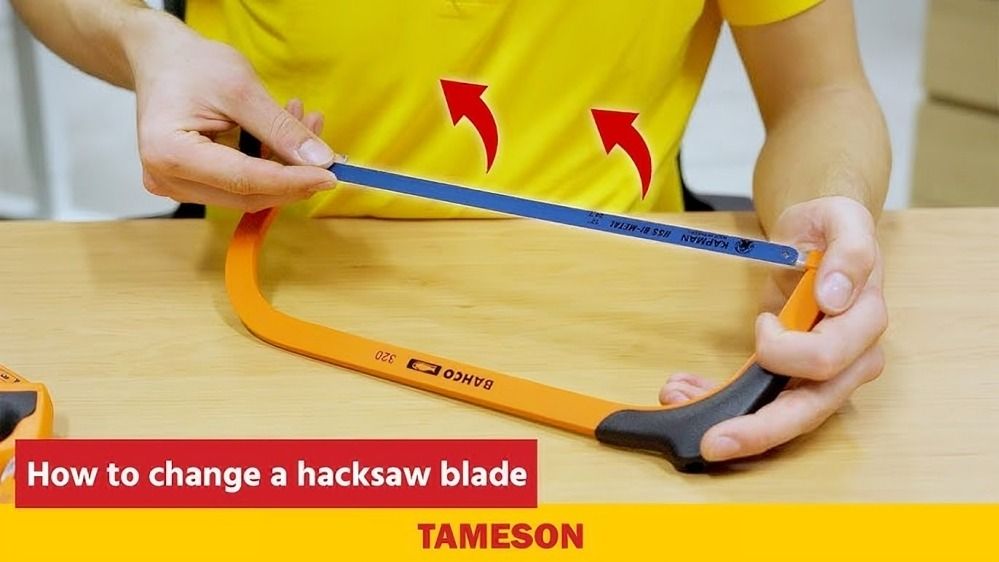
How to Put on a Hacksaw Blade
Follow these steps for a standard U.S. hacksaw frame with a tension knob or wing nut.
1. Protect yourself and secure the saw
Put on safety glasses before handling the blade. Hacksaw blades are thin and can have sharp edges, even when they are new.
Place the hacksaw on a stable surface. Keep your fingers away from the blade teeth while you work. If you are removing a blade that broke, use pliers to handle loose pieces instead of gripping the teeth directly.
2. Loosen the blade tension
Find the tension device at one end of the frame. It may be:
- A wing nut
- A threaded knob
- A lever
- A quick-release mechanism
Turn the tension knob counterclockwise, or use the release lever according to the frame design. Loosen the blade until the mounting holes can come off the frame pins.
Do not force a stuck knob. If the threads are dirty or rusty, clean them and apply a small amount of suitable penetrating oil. Keep oil away from the blade and the workpiece if it could affect cutting.
3. Remove the old blade
Hold the frame by its handle or side rail. Lift one end of the old blade off its pin, then remove the other end.
If the blade is broken, remove every loose piece. Check that no fragment remains around the pins or tension mechanism.
Use this moment to inspect the frame. Replace or repair it if you find:
- Bent side rails
- Cracked plastic or metal parts
- Damaged mounting pins
- Stripped threads
- A tension knob that will not hold
A damaged frame may not keep the blade aligned or tight.
4. Check the blade direction
Hold the replacement blade beside the frame before attaching it. On a normal hacksaw, the teeth should point away from the handle.
The reason is simple: a standard hacksaw cuts during the forward push stroke. With the teeth facing away from the handle, pressure from your hand drives the teeth into the material.
The blade should look like this:
Handle → smooth back of blade | teeth pointing forward →
Some hacksaw frames allow the blade to be installed with the teeth facing toward the handle. That setup is less common and may be used for a particular cutting action or frame design. If your frame has a special instruction, follow that instruction instead of assuming the usual direction.
5. Fit one blade hole onto its pin
Slide one mounting hole over the pin at the end of the frame. Keep the teeth facing in the intended direction.
Make sure the blade sits flat against the frame. Do not twist it sharply to reach the opposite pin. If the second hole does not line up, the blade may be too long, too short, or installed in the wrong position.
6. Fit the other end onto the second pin
Press the frame or tension mechanism just enough to line up the second mounting pin. Slide the other blade hole onto the pin.
Keep your fingers on the blade’s smooth sides, not along the teeth. The blade should rest straight between the two ends of the frame.
If your frame has a lever, hold the frame in the released position while fitting the blade. Then close the lever to apply tension.
7. Tighten the blade
Turn the tension knob clockwise, or tighten the wing nut by hand. Stop when the blade is firm and straight.
A properly tensioned blade should:
- Stay straight along the frame
- Make a clear, light ping when tapped
- Resist easy movement from side to side
- Remain seated in both mounting holes
Do not use pliers to force a hand-tightening knob unless the manufacturer specifically allows it. Excess tension can bend the frame, strip the threads, or snap the blade.
8. Check the final setup
Before cutting, inspect the blade from the side and front. It should be aligned with the frame and fully seated on both pins.
Move the frame gently through the air. The blade should not wobble, sag, or slide along the pins.
If the blade shifts, stop and release the tension. Refit it rather than trying to cut with a loose blade.

How Tight Should a Hacksaw Blade Be?
A hacksaw blade should be tight enough to stay straight during a cut, but not so tight that the frame or blade is under excessive stress.
There is no single tension setting for every hacksaw. Frames vary in size, material, and tension design. Unless the manufacturer provides a specific setting, use hand pressure only and stop when the blade is taut.
A blade that is too loose may:
- Bend away from the cut
- Twist and produce an angled cut
- Vibrate or chatter
- Slip off the mounting pins
- Break when the teeth catch
A blade that is too tight may:
- Snap without warning
- Damage the frame
- Strip the tension threads
- Bend the mounting pins
- Make blade changes difficult
Do not judge tension by sound alone. A light ping can help, but alignment and stability matter more. The blade should remain straight when you apply light finger pressure to its side.

Which Way Should the Teeth Face?
For most standard hacksaws, the teeth point away from the handle.
This orientation makes the forward stroke the cutting stroke. The return stroke should use little pressure. Let the teeth do the cutting instead of forcing the frame through the material.
If the teeth face the handle, the saw may cut on the pull stroke instead. That is not automatically wrong for every frame, but it is not the normal setup for a standard U.S. hacksaw. Check the frame manual when the design includes a reversible blade mount or a specialty cutting mode.
A quick check is to hold the saw as you would use it. The teeth should face the direction the frame moves when you apply cutting pressure.

How to Tell Whether the Blade Is Installed Correctly
The installation is successful when all of these conditions are true:
- The teeth face the correct direction.
- Both blade holes sit fully on the frame pins.
- The blade is straight between the frame ends.
- The blade has firm tension but is not overstressed.
- The blade does not twist when viewed from the front.
- The frame holds the blade without slipping.
- The blade length matches the frame.
Make a short test cut in scrap material. Use light forward pressure and short strokes at first. If the blade tracks straight and the frame feels stable, the setup is likely correct.
Stop if the blade bends sharply, slips, vibrates heavily, or produces a sudden crack. Release tension before inspecting it.

Troubleshooting Hacksaw Blade Installation
The blade keeps falling off
The blade may not be fully seated on one of the mounting pins. Release the tension, fit both holes over the pins, and retighten the blade.
The wrong blade length can also cause this problem. Compare the replacement blade with the frame specification.
The blade is loose after tightening
The tension threads may be stripped, or the blade may be sitting beside a pin instead of over it. Inspect the mounting points and tension mechanism.
Replace a frame that cannot hold a taut blade. Do not compensate for a damaged mechanism by forcing the knob tighter.
The blade breaks quickly
Check these possible causes:
- The blade is overtightened.
- The teeth face the wrong direction for the cutting stroke.
- The blade has too few teeth for thin material.
- You are using too much downward force.
- The workpiece is moving.
- The blade is twisted during the cut.
- The blade is worn or damaged.
Clamp the work securely and use steady strokes. A hacksaw should cut through the material; it should not be forced through it.
The saw cuts slowly
The blade may be dull, clogged, or unsuitable for the material. Select a fresh blade with an appropriate TPI rating.
For thick metal, a coarse blade may cut faster. For thin sheet metal, a fine blade helps prevent tooth snagging. Keep enough teeth in contact with the workpiece.
The cut is not straight
A loose blade, bent frame, or side pressure can cause an angled cut. Check the blade tension and frame alignment first.
Let the blade track naturally. Avoid twisting the handle to steer the cut. If the blade has already bent, replace it rather than trying to straighten it.

Safety Tips for Using a Hacksaw
Wear safety glasses when cutting metal, plastic, or other materials. Small chips and broken teeth can travel toward your face. OSHA’s general eye and face protection rule, 29 CFR 1910.133, requires suitable protection for workplace hazards such as flying particles.
Secure the workpiece in a vise or with an appropriate clamp. Do not hold a small part in your hand while cutting it. Keep the unused hand behind the blade path.
Use controlled strokes and moderate pressure. A hacksaw blade can break if it binds, twists, or catches. When the cut is nearly complete, reduce pressure so the blade does not strike the workpiece or your hand.
Replace the blade when the teeth are worn, missing, or packed with material. Do not use a blade with a visible crack or bend.
For electrical work, do not assume a hacksaw is safe near wires or energized equipment. De-energize and verify the circuit before cutting, and follow applicable workplace procedures.

Hacksaw Blade Installation: Key Takeaways
- Loosen the frame before removing or installing a blade.
- In most standard hacksaws, point the teeth away from the handle.
- Seat both blade holes fully on the frame pins.
- Tighten the blade until it is straight and firm.
- Do not use tools to overtighten a hand-operated tension knob.
- Choose TPI based on the thickness and type of material.
- Wear eye protection and secure the workpiece before cutting.
- Replace a damaged blade or frame instead of forcing it to work.
FAQs
Can you install a hacksaw blade backward?
Yes, the blade can often be physically installed backward, but that is usually incorrect for a standard hacksaw. With the teeth facing the handle, the saw will cut on the pull stroke rather than the usual forward push stroke. Check the frame instructions if it has a reversible or specialty design.
Why do hacksaw blades have teeth on only one side?
A traditional hacksaw is designed to cut in one direction. The teeth remove material during the cutting stroke, while the return stroke resets the blade. This one-way tooth pattern also makes the blade easier to tension and control.
Can a hacksaw blade be too tight?
Yes. Excessive tension can break the blade, damage the frame, or strip the threads on the tension mechanism. Tighten it by hand until it is straight and stable, unless the manufacturer gives a specific tension procedure.
What blade should you use for thin metal?
Use a fine-tooth blade, often around 24 to 32 TPI, for thin sheet metal and small tubing. Make sure several teeth contact the material during the cut. A coarse blade can catch or remove too much material at once.
How often should you replace a hacksaw blade?
Replace it when the teeth become dull, chipped, missing, or clogged, or when the blade bends. Cutting speed, material type, pressure, and blade quality affect service life, so there is no fixed replacement schedule.
Conclusion
To put on a hacksaw blade, loosen the tension, remove the old blade, point the new teeth away from the handle on a standard frame, fit both blade holes onto the pins, and tighten the blade by hand until it is straight and firm.
Before cutting, confirm that the blade is secure, choose the right TPI for the material, wear eye protection, and clamp the workpiece. If the blade slips, bends, vibrates, or breaks, stop and check the blade direction, fit, tension, and frame condition.