
For a standard hacksaw used in the United States, install the blade with the teeth pointing away from the handle. The teeth should face forward so the blade cuts when you push the saw away from your body.
This is the normal setup for cutting metal, plastic, conduit, pipe, threaded rod, and similar materials. A few specialty frames allow a blade to face the other way, but the forward-facing setup is the correct starting point for most U.S. hacksaws.

Why Hacksaw Teeth Point Forward
A hacksaw is made to cut on the push stroke. When you push the saw forward, the teeth bite into the material. When you pull the saw back, you should use light pressure and let the blade return.
Think of the teeth as small hooks. They must face the direction of travel that does the cutting. If the teeth point toward the handle, the saw will try to cut on the pull stroke instead.
A standard hacksaw has these main parts:
- Handle: The part you hold.
- Frame: The metal body that supports the blade.
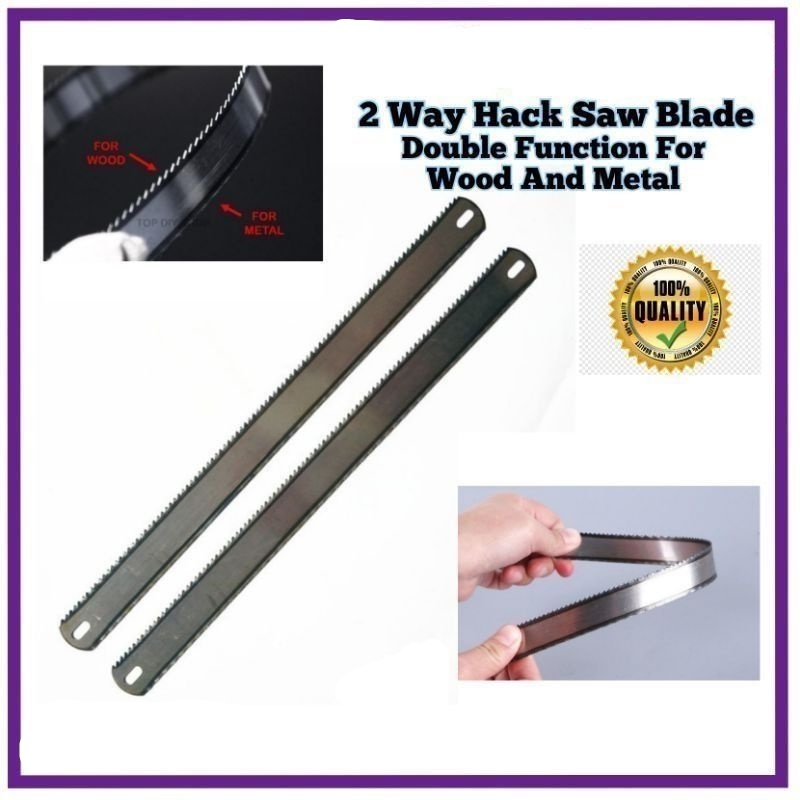
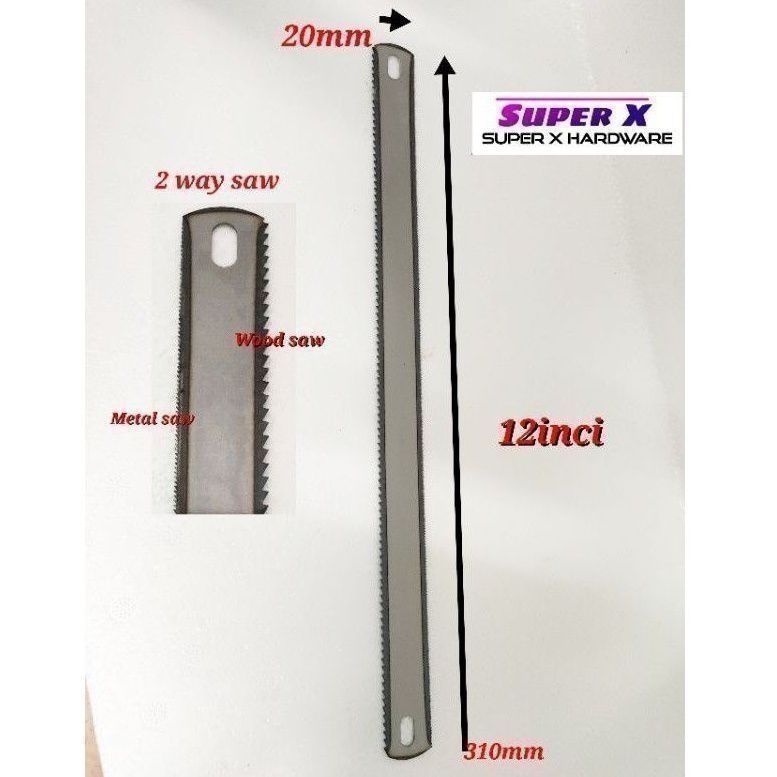
- Blade: The thin, toothed strip that does the cutting.
- Blade pins or mounting holes: The holes at each end of the blade.
- Tension mechanism: The screw, lever, or knob that keeps the blade tight.
The handle marks the rear of the saw. The opposite end is the front. For normal use, the blade teeth point toward the front.
Standard blade direction
[Handle] -------- [Blade] >>>>>>
                         Teeth point forward
The blade should also sit straight in the frame. It should not twist, bow, or hang loose.
How to Install a Hacksaw Blade
Install the blade with the saw unloaded, the frame stable, and the teeth facing forward. Wear safety glasses because old blades can snap during removal or installation.
1. Release the blade tension
Loosen the tension screw or release the lever on the hacksaw frame. Do not force a stuck adjustment screw with excessive pressure. A damaged frame can release suddenly.
2. Remove the old blade
Take the blade out of the mounting slots or pins. Hold it by the smooth back edge when possible. Avoid sliding your fingers along the teeth.
If the blade is broken, remove all pieces before installing the new one. Check the frame for bent arms, damaged pins, or a stripped tension screw.
3. Check the new blade
Look at both ends of the blade. Make sure the mounting holes are not cracked or enlarged.
Then inspect the teeth. The pointed edges should face away from the handle. Some blades have an arrow or printed direction mark. If the mark conflicts with your assumption, follow the blade or frame instructions.
4. Fit the rear end
place one mounting hole over the pin at the handle side of the frame. Keep the blade flat and centered.
Do not twist the blade to make it fit. If the hole does not line up, release more tension or check whether you have the right blade length.
5. Fit the front end
Place the other blade hole over the front pin. The blade should now run in a straight line between both ends of the frame.
6. Tighten the blade
Tighten the tension knob or lever until the blade is firm. A properly tensioned blade should not flop sideways when you touch it lightly.
Do not overtighten it. Too much tension can damage the frame, the mounting holes, or the blade.
7. Confirm the direction
Before cutting, check these points:
- The teeth point away from the handle.
- The blade sits straight.
- Both mounting holes rest fully on their pins.
- The blade is tight but not excessively tight.
- The frame does not press against the workpiece.
How to Tell if the Blade Is Installed Correctly
The blade is installed correctly when it cuts smoothly during a forward push and returns with little pressure.
Place the workpiece in a vise or clamp. Start with a few short strokes to make a shallow groove. Once the groove is clear, use longer strokes that use much of the blade length.
A correct setup usually gives you:
- Cutting action on the forward stroke.
- Little or no cutting on the return stroke.
- A stable blade with no sideways movement.
- A straight cut that does not wander at once.
- No clicking from loose mounting holes.
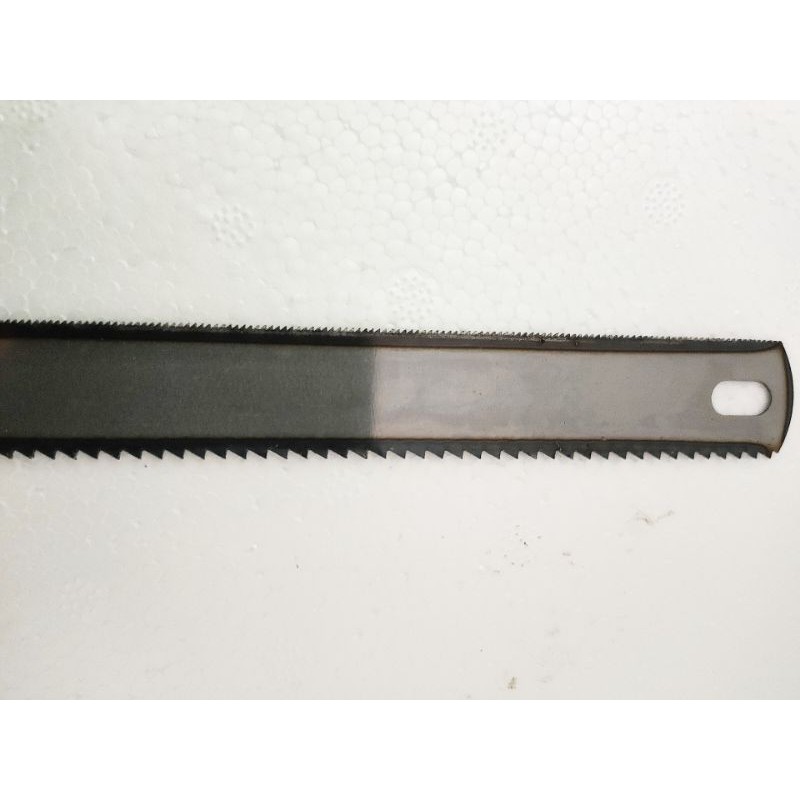
Do not judge blade direction only by how sharp the teeth look. Look at the angle of the teeth. The pointed cutting edges must face forward.
A simple hand test
With the blade removed from the work, run a fingertip only along the smooth back edge, never across the teeth. Then hold the blade so the tooth points face away from the handle side of the frame.
You can also make one very light test stroke on scrap material. If the saw cuts as you push and slides easily as you pull back, the direction is likely correct.

What Happens if the Blade Faces the Wrong Way?
A blade installed backward may still appear to work, but it will not cut as intended in a normal hacksaw frame.
Common signs include:
- The saw cuts mainly when you pull it toward yourself.
- The blade skates across the surface during the push stroke.
- You need unusual force to make progress.
- The cut feels rough or uneven.
- The teeth become damaged quickly.
- The blade vibrates or catches.
Stop and reinstall the blade if this happens. Do not compensate by pushing harder. Extra force can bend the blade, break a tooth, or cause the saw to slip.
A hacksaw blade can sometimes cut in either direction after the teeth become damaged or worn. That does not mean the blade is correctly installed. It means the cutting edge may be catching in an uncontrolled way.
Can You Install a Hacksaw Blade Backward?
Yes, some hacksaw frames can hold a blade with the teeth facing the handle. This setup makes the blade cut on the pull stroke.
A reverse setup may help in limited cases, such as:
- Cutting a fragile material that may lift during a push stroke.
- Using a frame designed for pull cutting.
- Following instructions for a specialty blade.
- Working in a position where a controlled pull stroke is safer.
However, do not reverse the blade simply because it feels easier. Check the instructions for your frame and blade first. A common metal-cutting hacksaw is normally designed for forward cutting.
The key rule is simple:
Use the direction intended by the frame and blade. For a standard hacksaw, teeth point away from the handle.

Blade Direction for Different Hacksaw Types
The basic rule applies to most full-size hacksaws, but the frame design can change how the tool is used.
| Tool or frame type | Usual tooth direction | Main point |
|---|---|---|
| Standard bow hacksaw | Away from the handle | Cuts on the push stroke |
| Adjustable metal hacksaw | Away from the handle | Follow the frame markings |
| Mini hacksaw | Usually away from the handle | Small frames may have a different grip |
| Pistol-grip hacksaw | Usually away from the handle | Confirm the frame design |
| Pull-cut or specialty frame | Toward the handle may be correct | Follow the manufacturer’s instructions |
The word “hacksaw” covers several frame styles. If the tool has a special trigger, enclosed blade, or unusual grip, do not rely on appearance alone.
Look for:
- An arrow stamped on the frame.
- A diagram near the blade holder.
- Instructions supplied with the tool.
- A blade direction mark.
- A cutting arrow printed on the blade package.

Choosing the Right Hacksaw Blade
Blade direction matters, but the blade’s tooth count also affects the cut.
Hacksaw blades are often described by teeth per inch, or TPI. A higher TPI gives smaller teeth. A lower TPI gives larger teeth.
As a general guide:
| Material or job | Typical blade choice |
|---|---|
| Thin sheet metal | Fine teeth, often 24 to 32 TPI |
| Small tubing | Fine to medium teeth |
| General steel stock | Medium teeth, often about 18 to 24 TPI |
| Thick metal or large pipe | Coarser teeth, often about 14 to 18 TPI |
| Plastic | A blade suited to plastic, with controlled tooth spacing |
The blade should have at least a few teeth in contact with the workpiece at all times. If the material is thin and the teeth are too coarse, the blade may catch and tear the edge.
If the material is thick and the teeth are too fine, the cut may be slow and the small teeth may clog or wear faster.
These ranges are general starting points. The exact choice depends on the material, thickness, blade design, and the manufacturer’s instructions.

Safe Hacksaw Use
Use a vise or clamp to hold the workpiece. Do not hold the material in one hand while cutting toward that hand.
Wear safety glasses. A hacksaw blade can break if it is bent, loose, over-tensioned, or forced into a jammed cut.
Keep both hands on the saw when practical:
- Hold the handle with your stronger hand.
- Place the other hand on the front of the frame.
- Keep your fingers away from the blade path.
- Push with steady, moderate pressure.
- Use long strokes when the work area allows.
- Slow down as the blade nears the end of the cut.
Do not use a blade with missing teeth, deep rust, cracks, or a bent edge. Replace it. The U.S. Occupational Safety and Health Administration advises workers to maintain hand tools in safe condition and use appropriate protection when tool use creates hazards. Its hand and power tools guidance is available at OSHA.gov.

Troubleshooting a Hacksaw That Will Not Cut
Check the direction first, then inspect the blade and work setup.
| Symptom | Likely cause | What to do |
|---|---|---|
| It cuts on the pull stroke | Blade is reversed | Turn the teeth away from the handle |
| It slides over the material | Teeth are dull, too fine, or facing the wrong way | Recheck direction and replace the blade if worn |
| The blade bends | Blade is loose or the cut is being forced | Increase tension slightly and reduce pressure |
| The teeth clog | Wrong blade for the material | Use a suitable tooth size and clear the cut |
| The blade breaks near an end | Excess tension, twisting, or damaged mounting hole | Replace the blade and inspect the frame |
| The cut wanders | Workpiece is loose or strokes are uneven | Clamp the work and begin with short strokes |
| The saw vibrates | Loose blade or damaged frame | Stop and inspect the blade mounts |
If a new blade still does not cut, verify that the teeth are not pointing backward. Then check whether the blade is fully seated on both pins.
If the frame is bent or the tension mechanism is damaged, replace the frame. A loose or damaged hacksaw can make a straight cut difficult and increase the chance of a broken blade.

Frequently Asked Questions
Should hacksaw teeth face forward or backward?
For a standard hacksaw, the teeth should face forward, away from the handle. This makes the saw cut on the push stroke.
Which side of a hacksaw blade is the sharp side?
The toothed edge is the cutting side. The individual teeth should point away from the handle in a normal hacksaw setup.
Can a hacksaw cut on the pull stroke?
Yes, if the blade is installed backward or the frame is designed for pull cutting. A standard hacksaw is normally used with the teeth facing forward, so it cuts during the push stroke.
How tight should a hacksaw blade be?
The blade should be firm and straight, with no loose sideways movement. Do not tighten it so much that the frame, mounting pins, or blade holes are under excessive stress.
Why does my hacksaw blade keep breaking?
Common causes include too much tension, twisting the frame, forcing the blade, using the wrong blade length, or cutting with a damaged blade. Inspect the frame and workpiece before fitting another blade.

Key Takeaways
- Install a standard hacksaw blade with the teeth pointing away from the handle.
- The blade should cut when you push the saw forward.
- Keep the blade straight, firm, and properly seated on both mounting pins.
- Use light pressure on the return stroke.
- Replace blades that are cracked, bent, badly rusted, or missing teeth.
- Reverse the blade only when the frame or blade instructions support pull cutting.
Conclusion
If you are unsure which way a hacksaw blade goes, use the handle as your reference point. On a normal hacksaw, the teeth point away from the handle and toward the front of the frame.
Install the blade evenly, apply moderate tension, secure the material, and let the teeth do the work. If the saw cuts on the wrong stroke or slips across the material, stop and check the blade direction before continuing.