
The best way to measure a hacksaw blade is to measure the distance from the center of one mounting hole to the center of the other. Do this with the blade removed from the hacksaw frame. This measurement tells you the blade length that should fit your saw.
Most U.S. hacksaws use blades listed by nominal length, such as 10 inches, 12 inches, or 14 inches. You should also check the blade width, thickness, tooth count, and hole shape before buying a replacement.
Introduction
A hacksaw blade can look simple, but the wrong size may not fit the frame or may not stay tight during a cut. Measuring only the blade’s total metal length can lead to an incorrect result because the ends may extend beyond the mounting holes.
This guide explains how to measure a hacksaw blade in inches, how to choose the right tooth count, and how to check whether a replacement will fit a standard U.S. hacksaw. It also covers worn blades, missing blades, junior hacksaws, and common measuring mistakes.
What Part of a Hacksaw Blade Should You Measure?
Measure the mounting-hole distance, not the full outside length of the blade. Place the end of a tape measure or ruler at the center of one mounting hole and measure to the center of the opposite hole.
Manufacturers often call this the blade’s nominal length or cutting length. A blade sold as a 12-inch hacksaw blade may not measure exactly 12 inches from its outside edge to the other outside edge.
The main blade measurements are:
| Measurement | What it means | Why it matters |
|---|---|---|
| Nominal length | Center-to-center distance between mounting holes | Must match the hacksaw frame |
| Overall length | Full end-to-end metal length | Useful for comparison, but less important for fit |
| Width | Distance from the toothed edge to the back edge | Affects stiffness and frame clearance |
| Thickness | Thickness of the blade steel | Affects strength and fit |
| TPI | Teeth per inch | Controls cutting speed and finish |
| Hole size and shape | Mounting opening at each end | Must fit the frame pins |
For most standard hand hacksaws, nominal length is the first measurement to check. The remaining measurements help you choose a blade for the material and cutting job.
How to Measure a Hacksaw Blade Step by Step
You need only a ruler or tape measure. A caliper can help with width, thickness, and hole size, but it is not required for basic replacement.
1. Remove the blade safely
Release the tension on the hacksaw frame before removing the blade. Many hacksaws use a tension knob or lever near the handle. Turn or release it until the blade is loose.
Wear work gloves if the blade has sharp or broken teeth. Keep your fingers away from the teeth while handling it.
2. Clean the blade if needed
Wipe away dirt, metal dust, or rust near the mounting holes. A dirty hole can make the blade appear shorter or make the hole center hard to locate.
Do not force a heavily rusted blade against a ruler. If it may break, wrap it in cardboard or thick cloth before handling it.
3. Find the center of each mounting hole
Look at the holes at both ends of the blade. The center is halfway across each hole.
For a round hole, measure from one inside edge to the other, divide that distance by two, and mark the midpoint. For a slot or oval hole, use the center of the opening along the blade’s length.
4. Measure from center to center
Place the ruler along the length of the blade. Measure from the center of the first hole to the center of the second hole.
For better accuracy:
- Keep the ruler parallel with the blade.
- Do not measure at an angle.
- Check the measurement twice.
- Record the result in inches if buying a U.S. replacement blade.
If the result is close to 12 inches, the blade is usually sold as a 12-inch hacksaw blade. A measurement close to 10 inches usually indicates a 10-inch blade.
5. Measure the blade width and thickness if necessary
Measure the blade from the toothed edge to the smooth back edge. Then measure its thickness with a caliper or a precise ruler.
You usually do not need these measurements for a standard full-size hacksaw. They become more useful when:
- The frame has limited clearance.
- You use a compact or junior hacksaw.
- The original blade has an unusual profile.
- You are matching a specialty blade.
- The blade sits loosely on the mounting pins.
6. Count the teeth per inch
TPI means teeth per inch. To measure it, place the ruler along the toothed edge and count the teeth across one inch.
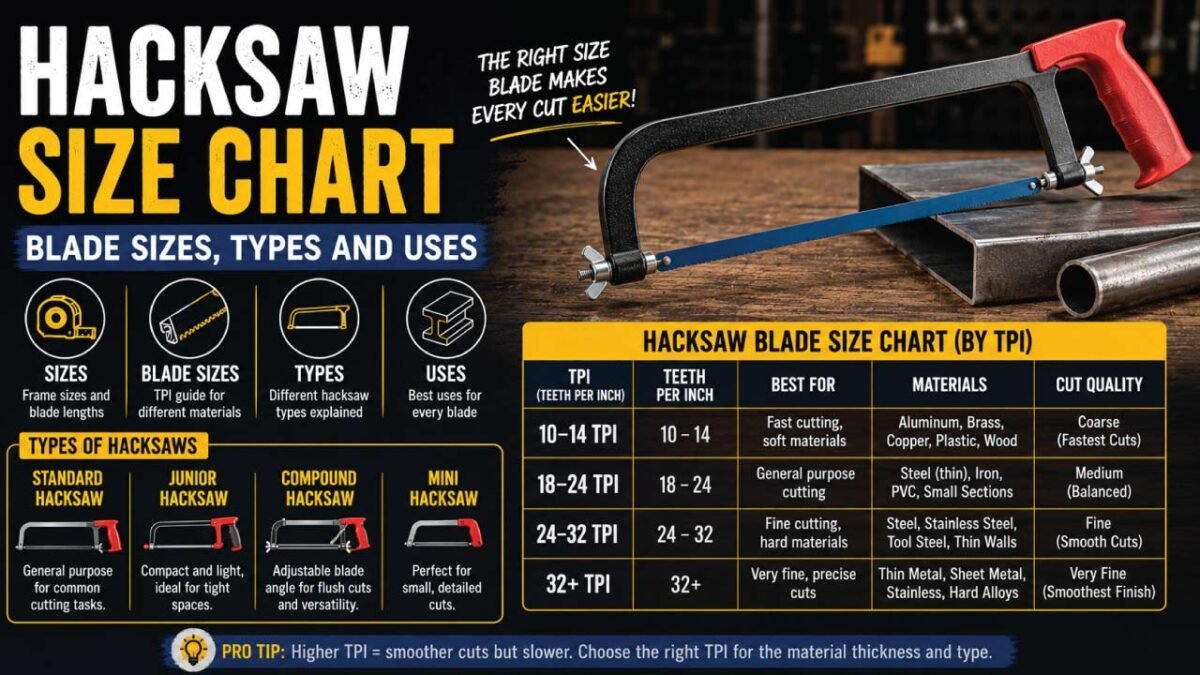
Common hacksaw blade choices include:
- 14 TPI: Fast cuts in thick metal and softer materials.
- 18 TPI: General-purpose cutting.
- 24 TPI: Thin-wall tubing, sheet metal, and smaller stock.
- 32 TPI: Thin metal and fine cuts.
Some blades use a variable tooth pattern. In that case, the spacing changes along the blade, so the package may list a range instead of one fixed TPI number.
How to Measure a Hacksaw Frame Without a Blade
If the old blade is missing, measure the distance between the two blade mounting pins on the frame. Measure from the center of one pin to the center of the other pin.
Do not measure the outside length of the frame. The frame extends beyond the blade, so its total length will be too large.
To measure the frame:
- Release the blade tension.
- Locate the two pins, posts, or hooks that hold the blade.
- Measure from the center of one mounting point to the center of the other.
- Compare the result with common nominal blade sizes.
- Confirm the size in the saw’s manual or on the frame markings.
A frame designed for a 12-inch blade may have a small adjustment range. That range helps tension the blade, but it does not always mean the frame accepts every nearby blade length.
If the measurement falls between common sizes, check the frame adjustment. Do not assume that a 10-inch blade will fit a frame designed for a 12-inch blade unless the manufacturer lists it as compatible.
How to Choose the Correct Hacksaw Blade Size
Choose the replacement by matching the blade’s nominal length to the frame’s mounting-hole distance. Then choose the tooth count based on the material’s thickness.
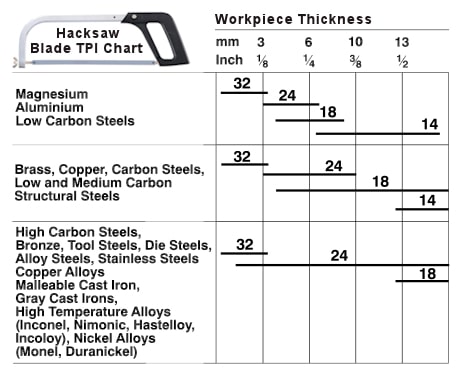
A useful rule is to keep at least three teeth in contact with the workpiece during the cut. If too few teeth engage the material, the blade may catch, chatter, or lose teeth. If the material is thin, use a finer tooth count.
| Material or job | Common blade choice |
|---|---|
| Thick steel bar | 14 or 18 TPI |
| Steel angle iron | 18 TPI |
| General steel work | 18 or 24 TPI |
| Thin-wall steel tubing | 24 or 32 TPI |
| Sheet metal | 24 or 32 TPI |
| Plastic pipe | 18 to 24 TPI |
| Aluminum | 14 to 24 TPI, depending on thickness |
These are starting points, not universal rules. The material thickness, blade design, cutting speed, and user technique all affect the result.
For example, a 12-inch blade with 18 TPI may suit a general steel repair. A 12-inch blade with 32 TPI may work better on thin sheet metal because more teeth remain engaged.

Hacksaw Blade Measurement Examples
Example 1: A standard full-size hacksaw
You measure from the center of one blade hole to the center of the other and get 11.9 inches. The blade is normally sold as a 12-inch hacksaw blade.
The small difference is expected. Nominal sizes are rounded for product labeling.
Example 2: A compact hacksaw
The hole-center distance measures about 10 inches. Look for a 10-inch hacksaw blade, but verify that the blade width and mounting holes match the compact frame.
Example 3: A junior hacksaw
A junior hacksaw often uses a shorter blade than a full-size frame. Measure between the blade’s mounting holes rather than relying on the handle-to-frame length.
Junior hacksaw blades can use different mounting styles from full-size hacksaw blades. Check the hole shape and pin arrangement before ordering.
Example 4: A thin sheet-metal cut
Suppose the blade measures 12 inches between mounting-hole centers, and the workpiece is thin steel sheet. The length is correct, but a 14 TPI blade may be too coarse. A 24 or 32 TPI blade is often a better starting point because it keeps more teeth in the material.
How to Tell If a Hacksaw Blade Fits
A blade fits correctly when it meets all of these conditions:
- The mounting holes sit fully on the frame pins.
- The blade is straight and centered in the frame.
- The tension system can tighten the blade.
- The blade does not touch the frame during use.
- The blade remains tight without excessive force.
- The teeth point in the correct direction.
- The blade does not twist or bow under light hand pressure.
Most standard hacksaw blades are installed with the teeth pointing away from the handle so the blade cuts on the forward push stroke. Always follow the marking on the blade or the saw manufacturer’s instructions, because specialty frames may differ.
After installation, tighten the blade until it is firm and straight. Do not over-tighten it. Excessive tension can damage the frame, mounting pins, or blade.
Common Hacksaw Blade Measuring Mistakes
Measuring the outside length
The full metal length includes the ends beyond the mounting holes. This measurement can be longer than the size printed on the package.
Better method: Measure from hole center to hole center.
Measuring the frame’s overall length
The frame is longer than the blade. Its handle and support bar add extra length.
Better method: Measure between the blade mounting pins.
Ignoring the hole shape
Two blades can have a similar length but different mounting holes. A round hole, slot, or unusual opening may not fit the same pins.
Better method: Compare both the length and the hole design.
Choosing TPI by blade length alone
A longer blade is not automatically better for thin metal. Tooth count must match the workpiece thickness.
Better method: Keep several teeth engaged in the material during each cut.
Using a damaged blade as an exact template
A bent or broken blade may have stretched, twisted, or lost part of an end.
Better method: Measure the frame pins or check the saw model when the old blade is badly damaged.
Measuring while the blade is under tension
A tensioned blade can move or slip while you measure it. The teeth can also cause injury.
Better method: Release the tension and remove the blade first.

What to Do If the Blade Size Does Not Match
If the replacement blade seems too long or too short, stop before cutting. Check the following items in order:
- Recheck the hole-center measurement. Make sure both points are at the centers of the mounting holes.
- Check the saw frame adjustment. Some frames accept a small range of blade lengths.
- Confirm the blade type. A junior hacksaw blade is not automatically interchangeable with a full-size hacksaw blade.
- Compare the mounting holes. The pins must pass through the holes without forcing them.
- Check the blade package. Confirm whether the listed length is nominal or overall.
- Read the manufacturer’s instructions. Use the saw model number if the frame has one.
Do not bend the blade to make it fit. Do not enlarge the holes with a drill or grinder unless the manufacturer specifically permits that modification. A modified blade may break or detach during a cut.
If no standard blade fits, replace the blade with the exact type listed for the frame or replace the frame itself.
Safety Tips When Measuring and Installing a Blade
A hacksaw blade has small, sharp teeth and can snap if damaged or over-tensioned. Use basic hand-tool precautions:
- Wear safety glasses while cutting.
- Release blade tension before removal.
- Handle the blade by its smooth back edge when possible.
- Do not use a blade with major rust, cracks, missing teeth, or a bent body.
- Clamp the workpiece securely.
- Keep both hands clear of the cutting path.
- Use steady pressure rather than forcing the blade.
- Replace the blade when it becomes dull or starts to bind.
- Keep the saw frame and blade aligned during the cut.
The Occupational Safety and Health Administration advises users to inspect hand and power tools and remove damaged tools from service. That general rule applies to a damaged hacksaw blade as well.

Quick Takeaways
- Measure a hacksaw blade from mounting-hole center to mounting-hole center.
- Use the frame’s mounting-pin distance if the blade is missing.
- Common nominal sizes include 10, 12, and 14 inches.
- Check the mounting-hole shape before buying a replacement.
- Match TPI to the material thickness.
- Use finer teeth for thin metal and coarser teeth for thicker stock.
- Release the blade tension before measuring or replacing the blade.
- Do not force a blade that does not fit the frame.
Frequently Asked Questions
Is a 12-inch hacksaw blade exactly 12 inches long?
Not always. The 12-inch label usually refers to the nominal distance between the centers of the mounting holes. The total end-to-end length may be slightly different.
Can I measure a hacksaw blade with a tape measure?
Yes. A tape measure works for the nominal length. Use a ruler or caliper when checking small holes, blade thickness, or narrow junior hacksaw blades.
How do I know which way to install a hacksaw blade?
On most standard U.S. hacksaws, the teeth point away from the handle and cut on the forward stroke. Check the blade markings and the saw manual before installation.
What does TPI mean on a hacksaw blade?
TPI means teeth per inch. A higher TPI gives a finer cut and suits thinner material. A lower TPI cuts faster through thicker material.
Can I use a 10-inch blade in a 12-inch hacksaw?
Only if the frame’s adjustment range and manufacturer instructions allow it. The blade must sit securely on both mounting pins and reach the correct tension without bending.
Conclusion
To measure a hacksaw blade, remove it from the frame and measure from the center of one mounting hole to the center of the other. Use that nominal length to choose a replacement, then confirm the hole shape, blade profile, and TPI.
For most repairs, measuring takes less than a minute. The key is to match the blade to the frame first and the cutting job second. When in doubt, compare the measurement with the saw manual or the blade manufacturer’s size information before installing it.