How To Use A Hex Wrench: Easy Step-By-Step Guide
In the United States, a hex wrench is a common tool for assembling furniture, adjusting bicycles, tightening patio equipment, and repairing many household items. You may know it as an Allen wrench or Allen key. The tool looks simple, but using the right size and turning it the right way can prevent stripped bolts and damaged parts.
A hex wrench fits into a six-sided recess in a bolt or screw head. Insert the correct size fully, keep the tool straight, and turn it with steady pressure. For final tightening, follow the product maker’s torque instructions instead of relying only on hand strength.

What Is a Hex Wrench?
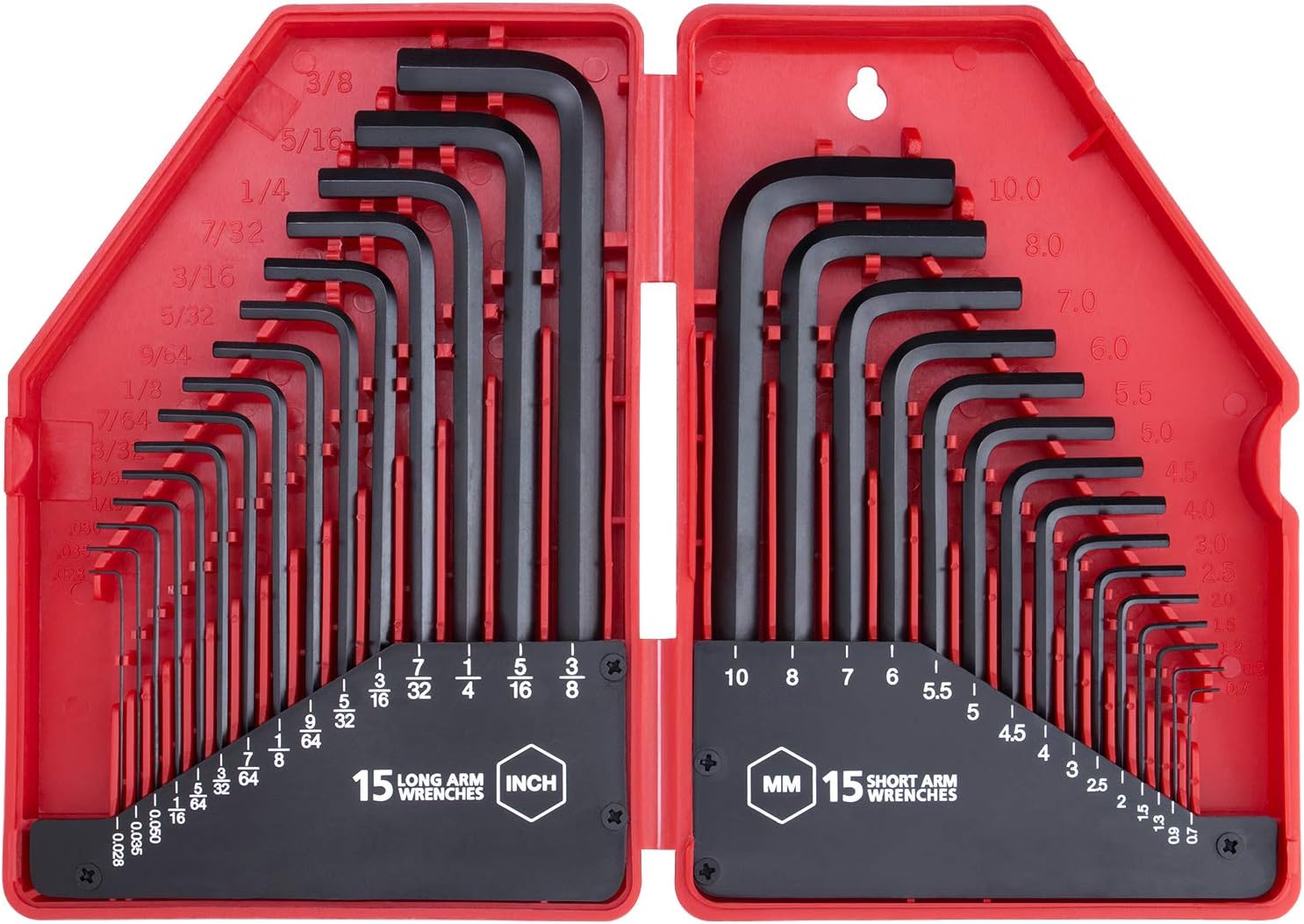
A hex wrench is a metal tool with a six-sided tip. Most are shaped like an “L,” with one short arm and one long arm. Some sets use a folding handle, T-handle, screwdriver handle, or a hex bit for a drill or torque wrench.
The tool fits into a hex socket, also called an internal hex or hex recess. The matching fastener is often called a hex-socket screw. “Allen wrench” and “hex key” are common alternate names for the same basic tool.
Hex wrenches are used on:
- Flat-pack furniture
- Bicycles and exercise equipment
- Lawn and garden tools
- Cabinet and door hardware
- Automotive parts
- Machinery and shop equipment
- Electronics and small devices
SAE and metric hex wrench sizes
Hex wrenches come in two main measurement systems:
- Metric, measured in millimeters, such as 3 mm, 4 mm, or 5 mm
- SAE, measured in fractions of an inch, such as 1/8 inch, 3/16 inch, or 1/4 inch
Many products sold in the United States use metric fasteners, but American-made equipment and older products may use SAE sizes. A near match is not good enough. A wrench that is slightly too small can round the corners inside the fastener.
Standard and ball-end hex wrenches
A standard hex wrench has a flat end. It gives the best contact with the fastener when the wrench is straight and fully inserted.
A ball-end hex wrench has a rounded tip. It can turn a fastener when the wrench is held at an angle, which helps in tight spaces. However, the ball end has less contact with the socket. Use the straight end for breaking loose a tight fastener or applying high torque.

How to Use a Hex Wrench Correctly
Follow these steps for most household, furniture, bicycle, and light mechanical tasks.
1. Choose the correct hex wrench
Look at the fastener and select a wrench that fits without play. Try the likely size by hand rather than forcing it.
The correct wrench should:
- Slide into the socket fully
- Sit firmly with little or no side-to-side movement
- Reach the bottom of the socket
- Turn the fastener without slipping
If the fastener is metric, use a metric wrench. If it is SAE, use an SAE wrench. Do not assume that a close-looking size will work.
2. Clean the fastener
Remove dirt, paint, rust, or metal chips from the hex socket. A small brush, cloth, or pick can help clear debris.
A dirty socket may prevent the wrench from reaching the bottom. This reduces contact and increases the chance of rounding the fastener.
Do not push a sharp tool deeply into a fastener if doing so may damage wires, seals, or nearby parts. Clean only as much as needed to make the socket clear.
3. Insert the wrench fully
Push the short or long end straight into the socket. Press until the tool stops at the bottom.
Hold the wrench in line with the fastener. The wrench should not lean unless you are using a ball end in a space designed for angled access.
A partially inserted wrench can damage both the tool and the fastener. This is one of the most common causes of a stripped hex socket.
4. Turn counterclockwise to loosen
For a normal right-hand thread, turn the wrench counterclockwise to loosen the fastener. Turn it clockwise to tighten.
This is often remembered as “lefty loosey, righty tighty,” but do not rely on that phrase for every application. Some specialized equipment may use reverse threads. Check the instructions when the fastener does not behave as expected.
Apply slow, even pressure. Avoid sudden jerks, especially when the fastener is small or the surrounding part is plastic.
5. Use the long or short arm for the right task
The two arms of an L-shaped hex wrench give you a choice between reach and leverage.
- Use the long arm in the fastener when you need reach and quick turning.
- Use the short arm in the fastener when you need more leverage from the longer handle.
More leverage also creates more torque. That can help loosen a tight fastener, but it can also break a small screw or damage a soft part.
6. Tighten until snug, then follow the specifications
For simple furniture, tighten the fastener until the joint is secure and the parts are properly aligned. Do not keep turning after the joint is firm.
For bicycles, vehicles, machinery, playground equipment, and other safety-related items, use the maker’s torque specification. Torque is the twisting force applied to the fastener. A torque wrench or torque driver is needed when the required value matters.
Do not use a long pipe over a hex wrench to gain extra force unless the manufacturer specifically allows that method. It can exceed the fastener’s design limit.
7. Check the finished joint
After tightening, inspect the assembly.
A successful result usually means:
- The fastener head sits as designed
- The hex socket is not rounded
- The joined parts are aligned
- The part does not move when it should be fixed
- No crack, dent, or distortion appears around the fastener
If the joint still moves, stop and check for the wrong fastener, missing washer, damaged threads, or an assembly error.

How to Choose the Right Hex Wrench Size
The best hex wrench is the one that fills the socket with no visible gap. Size charts can help, but physical fit is the final check because wear, dirt, and damaged fasteners affect the fit.
| Fastener or tool system | Common examples | Correct approach |
|---|---|---|
| Metric | 2 mm, 3 mm, 4 mm, 5 mm, 6 mm | Use a metric hex key of the stated size |
| SAE | 1/16 in., 3/32 in., 1/8 in., 3/16 in. | Use the matching fractional-inch key |
| Ball end | Angled access | Use mainly for light turning and final access |
| Hex bit | Drill, driver, or torque tool | Confirm the bit size and tool limit |
| Torx | Star-shaped recess | Use a Torx bit, not a hex wrench |
A Torx fastener has a six-point star shape, not six flat sides. A hex wrench will not fit it correctly. Using the wrong tool can destroy the recess.
How to tell metric from SAE
The appearance of metric and SAE hex wrenches is nearly identical. You can identify the system by:
- Checking the product manual.
- Looking for size marks on the fastener or tool.
- Comparing the fit with a complete metric and SAE set.
- Testing the wrench that fits fully with no rocking.
Do not force a wrench that nearly fits. For example, a 3/16-inch wrench and a 5 mm wrench are close in size, but they are not interchangeable in every fastener.
Why a full set helps
A complete set reduces guesswork. It also makes it easier to find a size that fits without forcing the tool.
Choose a set with clear size markings. For frequent work, separate metric and SAE holders can help prevent mixing the two systems.

How Much Force Should You Use?
Use the least force that completes the job. A hex wrench is meant to turn the fastener, not serve as a hammer, pry bar, or punch.
For a basic assembly:
- Start the fastener by hand.
- Tighten until the parts meet.
- Add only enough force to remove looseness.
- Stop if the material begins to bend, crack, or crush.
For a specified torque, use the value in the product manual or service manual. Torque values may depend on the fastener size, thread condition, lubrication, material, and installation method.
A dry bolt and a lubricated bolt can produce different clamping force at the same measured torque. Follow the instructions for that exact product. Do not apply a generic torque number from an unrelated chart.
When to use a torque wrench
A torque wrench is useful when over-tightening could cause injury, failure, or expensive damage. Examples include:
- Bicycle stem and handlebar fasteners
- Brake components
- Automotive suspension parts
- Engine components
- Pressure equipment
- Structural or load-bearing connections
- Parts made from carbon fiber or soft aluminum
A standard hex wrench cannot show how much torque you apply. It is fine for many low-risk tasks, but it is not a substitute for a torque tool when the manufacturer gives a precise specification.

How to Loosen a Stuck Hex Fastener
If a hex fastener will not move, stop before the socket starts to round. A damaged recess makes removal much harder.
Try this sequence:
- Confirm the size. Test both metric and SAE options if the system is unknown.
- Clean the socket. Remove dirt, rust, paint, and debris.
- Use the straight end. Avoid a ball end for the first force.
- Seat the wrench fully. Tap the wrench lightly with a tool handle only when the surrounding part can safely withstand it.
- Apply steady pressure. Push the wrench in toward the fastener while turning.
- Use an appropriate penetrating oil. Only use it when compatible with nearby plastics, seals, finishes, and electrical parts.
- Allow time to work. Follow the product label for the waiting period.
- Try a small tightening movement first. A slight movement in the tightening direction can sometimes break corrosion loose.
- Stop if the socket rounds. Move to a proper extraction method or seek professional help.
Never heat a fastener when flammable liquids, batteries, fuel, pressurized parts, or heat-sensitive materials are nearby. Heat can also damage paint, seals, wiring, and plastic components.
What if the hex socket is stripped?
A stripped socket has rounded internal corners. The wrench may spin without turning the fastener.
Possible next steps include:
- Try the next larger SAE or metric size only if it can be seated firmly.
- Use a hex-socket extractor designed for damaged fasteners.
- Use locking pliers if the fastener head is exposed.
- Cut a slot for a flat screwdriver only when the surrounding material allows it.
- Ask a qualified repair shop for help if the fastener holds a safety-critical part.
Do not keep turning a slipping wrench. Each slip removes more metal and reduces the chance of easy removal.

Common Hex Wrench Mistakes to Avoid
Using the wrong size
A loose fit concentrates force on a few corners. This can round the socket.
Using a ball end for high force
Ball ends are useful for access, not maximum torque. Switch to the straight end before loosening a tight fastener.
Tightening too much
Over-tightening can strip threads, crack plastic, crush soft metal, or make future removal difficult.
Starting with a power drill
A drill can turn a hex bit quickly, but it can also cross-thread or over-tighten a fastener before you notice. Start threads by hand, use a low setting, and finish with the specified torque tool when required.
Turning a cross-threaded fastener
If a screw becomes hard to turn after only a few threads, remove it and inspect the threads. Do not force it. Cross-threading can damage the receiving hole.
Mixing fasteners
Furniture and equipment kits may include screws that look similar but have different lengths or thread types. Use each fastener in its labeled location. A screw that is too long can damage hidden parts.
Ignoring tool wear
Replace a hex wrench if its tip is rounded, twisted, cracked, or badly corroded. A worn tool is more likely to slip.
Working without eye protection
Wear safety glasses when a fastener may break, metal may chip, or a cutting or extraction method is needed. Keep fingers clear of the wrench’s swing path.
Hex Wrench Troubleshooting Table
| Problem | Likely cause | First action |
|---|---|---|
| Wrench will not enter | Wrong size or debris | Check the size and clean the socket |
| Wrench rocks in the socket | Loose fit or worn recess | Try the correct size; stop if it still moves |
| Fastener turns but does not tighten | Stripped threads or spinning insert | Remove the fastener and inspect the joint |
| Fastener will not move | Corrosion, thread damage, or over-tightening | Use the straight end and steady pressure |
| Socket rounds during removal | Wrong tool, poor seating, or excessive force | Stop and use an extractor or repair service |
| Joint remains loose | Missing part or wrong fastener | Check the assembly instructions |
| Screw tightens at an angle | Cross-threading | Back it out and start again by hand |

Frequently Asked Questions
Is a hex wrench the same as an Allen wrench?
Yes. “Hex wrench,” “hex key,” and “Allen wrench” usually describe the same type of six-sided tool. “Allen” is a widely used trade name, while “hex key” is a more general term.
Which way do you turn a hex wrench?
For most standard fasteners, turn counterclockwise to loosen and clockwise to tighten. Reverse-threaded parts are an exception, so check the instructions if normal turning does not work.
Can I use pliers on a hex wrench?
You can use pliers to hold the outside of an exposed wrench, but this may damage the tool or cause a slip. A longer hex key, T-handle, or correctly sized hex bit is usually safer.
Can a hex wrench remove a Torx screw?
No. Torx screws have a star-shaped recess. Use the correct Torx key or bit. A hex wrench may damage the Torx recess.
Why does my hex wrench keep slipping?
The wrench may be the wrong size, only partly inserted, worn, or used at an angle. The fastener socket may also be rounded. Stop turning, clean the recess, and test the fit before applying more force.
Do I need a torque wrench?
Not for every small household task. Use one when the manufacturer gives a torque value or when incorrect tightness could affect safety, performance, or expensive parts.
Key Takeaways
- Use the exact metric or SAE size that fits the socket fully.
- Clean the recess and keep the wrench straight.
- Turn counterclockwise to loosen and clockwise to tighten most fasteners.
- Use the straight end for high force and the ball end mainly for angled access.
- Stop if the wrench slips or the socket begins to round.
- Follow the manufacturer’s torque specification for bicycles, vehicles, machinery, and safety-related equipment.
- Replace worn tools and seek professional help for damaged or critical fasteners.
Conclusion
Using a hex wrench is simple when the tool and fastener match. Select the correct size, clear the socket, seat the wrench fully, and apply steady force. For routine household work, stop when the joint is secure. For technical or safety-critical work, use the product instructions and a torque tool when specified.
Recent Tool Guides
 Hammer
How To Hammer Flowers Onto Paper: Easy Guide
Learn how to hammer flowers onto paper with simple steps, helpful tips, and beautiful results for...
Read Guide → Hacksaw
How To Cut Curtain Pole With Hacksaw: Easy Guide
Learn how to cut curtain pole with hacksaw safely and neatly. Follow simple steps for accurate...
Read Guide → Wrench
How To Use A Husky Torque Wrench: Easy Guide
Learn how to use a Husky torque wrench correctly with simple steps, torque settings, and safety...
Read Guide → Hammer
How To Hold A Hammer: Safe Grip Guide
Learn how to hold a hammer with the right grip, stance, and technique for safer, more...
Read Guide → Hacksaw
How To Cut Flexible Metal Conduit With Hacksaw: Easy Guide
Learn how to cut flexible metal conduit with hacksaw safely and cleanly. Follow simple steps for...
Read Guide → Wrench
How To Use An Inch Pound Torque Wrench: Easy Guide
Learn how to use an inch pound torque wrench correctly with simple steps, accurate settings, and...
Read Guide →