Can A Rotary Hammer Drill Wood: Safe Uses And Tips
Introduction
Yes, a rotary hammer can drill wood—but only when you use it in rotation-only mode and fit it with the right wood-drilling accessory. In a U.S. workshop or job site, a rotary hammer may help with an occasional hole through lumber, but it is usually not the best tool for routine woodwork.
A rotary hammer is built to break concrete, brick, and masonry. Its motor, gearbox, and hammer mechanism deliver more force than most wood drills need. That extra power can make a wood bit grab, overheat, or damage the workpiece if you use the wrong mode or accessory.
For clean, controlled holes in wood, a standard drill, drill/driver, or right-angle drill is normally the better choice.
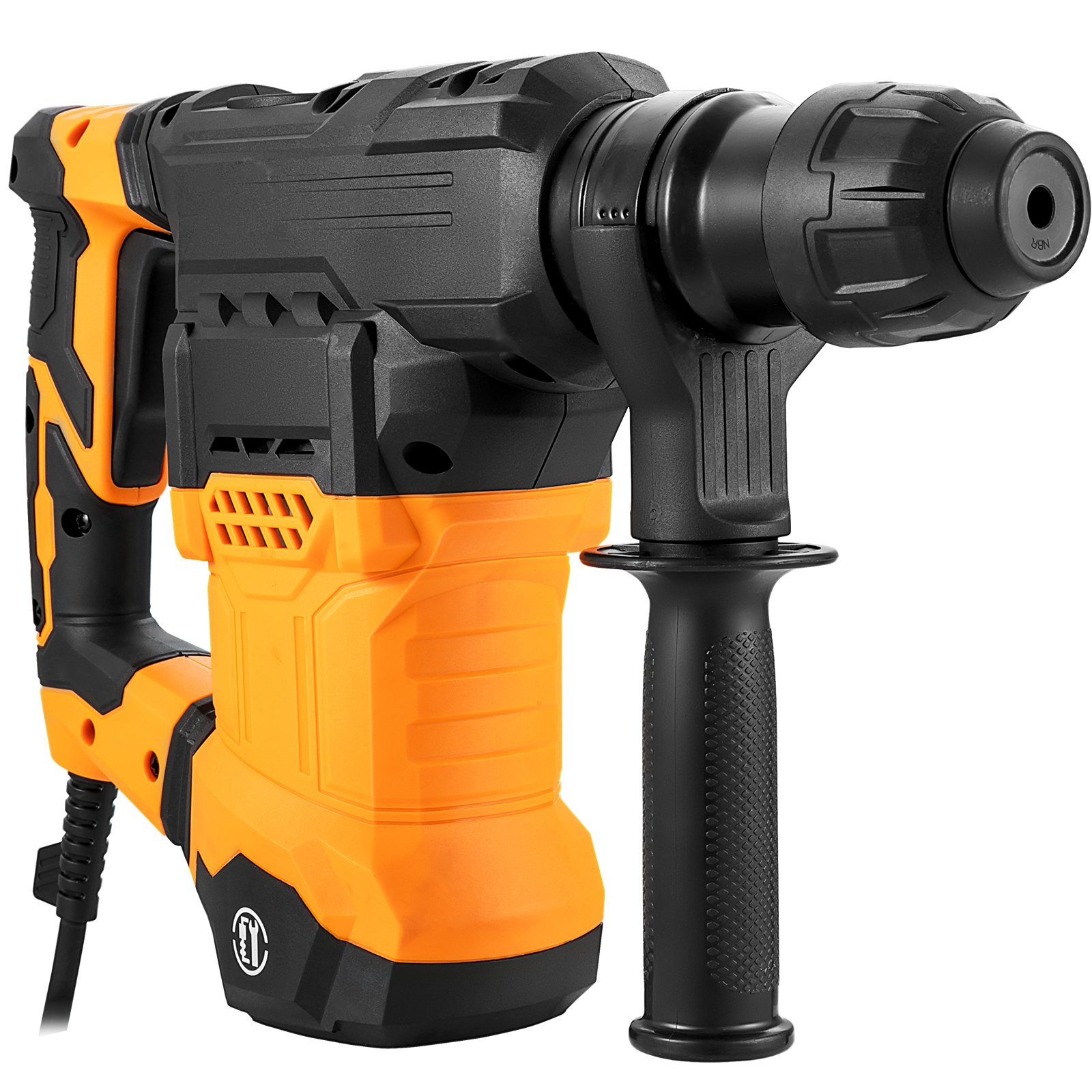
Why a Rotary Hammer Can Drill Wood
A rotary hammer can drill wood because it has a rotating motor, just like a standard drill. The key difference is that it also has a separate hammer mechanism for masonry work.
Most rotary hammers offer at least these modes:
- Rotary hammer: The bit spins and strikes forward.
- Rotation only: The bit spins without hammering.
- Chiseling only: The tool strikes without rotating, if the model supports this mode.
Use rotation-only mode for wood. Do not use hammer mode with a wood bit. The repeated impacts can damage the bit, tear the wood, and create a loss of control.
A rotary hammer may have more than enough torque for wood. That is useful for some large holes, but it also increases the risk of:
- Bit binding
- Sudden tool twisting
- Split lumber
- Burn marks
- Damaged drill chucks or adapters
- Loss of control near the end of the hole
The tool’s ability is not the same as its suitability. A pickup truck can carry a small box, but that does not make it the best vehicle for every small delivery.
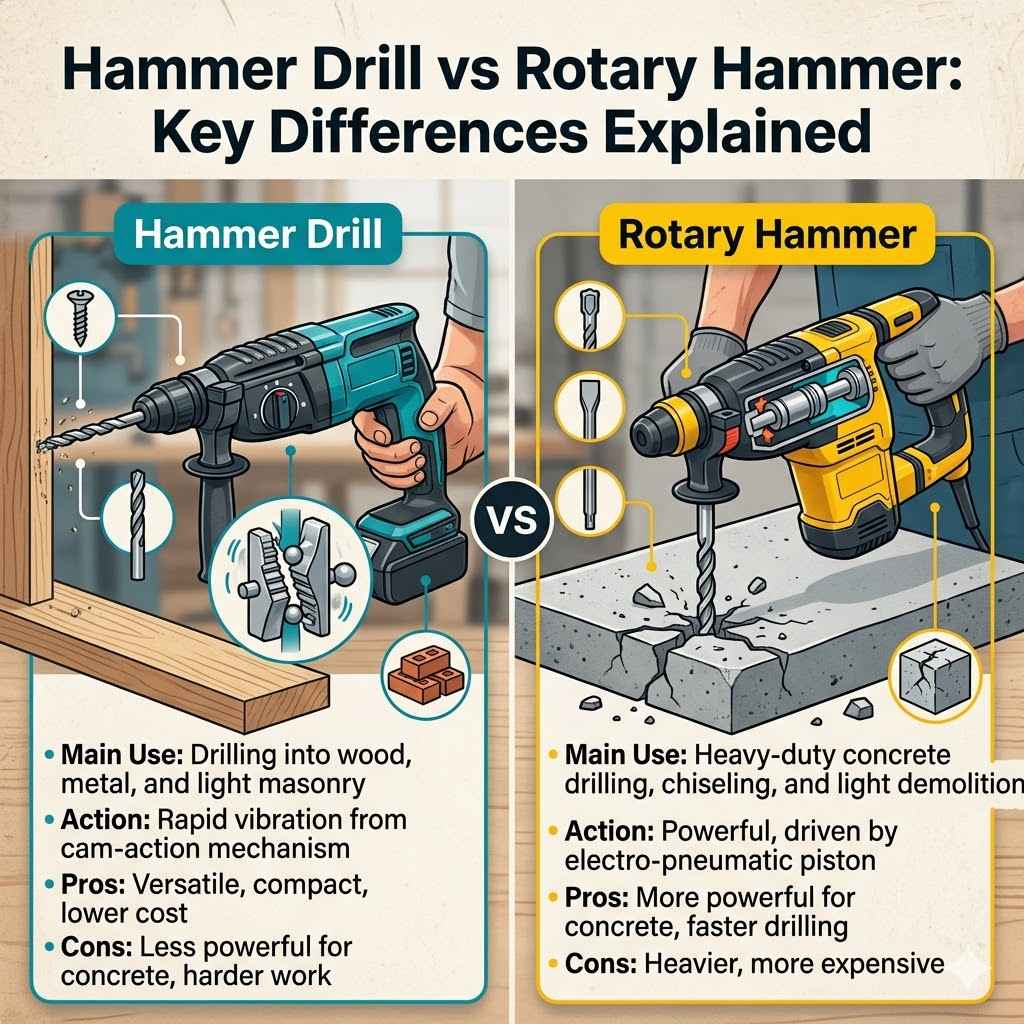
Rotary hammer versus hammer drill
These tools are often confused.
| Tool | Main purpose | Wood-drilling ability | Typical chuck |
|---|---|---|---|
| Standard drill or drill/driver | Wood, metal, plastic, fasteners | Excellent | Keyless or keyed chuck |
| Hammer drill | Drilling masonry with light impact | Good when hammer mode is off | Standard chuck |
| Rotary hammer | Concrete, brick, and heavy masonry | Possible in rotation-only mode | SDS-Plus or SDS-Max |
| Impact driver | Driving screws and bolts | Poor for normal drilling | Hex quick-change holder |
A hammer drill usually uses a standard chuck, so it can accept common twist bits, brad-point bits, spade bits, and hole saws. A rotary hammer often uses an SDS chuck, so standard wood bits may not fit directly.
What You Need Before Drilling Wood
You need three things: the correct operating mode, a compatible bit, and a secure workpiece.
1. A rotary-only setting
Check the mode selector on the tool. Look for a symbol that shows a drill bit without a hammer or impact symbol.
If your rotary hammer has no rotation-only setting, do not use it for drilling wood. Hammering and wood drilling are a poor combination.
Read the manual for your exact model. Some tools use a mechanical mode selector. Others use an electronic control, a clutch setting, or a separate switch.
2. A compatible chuck or adapter
Many rotary hammers use an SDS-Plus chuck. Larger models may use SDS-Max. These systems hold special masonry bits and chisels.
A normal round-shank wood bit will not fit directly into most SDS rotary hammers. You may need one of these options:
- An SDS-to-keyed-chuck adapter
- An SDS-to-keyless-chuck adapter
- An SDS-compatible wood bit, if the manufacturer makes one
- An approved chuck attachment made for that specific tool
Use only an adapter rated for your rotary hammer. A low-quality adapter can wobble, come loose, or fail under torque.
An SDS adapter can also add play to the bit. That may be acceptable for a rough clearance hole, but it is not ideal for precise cabinet, trim, or furniture work.
3. A suitable wood bit
The best choice depends on the hole.
- Brad-point bit: Clean, accurate holes in boards and plywood.
- Twist bit: Small holes and general-purpose work.
- Spade bit: Fast, rough holes in framing lumber.
- Auger bit: Deep holes with good chip removal.
- Forstner bit: Flat-bottom holes and clean, controlled cuts.
- Hole saw: Large holes for pipes, wires, or recessed fittings.
Use a bit that matches the material and hole size. Do not force a small general-purpose bit to do the work of an auger or hole saw.

How to Drill Wood With a Rotary Hammer
Use this process for an occasional wood hole. Stop if the tool behaves in a way the manual does not allow.
Step 1: Check the tool and bit
Inspect the power cord, battery, chuck, adapter, and bit. Do not use a cracked adapter or bent bit.
Confirm that:
- The bit is made for the hole and material.
- The bit fits the chuck or adapter correctly.
- The rotary hammer is set to rotation only.
- The tool’s manual permits the attachment.
- The work area is free of hidden wires, pipes, and fasteners.
If you are drilling into installed framing, check both sides of the work area when possible. In U.S. homes, electrical cables and plumbing can pass through wall studs and joists.
Step 2: Secure the wood
Clamp loose boards to a stable bench. Do not hold a small board in one hand while drilling with the other.
For a board that may split, place scrap wood beneath it. The backing board supports the fibers as the bit exits.
If you are drilling a large hole, clamp the workpiece more firmly. A large bit can create enough resistance to move the board or twist the tool.
Step 3: Mark the hole
Mark the center with a pencil. A brad-point bit can start on the mark more easily than a standard twist bit.
For a hole that must be straight, use a drill guide or another method that keeps the tool aligned. A rotary hammer is heavy, and its added movement can make a hand-drilled hole wander.
Step 4: Start at low speed
Place the bit at a right angle to the workpiece. Begin slowly so the cutting edges can form a clean path.
Use light pressure. Let the bit cut instead of forcing the tool into the wood.
If the bit slips, stop and reset it. Do not increase pressure to compensate for a poor start.
Step 5: Clear chips from deep holes
Withdraw the bit from time to time when drilling a deep hole. This clears chips and reduces heat.
An auger bit removes chips better than many other bit types. A spade bit may need more frequent withdrawal, especially in thick hardwood.
If you smell burning wood, see smoke, or feel unusual heat, stop. Allow the bit to cool and inspect it.
Step 6: Reduce pressure near the exit
The bit can grab as it breaks through the far side. Ease off the pressure near the end of the hole.
For the cleanest exit:
- Drill most of the way from one side.
- Stop when the center point or pilot tip begins to show.
- Finish from the opposite side.
This method helps prevent splintering and blowout.
Step 7: Stop before changing anything
Turn the tool off and wait for the bit to stop completely before removing the bit, changing the mode, or clearing chips.
Never switch from rotation-only mode to hammer mode while the bit is still turning unless the manufacturer specifically allows it.

When a Rotary Hammer Is the Wrong Tool for Wood
A rotary hammer is usually the wrong choice when the job needs control, a clean finish, or repeated drilling.
Choose a standard drill or drill/driver when you need to:
- Drill pilot holes for screws
- Install hinges or cabinet hardware
- Drill small holes in trim
- Make accurate holes in plywood
- Use a countersink
- Drill many holes in a row
- Work close to finished surfaces
- Use a clutch to prevent stripping or overdriving
A rotary hammer may make sense when it is already in your hand and you need one or two holes in rough framing. It can also help with a large clearance hole when no standard drill is available and the tool supports the correct adapter.
For regular woodworking, the trade-off is simple: a normal drill gives better control and cleaner results, while a rotary hammer offers more power than the material usually needs.
Wood type changes the result
Softwood, such as pine, usually drills easily. Hardwood, laminated lumber, and dense plywood need sharper bits and slower, more careful work.
The hole may also behave differently in:
- Pressure-treated lumber
- Glued laminated wood
- Plywood with many veneer layers
- Wood containing nails or screws
- Old framing with hidden debris
Do not assume that more torque solves every problem. A sharp bit and stable setup matter more than raw tool power.
Hole size matters
Small holes place less load on the tool. Large holes create more resistance and may cause the bit to bind.
For large holes, use a bit designed for that size. A hole saw or auger is generally more suitable than trying to enlarge a small hole with a large amount of pressure.
If the hole is large enough to catch the bit, keep both hands on the tool and position your body so a sudden twist will not pull you off balance.

Safety Rules for Using a Rotary Hammer on Wood
Use the same basic precautions required for power-tool work in the United States.
Wear safety glasses or a face shield when chips may fly. Hearing protection is also sensible because rotary hammers are loud, even when used without hammer action.
Keep loose clothing, hair, and jewelry away from the rotating bit. Remove the battery or unplug the tool before changing an attachment.
Follow the safety instructions in the tool manual and the applicable guidance from the Occupational Safety and Health Administration for woodworking machinery.
Watch for hidden hazards
Before drilling installed wood, consider the possibility of:
- Electrical cable
- Water supply pipe
- Drain pipe
- Gas piping
- Structural hardware
- Nails and screws
A stud finder may help, but no basic detector finds every hazard. If the location is uncertain, inspect the area from an accessible side or ask a qualified professional.
Use the correct personal protection
At minimum, use:
- Safety glasses with side protection
- Hearing protection in loud areas
- A dust mask or respirator when the material creates harmful dust
- Work gloves only when they do not create an entanglement risk
Gloves can catch on rotating tools. Use them only when the manufacturer’s safety guidance and the work setup make them appropriate.
Avoid excessive force
Excess pressure can cause a bit to bind. When that happens, the rotary hammer may twist suddenly.
If the bit stops, release the trigger. Do not pull harder or rock the tool aggressively. Remove the bit only after the tool has stopped, then inspect the hole and attachment.

Common Problems and What They Mean
The bit does not fit
The rotary hammer probably uses an SDS chuck, while the bit has a standard round shank.
Fix: Use a compatible chuck adapter or an SDS-compatible bit. Do not force the bit into the chuck.
The hole is rough or oversized
The adapter may have too much movement, or the bit may be dull. A heavy rotary hammer can also be difficult to hold straight.
Fix: Use a sharp bit, reduce pressure, and support the tool with both hands. For precision work, switch to a standard drill.
The wood smokes or smells burned
The bit may be dull, the speed may be too high, or chips may be trapped in a deep hole.
Fix: Stop and let the bit cool. Clean the flutes, sharpen or replace the bit, and use lighter pressure.
The tool twists suddenly
The bit may have caught on a knot, nail, screw, or the far edge of the hole.
Fix: Release the trigger at once. Check the workpiece for metal and use a smaller or better-suited bit if needed.
The bit damages the wood
Hammer mode may be active, or the bit may be too aggressive for the material.
Fix: Select rotation-only mode. Use a brad-point bit for clean entry and support the exit side with scrap wood.
The adapter gets hot or wobbles
The adapter may be poorly made, incorrectly installed, or unsuitable for the tool.
Fix: Stop using it. Check the manufacturer’s instructions and replace the attachment if it has play, cracks, or heat damage.
Rotary Hammer Wood Drilling Decision Guide
Use this quick guide before choosing the tool:
| Task | Best choice | Can a rotary hammer do it? |
|---|---|---|
| Small pilot hole | Drill/driver | Yes, but unnecessary |
| Screw installation | Drill/driver | Not recommended |
| Clean hole in plywood | Standard drill | Possible, with less control |
| Large hole in rough framing | Drill with auger or hole saw | Possible in rotation-only mode |
| Hole through a stud for cable | Standard drill or right-angle drill | Possible, but often awkward |
| Drilling concrete, then wood | Rotary hammer plus proper attachment | Yes, if the model supports it |
| Cabinet or furniture work | Standard drill or drill press | Not a good choice |
| Chiseling wood | Dedicated woodworking tool | Do not use a masonry chisel |
The best reason to use a rotary hammer on wood is convenience when the tool is already available and the result does not require fine accuracy. The best reason not to use one is control.
Frequently Asked Questions
Can you use a regular drill bit in a rotary hammer?
Usually not directly. Many rotary hammers use SDS-Plus or SDS-Max chucks, while regular drill bits have round shanks. You need a manufacturer-approved chuck adapter or a compatible bit system.
Can you use an auger bit in a rotary hammer?
You may be able to use one in rotation-only mode with a suitable chuck or adapter. Check the rotary hammer manual first. An auger can create high torque when it catches, so secure the workpiece and hold the tool with both hands.
Can a rotary hammer drill through a wood stud?
Yes, if the tool has rotation-only mode and the bit fits correctly. However, a standard drill or right-angle drill is usually easier to control, especially in a wall cavity.
Can you use hammer mode on wood?
No. Hammer mode is intended for materials such as concrete, brick, and block. Its impacts can damage wood, the bit, and the workpiece.
Is a rotary hammer better than a drill for wood?
No, not for most wood jobs. A standard drill provides better speed control, easier bit changes, less weight, and more precise handling. A rotary hammer is mainly useful for occasional rough holes when its rotation-only function and attachment support the task.
Conclusion
A rotary hammer can drill wood when it is set to rotation only and equipped with a compatible wood bit or chuck adapter. It can handle occasional holes in framing or rough lumber, but it is not a substitute for a standard drill in most woodworking tasks.
Use a sharp bit, clamp the wood, start slowly, clear chips, and reduce pressure as the bit exits. If you need clean, accurate holes—or plan to drill many holes—choose a drill/driver instead.
Recent Tool Guides
 Wrench
How To Store A Torque Wrench: Smart Storage Guide
Learn how to store a torque wrench correctly to protect its calibration, prevent damage, and extend...
Read Guide → Hammer
How To Hammer Flowers Onto Paper: Easy Guide
Learn how to hammer flowers onto paper with simple steps, helpful tips, and beautiful results for...
Read Guide → Wrench
How To Use A Hex Wrench: Easy Step-By-Step Guide
Learn how to use a hex wrench correctly with simple steps, helpful tips, and common mistakes...
Read Guide → Hacksaw
How To Cut Curtain Pole With Hacksaw: Easy Guide
Learn how to cut curtain pole with hacksaw safely and neatly. Follow simple steps for accurate...
Read Guide → Wrench
How To Use A Husky Torque Wrench: Easy Guide
Learn how to use a Husky torque wrench correctly with simple steps, torque settings, and safety...
Read Guide → Hammer
How To Hold A Hammer: Safe Grip Guide
Learn how to hold a hammer with the right grip, stance, and technique for safer, more...
Read Guide →