What Type Of Lever Is A Hammer: Simple Answer
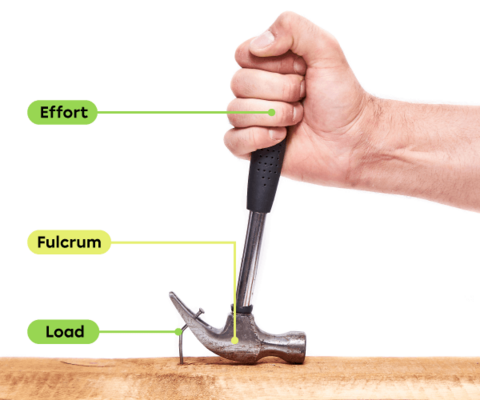
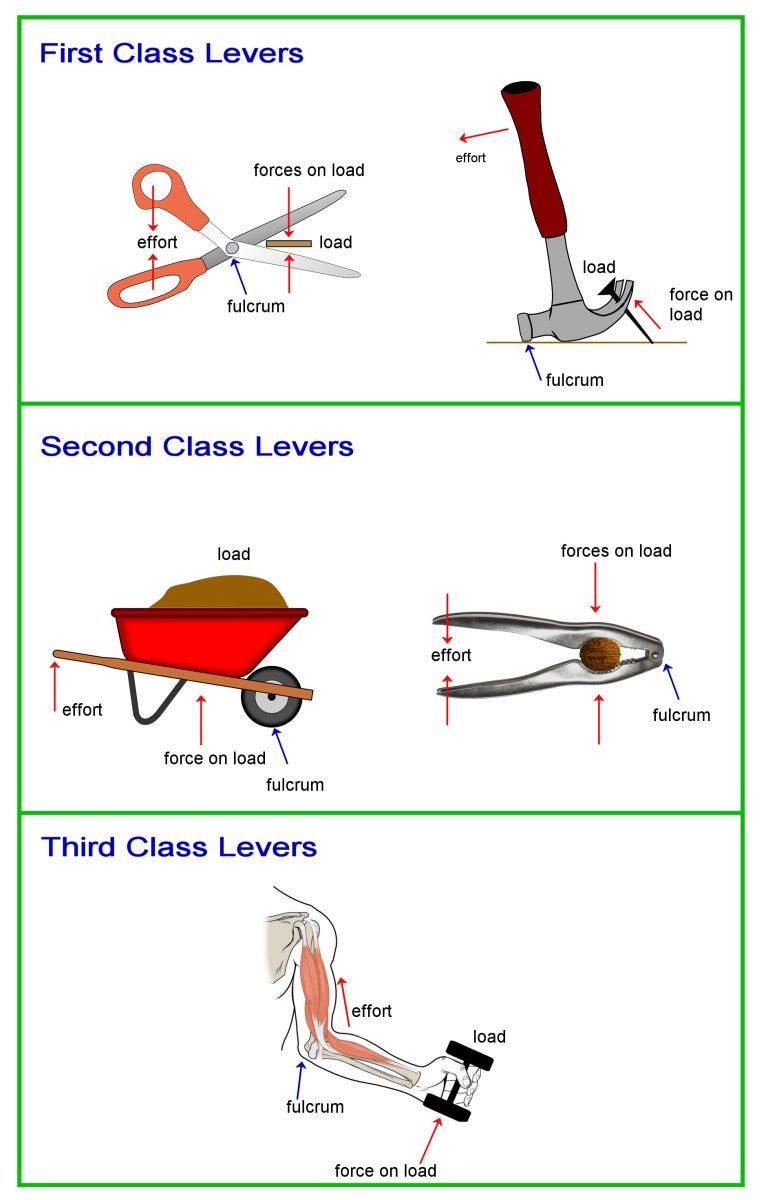
In a U.S. workshop, a claw hammer acts as a first-class lever when you use its claw to pull a nail. The hammer head rests against the wood as the fulcrum, the nail is the load, and your hand applies the effort through the handle.
A hammer is not always a lever, though. When you use it to drive a nail, it mainly transfers motion and impact. The lever classification depends on how you use the tool.
Why a Claw Hammer Is a First-Class Lever
A first-class lever has the fulcrum between the effort and the load. A seesaw is a simple example.
When removing a nail with a claw hammer:
- Fulcrum: The part of the hammer head touching the wood
- Load: The nail held by the claw
- Effort: The force your hand applies to the handle
- Lever arm: The hammer handle and head working around the contact point
The hammer head rests on the surface. As you pull the handle, the head turns around that contact point. The claw moves upward and pulls the nail from the wood.
That arrangement places the fulcrum between your hand and the nail. It makes the claw hammer a first-class lever for nail removal.
Simple layout
You can picture the setup like this:
Effort — Fulcrum — Load
Your hand is on one side of the fulcrum. The nail is on the other side. This is the defining layout of a first-class lever.
The exact contact point may shift as the nail comes out. The hammer may roll slightly on the wood, but the basic lever action remains the same.

What Are the Three Parts of a Lever?
Every basic lever has three key parts: the fulcrum, the effort, and the load.
fulcrum
The fulcrum is the point around which the lever turns. With a claw hammer, it is usually the rounded part of the hammer head that presses against the wood.
The fulcrum is not always a fixed pin. In a hammer, it is a temporary contact point. The wood, hammer head, and nail shape the position of that contact point.
Effort
The effort is the force applied to move the load. Your hand supplies the effort when you pull down or back on the hammer handle.
A longer handle usually gives your hand a longer distance from the fulcrum. This can increase the turning effect, also called torque, for the same hand force.
Load
The load is the object being moved. When you use the claw to remove a nail, the nail is the load.
The load also includes resistance from the wood. A nail driven deep into hard wood requires more force than a loose nail in soft wood.
How Does the Hammer Increase Force?
A claw hammer increases force through mechanical advantage. Mechanical advantage compares the output force on the load with the input force from your hand.
For an ideal lever:
[
\text{Mechanical advantage} =
\frac{\text{effort arm}}{\text{load arm}}
]
The effort arm is the distance from your hand to the fulcrum. The load arm is the distance from the nail to the fulcrum.
Hypothetical example
Suppose:
- Your hand is 12 inches from the fulcrum.
- The nail is 1 inch from the fulcrum.
- You apply 20 pounds of force to the handle.
The ideal mechanical advantage would be:
[
\frac{12}{1} = 12
]
The ideal output force would be:
[
20 \times 12 = 240 \text{ pounds}
]
This is a simplified calculation. Real results are lower because of friction, bending, slipping, wood resistance, and the changing angle of the claw.
The example still shows the main idea: a long effort arm and a short load arm can greatly increase force at the nail.
Why the claw shape matters
The curved claw helps keep the nail close to the fulcrum. That shortens the load arm and improves force multiplication.
The claw also gives the nail a place to sit while the hammer rotates. Without that curved shape, the hammer would be less useful for pulling nails.

Is a Hammer a Lever When Driving a Nail?
Usually, no. When driving a nail, a hammer mainly acts as an impact tool rather than as a simple lever.
You raise the hammer, move it toward the nail, and stop the hammer head against the nail. The head transfers momentum and energy to the nail. The nail then moves into the wood.
This action does not use a clear, fixed fulcrum between the effort and the load. The hammer head is moving freely before impact.
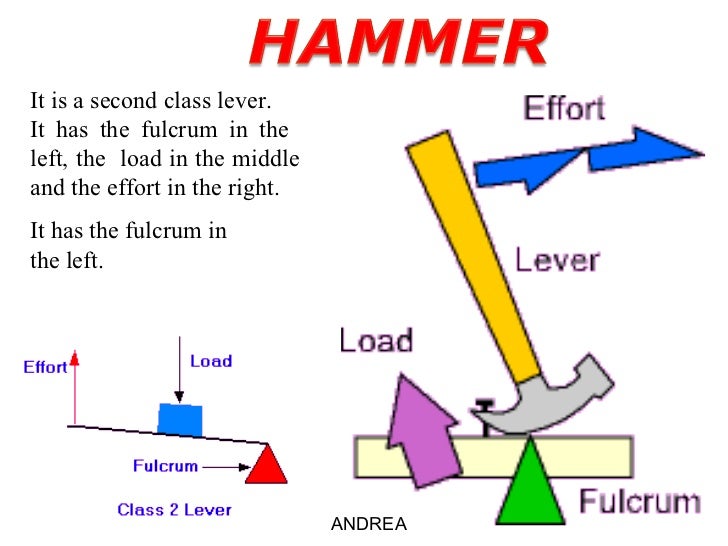
Why some lessons call it a third-class lever
Some basic physics lessons model a swinging hammer as a third-class lever. In that model:
- The wrist or hand acts as the fulcrum.
- Your muscles or hand apply effort between the fulcrum and the hammer head.
- The hammer head is the load at the end of the handle.
That arrangement has this pattern:
Fulcrum — Effort — Load
This is the pattern of a third-class lever.
However, the model has limits. During a normal swing, the wrist is not a rigid, fixed pivot. The hammer also stores and transfers energy through its moving mass. For that reason, calling the entire hammering action a third-class lever is a useful simplified model, not a complete description.
The clearest school-level answer is:
- Pulling a nail: First-class lever
- Driving a nail: Mainly an impact action, sometimes modeled as a third-class lever during the swing

Lever Classes Compared With Hammer Uses
The three lever classes depend on the position of the fulcrum, effort, and load.
| Lever class | Part in the middle | Common example | Hammer connection |
|---|---|---|---|
| First class | Fulcrum | Seesaw, scissors | Claw hammer pulling a nail |
| Second class | Load | Wheelbarrow, bottle opener | Not the usual claw-hammer action |
| Third class | Effort | Tweezers, human forearm | Possible model for swinging a hammer |
First-class lever
A first-class lever places the fulcrum between the effort and the load. It can increase force, increase movement, or change the direction of force.
A claw hammer pulling a nail is the standard hammer example.
Second-class lever
A second-class lever places the load between the fulcrum and the effort. A wheelbarrow is a common example.
A normal claw hammer does not usually work as a second-class lever when pulling a nail. The nail is not between the hammer’s contact point and your hand.
Third-class lever
A third-class lever places the effort between the fulcrum and the load. The human forearm is a familiar example.
A hammer swing may be described this way if the wrist is treated as the pivot and the hand applies force between the wrist and hammer head. Still, the hammer’s impact and momentum are central to the task.

Why Hammer Position Changes the Mechanical Advantage
The hammer gives more mechanical advantage when the nail stays close to the fulcrum and your hand stays farther away.
This means you can often increase pulling force by:
- Placing the claw securely under the nail head.
- Keeping the hammer head firmly against the wood.
- Pulling from the end of the handle.
- Using a controlled motion rather than jerking the tool.
A longer handle increases the effort arm. A shorter distance from the fulcrum to the nail decreases the load arm.
The trade-off
More mechanical advantage usually means less movement at the load for each movement of the handle. A long handle may pull hard but raise the nail only a small distance per stroke.
A short handle may move the claw through a wider angle but provide less force. This is why people often rock the hammer several times when removing a deeply set nail.
For a stubborn nail, place a scrap block of wood under the hammer head. This can change the fulcrum position and improve the angle. The block also helps protect the work surface.

Is a Hammer a Simple Machine?
Yes. A claw hammer can function as a simple machine when used to pull a nail.
Simple machines use basic mechanical principles to make work easier or more controlled. The six commonly taught simple machines are:
- Lever
- Wheel and axle
- Pulley
- Inclined plane
- Wedge
- Screw
The claw hammer’s nail-pulling action uses the lever principle. The hammer head and claw also include wedge-like surfaces that can grip or separate material, but those features do not change the main answer.
The handle is not a separate lever by itself. The whole tool works as a lever when the head contacts the wood and the claw engages the nail.

Common Mistakes About Hammer Levers
Mistake 1: Saying every hammer is a first-class lever
A hammer is not permanently assigned to one lever class. Its classification depends on the task.
A claw hammer is a first-class lever when pulling a nail. That answer does not describe every motion the tool can make.
Mistake 2: Calling the handle the fulcrum
The handle is where you usually apply effort. The fulcrum is the point where the hammer head presses against the wood.
Mistake 3: Treating the nail as the fulcrum
The nail is the load. The hammer head’s contact with the wood supplies the pivot point.
Mistake 4: Ignoring the contact surface
If the hammer head slips, the fulcrum changes or disappears. The tool may then lose force, damage the wood, or cause your hand to move suddenly.
Mistake 5: Assuming ideal force in real work
Mechanical advantage calculations describe an ideal lever. They do not account for friction, nail angle, wood grain, rust, damaged claws, or a loose hammer head.

Hammer Safety When Pulling Nails
Use the claw only when it can grip the nail firmly. A slipping claw can damage the wood or send the tool toward your hand.
Follow these basic precautions:
- Wear safety glasses to protect against flying wood chips or broken nail pieces.
- Keep your free hand away from the claw and nail path.
- Check that the hammer head is firmly attached to the handle.
- Do not strike a hardened steel object with a hammer unless the tool is designed for that use.
- Use a scrap block under the head when needed to protect finished wood.
- Replace a hammer with a cracked handle, damaged claw, or loose head.
- Do not use a hammer as a pry bar if the tool is not designed for that purpose.
The Occupational Safety and Health Administration advises users to inspect hand tools and keep them in safe condition. The tool’s lever action does not remove the risk of sudden release.

Frequently Asked Questions
What type of lever is a claw hammer when removing a nail?
A claw hammer is a first-class lever when removing a nail. The hammer head acts as the fulcrum, your hand supplies the effort, and the nail is the load.
What is the fulcrum of a hammer?
The fulcrum is the part of the hammer head that rests against the wood while the claw pulls the nail. Its exact location can move as the hammer rocks.
Is a hammer a first-, second-, or third-class lever?
It depends on how you use it. Nail removal with the claw is a first-class lever. A hammer swing may be modeled as a third-class lever, but striking a nail is mainly an impact action.
Does a longer hammer handle create more force?
A longer handle can create more torque because it increases the distance between your hand and the fulcrum. It may also make the tool harder to control and less convenient in tight spaces.
Why does a hammer pull a nail more easily than my hand?
The hammer increases mechanical advantage by using a long effort arm and a short load arm. This lets a smaller hand force produce a larger force at the nail.
Sources and Scope
This explanation follows standard lever mechanics and common hand-tool safety guidance. For further reading, see:
- OpenStax, College Physics: Simple Machines
- Encyclopaedia Britannica: Lever
- OSHA, Hand and Power Tools
These sources support the definitions of levers, mechanical advantage, and basic hand-tool safety. The exact force needed to remove a nail varies with the nail, wood, angle, friction, and condition of the hammer.
Conclusion
A claw hammer is a first-class lever when it pulls a nail. The hammer head is the fulcrum, the nail is the load, and your hand applies effort through the handle.
When driving a nail, the hammer mainly works as an impact tool. The key lesson is that a tool’s lever class depends on its arrangement and use—not just its name.
For a quick test, identify the three parts: Where is the fulcrum? Where is the effort? What is the load? With a claw hammer pulling a nail, the fulcrum is in the middle, so the answer is first-class lever.
Recent Tool Guides
 Hammer
How To Hammer Flowers Onto Paper: Easy Guide
Learn how to hammer flowers onto paper with simple steps, helpful tips, and beautiful results for...
Read Guide → Wrench
How To Use A Hex Wrench: Easy Step-By-Step Guide
Learn how to use a hex wrench correctly with simple steps, helpful tips, and common mistakes...
Read Guide → Hacksaw
How To Cut Curtain Pole With Hacksaw: Easy Guide
Learn how to cut curtain pole with hacksaw safely and neatly. Follow simple steps for accurate...
Read Guide → Wrench
How To Use A Husky Torque Wrench: Easy Guide
Learn how to use a Husky torque wrench correctly with simple steps, torque settings, and safety...
Read Guide → Hammer
How To Hold A Hammer: Safe Grip Guide
Learn how to hold a hammer with the right grip, stance, and technique for safer, more...
Read Guide → Hacksaw
How To Cut Flexible Metal Conduit With Hacksaw: Easy Guide
Learn how to cut flexible metal conduit with hacksaw safely and cleanly. Follow simple steps for...
Read Guide →