
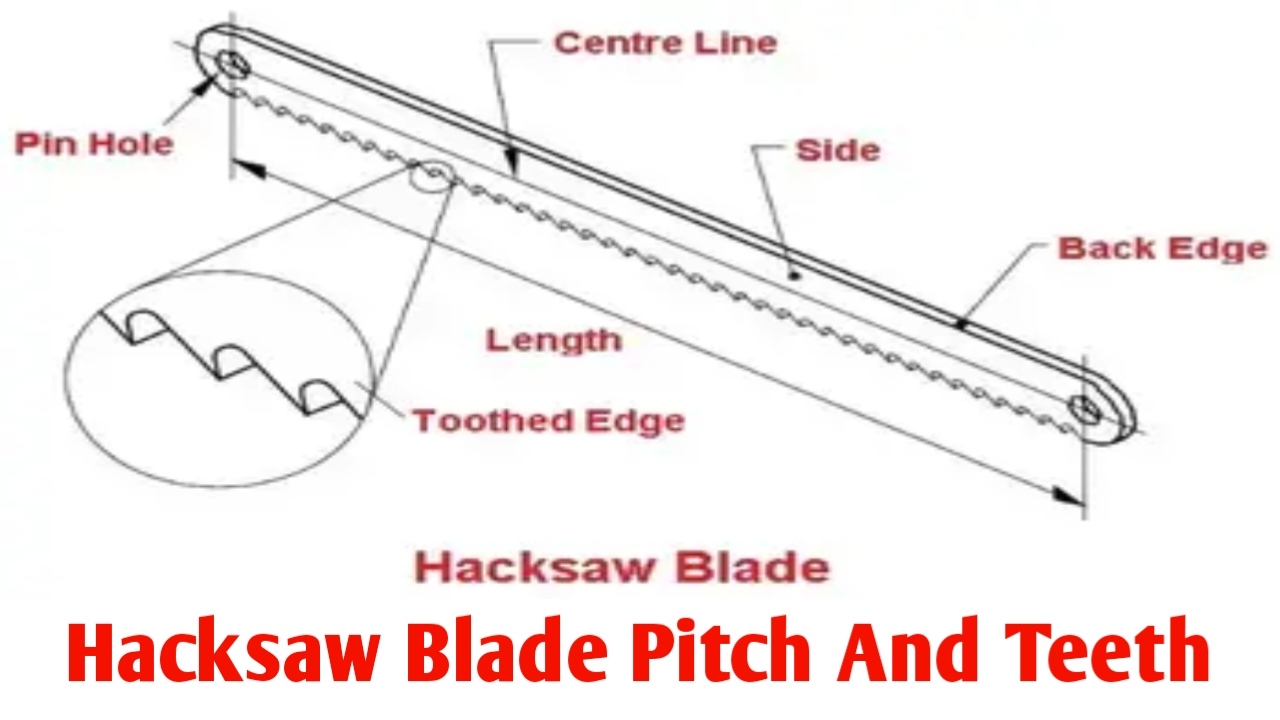
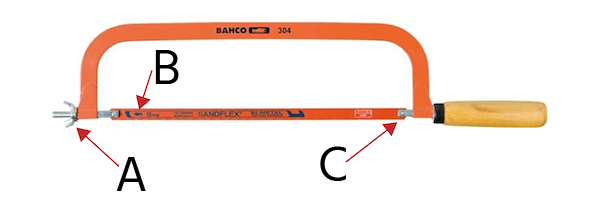
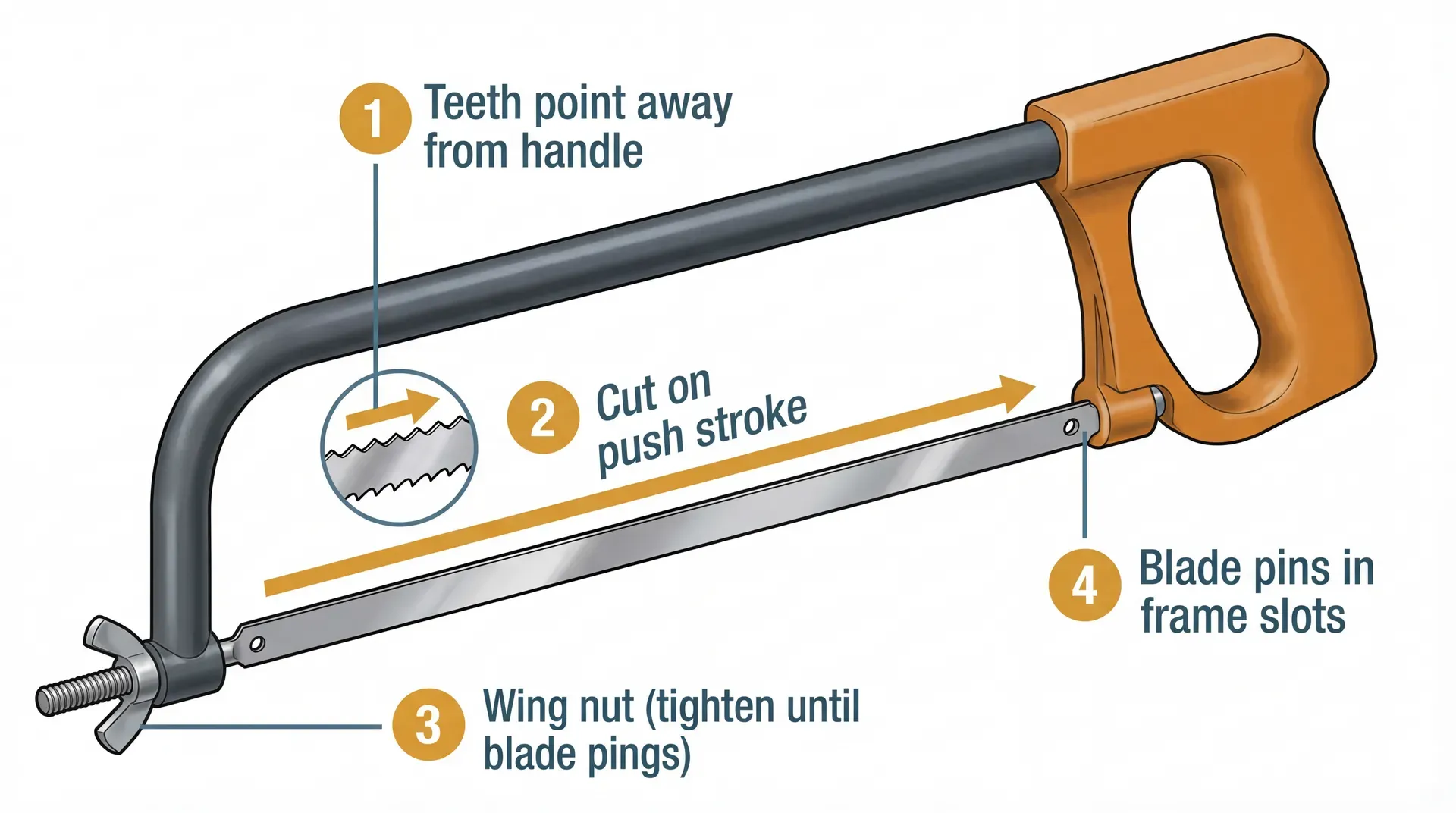
The teeth on a standard hacksaw blade should face away from the handle. In other words, they point toward the front end of the hacksaw frame. This lets the blade cut on the forward push stroke.
If the teeth face the handle, the saw may still move through soft material, but it will cut poorly. The blade may bend, snag, or break.
Why Do Hacksaw Teeth Face Forward?
A standard hacksaw is designed to cut when you push it away from your body. The blade teeth point forward so they bite into the material during that push.
On the return stroke, the blade should glide back with little pressure. This cutting action differs from many wood saws, which often cut on the pull stroke.
A hacksaw blade is thin and flexible. It works best when the frame keeps it tight and the cutting force stays in one direction. Forward-facing teeth help the blade stay stable during the cut.
The basic rule
- Teeth pointing away from the handle: Correct for most hacksaws.
- Teeth pointing toward the handle: Usually installed backward.
- Blade cutting on the push stroke: Normal.
- Blade cutting on the pull stroke: Not normal for a standard hacksaw.
This rule applies to common full-size hacksaws and most mini hacksaws used in U.S. home workshops, garages, and job sites.

How to Install a Hacksaw Blade Correctly
Follow these steps before you start cutting:
Release the blade tension.
Turn the tension knob or lever until the old blade becomes loose.Remove the old blade.
Wear gloves if the blade has sharp or broken teeth.Check the new blade.
Look at both ends and along the edge. The teeth should point in the same direction.Place the blade in the frame.
Put the blade into the mounting pins or slots. The teeth should point away from the handle.Tighten the blade.
Add enough tension to make the blade feel firm. It should not hang loose or twist easily.Check the frame.
Make sure the blade sits straight and the mounting pins are fully engaged.Test the blade by hand.
Lightly press the side of the blade with one finger. It should flex a little, but it should not feel loose.
Do not over-tighten the blade. Too much tension can damage the frame or cause the blade to snap.
How tight should the blade be?
A properly tightened blade feels firm and gives a clear, light tone when tapped. This is only a rough check, not a precise measurement.
The blade should remain straight during a cut. If it bows or twists, stop and increase the tension slightly. If the frame bends or the blade breaks near the mounting hole, reduce the tension.

How to Use a Hacksaw With the Teeth Facing Forward
Once the blade is installed, place the workpiece in a vise or clamp. The material should not move while you cut.
Use long, steady strokes. Try to use most of the blade length instead of moving the saw only a short distance. Short strokes can wear one small area of the blade and make the cut less even.
Apply pressure on the forward stroke. Ease off pressure as you pull the saw back. Let the teeth do the work rather than forcing the frame.
A useful cutting pattern is:
- Start with slow, light strokes.
- Create a shallow groove in the material.
- Keep the blade in that groove.
- Increase the stroke length once the groove is stable.
- Reduce pressure near the end of the cut.
Keep the blade square to the workpiece unless you need a special angle. A tilted frame can make the blade bind or wander.
Cutting speed and pressure
The right pressure depends on the material and the blade tooth size.
| Material | Typical approach |
|---|---|
| Thin sheet metal | Light pressure and slow strokes |
| Steel bar or pipe | Firm, even pressure |
| Aluminum or copper | Moderate pressure and frequent chip clearing |
| Plastic | Light pressure to prevent melting or cracking |
| Small fasteners | Short, controlled strokes |
These are general starting points. The blade’s tooth count and the material’s thickness also affect the best technique.

What Happens if the Hacksaw Blade Is Installed Backward?
A backward blade usually cuts very slowly or does not cut at all. The teeth face away from the cutting force, so they tend to slide over the surface instead of removing material.
You may notice these signs:
- The blade skates across the workpiece.
- The saw produces little or no progress.
- The blade catches during the return stroke.
- The cut feels rough or uneven.
- The blade bends more than usual.
- The teeth become dull quickly.
Do not compensate by pushing harder. Excess force can bend the blade, damage the workpiece, or cause the blade to break.
Remove the blade, turn it around, and reinstall it with the teeth pointing away from the handle.
Are There Exceptions to the Forward-Facing Rule?
Most standard hacksaw blades face forward, but not every saw with a narrow metal-cutting blade works the same way.
Junior hacksaws and mini hacksaws
Many junior hacksaws use the same forward-cutting setup as a full-size hacksaw. However, some small frames allow the blade to mount in more than one position.
Check the tooth direction before cutting. The handle may not be a reliable guide if the frame has an unusual design.
Flush-cut or specialty saws
Some specialty hand saws are made to cut on the pull stroke. These tools may look similar to small hacksaws, but they are not standard hacksaws.
Follow the markings on the blade or the tool’s instructions. A saw labeled for pull cutting may require the teeth to face the handle.
Powered reciprocating saws
A reciprocating saw is different from a hand hacksaw. Its blade may cut on the push stroke, the pull stroke, or both, depending on the tooth design and blade type.
Install a reciprocating-saw blade according to the blade markings and the power tool manufacturer’s instructions. Do not apply the standard hacksaw rule automatically.
Reversible blades
Some blades have teeth or mounting designs that allow more than one direction. If the manufacturer states that the blade is reversible, follow those instructions.
When no clear instruction exists, use the standard setup: teeth away from the handle for a normal hacksaw.
How Blade Tooth Size Changes the Cut
Tooth direction tells you how the blade cuts. Tooth size tells you how well it suits the material.
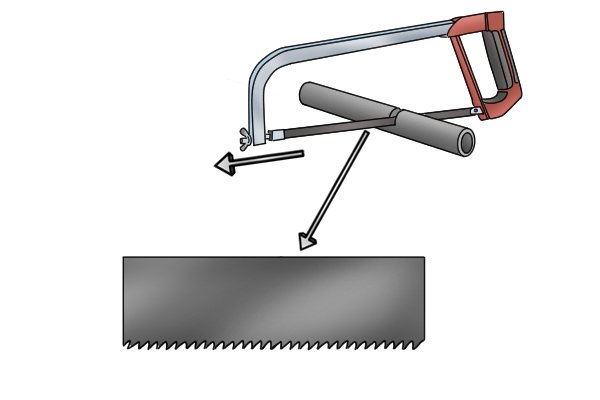
Hacksaw blades are often described by teeth per inch, or TPI. A higher TPI blade has smaller teeth. A lower TPI blade has larger teeth.
As a general guide:
- 14 TPI: Large teeth for thick, softer material.
- 18 TPI: A useful choice for many medium-thickness metal cuts.
- 24 TPI: Fine teeth for thinner metal.
- 32 TPI: Very fine teeth for thin sheet, tubing, and small parts.
The workpiece should usually have at least two or three teeth in contact with the material. If only one tooth touches the work, that tooth may catch and break.
If too many teeth contact a thick workpiece, chips can clog the blade. If too few teeth contact thin material, the blade may snag.
Tooth direction remains the same regardless of TPI: on a standard hacksaw, the teeth face away from the handle.

Common Hacksaw Blade Installation Mistakes
Installing the blade by looking only at the frame
The frame can be symmetrical, so it may not show which way the teeth should face. Look directly at the teeth.
Confusing the handle with the cutting direction
The saw cuts away from the handle. Do not point the teeth toward the handle just because that feels natural when holding the tool.
Using a wood-saw technique
Many wood saws cut on the pull stroke. A standard hacksaw normally cuts on the push stroke. Use light pressure on the return stroke.
Over-tightening the blade
A loose blade can wander, but an extremely tight blade can snap. Tighten it until it is firm and straight, not until the frame is under extreme strain.
Using the wrong TPI
A fine blade on thick steel may clog and cut slowly. A coarse blade on thin sheet metal may grab the workpiece and damage the teeth.
Cutting loose material
A moving pipe or bar can pinch the blade. Clamp the workpiece securely before you begin.

Hacksaw Safety Tips
Wear safety glasses when cutting metal. Small chips can fly from the teeth or the workpiece.
Secure the material in a vise or clamp. Keep your free hand away from the blade path, especially near the end of the cut.
Inspect the blade before use. Replace it if it is cracked, badly worn, bent, or missing several teeth. A damaged blade can break without much warning.
Keep the hacksaw under control. Do not use your body weight to force the cut. If the blade binds, stop, find the cause, and restart with less pressure.
After cutting, the metal edge may be sharp. Deburr it with a file or suitable abrasive, while wearing eye protection.
For work involving contaminated metal, coatings, lead, asbestos, pressurized pipe, or unknown substances, follow the applicable workplace safety rules and use qualified guidance.

What to Check When the Hacksaw Will Not Cut
Use this order when the saw makes little progress:
Check tooth direction.
The teeth should point away from the handle.Check blade tension.
A loose blade can bend instead of cutting.Check the blade condition.
Dull, broken, or clogged teeth need replacement.Check the TPI.
Choose a tooth size that matches the material thickness.Check the workpiece support.
Clamp it firmly so it cannot vibrate or move.Check your stroke.
Push with steady pressure and ease off on the return.Check the cutting angle.
Keep the blade square unless the job calls for an angle.
If the blade keeps breaking, stop using the saw. The frame may be bent, the blade may be under too much tension, or the workpiece may be pinching the cut.
Key Takeaways
- A standard hacksaw blade should have its teeth facing away from the handle.
- The saw normally cuts on the forward push stroke.
- Apply pressure while pushing and reduce pressure while pulling back.
- Keep the blade tight but do not over-tighten it.
- Match the blade’s TPI to the material thickness.
- Clamp the workpiece and wear eye protection.
- Check the tool instructions for specialty saws, pull-cut blades, and powered reciprocating saws.
Frequently Asked Questions
Should hacksaw teeth face toward or away from the handle?
They should face away from the handle on a standard hacksaw. This position makes the blade cut as you push the saw forward.
Do hacksaws cut on the push or pull stroke?
A standard hacksaw cuts on the push stroke. Use light pressure while moving the saw back.
Can you install a hacksaw blade backward?
You can physically install some blades backward, but it is not the correct setup for normal cutting. Turn the blade around so the teeth point away from the handle.
Why does my hacksaw blade keep breaking?
Common causes include excessive tension, too much cutting force, a loose or moving workpiece, a bent frame, or the wrong blade tooth size. Stop and inspect the setup before installing another blade.
What TPI hacksaw blade should I use?
Use a coarse blade for thicker material and a fine blade for thinner material. As a starting point, 18 TPI suits many general metal cuts, while 24 or 32 TPI works better for thin stock.
Do reciprocating saw blades face the same way as hacksaw blades?
Not always. Reciprocating saw blades vary by design and may cut on the push stroke, pull stroke, or both. Follow the blade markings and the power tool instructions.
Conclusion
For a normal hand hacksaw, point the teeth away from the handle. Tighten the blade, clamp the material, and cut with steady pressure on the forward stroke.
If the tool is a specialty pull-cut saw or a powered reciprocating saw, check its instructions instead. When the blade direction, tension, tooth size, and cutting method all match the job, a hacksaw should cut smoothly without excessive force.