
Putting a hacksaw blade on takes only a few minutes. For a standard hacksaw, place the blade in the frame with the teeth pointing away from the handle. The saw should cut as you push it forward. Fit both blade ends onto the pins, tighten the tension until the blade is straight and firm, then check that it is secure before cutting.
This guide applies to common hacksaws used in the United States for cutting metal, plastic pipe, conduit, threaded rod, and similar materials. Always follow the instructions for your specific saw if its frame uses a different blade system.

What You Need Before You Start
You need three things:
- A hacksaw frame
- A compatible hacksaw blade
- Eye protection
Most full-size hacksaws use blades about 12 inches long, measured from hole to hole. Some compact and mini hacksaws use shorter blades. Check the frame before buying a replacement blade.
A hacksaw blade has a hole at each end. Small pins, hooks, or posts on the frame fit through these holes. The frame then holds the blade under tension so it stays straight during a cut.
Check the blade first
Before installing the blade, look for:
- Cracked or missing teeth
- Bent ends
- Rust that has weakened the blade
- A blade that is too short or too long for the frame
- The wrong tooth style for the material
Handle the blade by its smooth edges when possible. The teeth are sharp enough to cut skin.
Choose the right tooth count
Hacksaw blades are commonly described by teeth per inch, or TPI.
| Blade type | Common use |
|---|---|
| 14–18 TPI | Thick metal, heavy steel, aluminum, and larger stock |
| 24 TPI | General-purpose metal cutting |
| 32 TPI | Thin sheet metal, tubing, and small metal parts |
Use a blade with at least two or three teeth in the material at one time. A blade with too few teeth may catch and break. A blade with very fine teeth can clog or cut slowly in thick material.
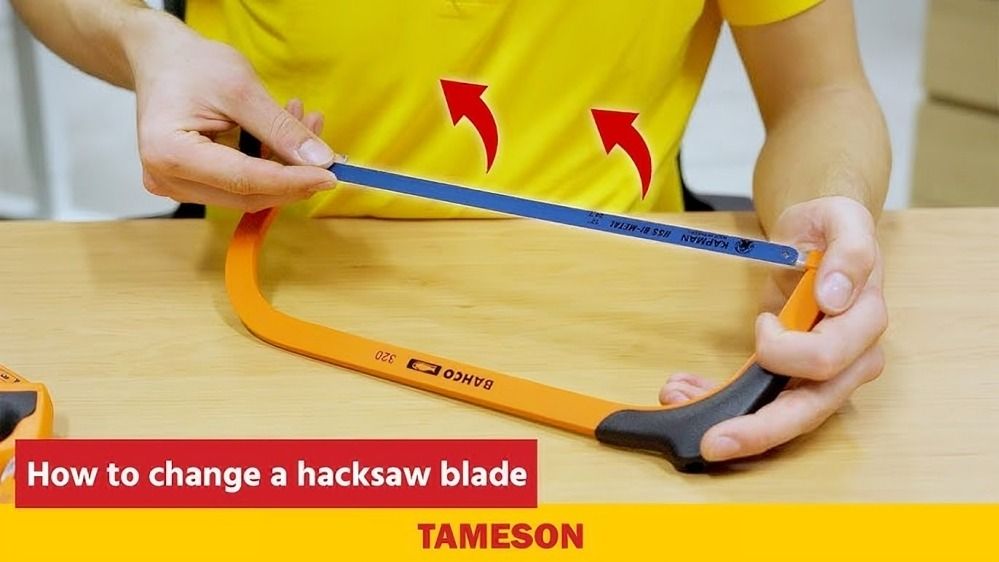
How to Put a Hacksaw Blade On
Follow these steps for a standard hacksaw frame.
1. Release the blade tension
Hold the frame away from your body. Turn the tension knob or lever counterclockwise, or use the release lever if the saw has one.
Loosen the frame until the old blade can come off the mounting pins. Do not force the blade free while it is still tight.
If the frame has a quick-release lever, open it fully before removing the blade.
2. Remove the old blade
Lift one end of the blade off its pin. Then remove the other end.
If the old blade is broken, use care. A snapped blade can have sharp, uneven ends. Wear gloves if needed, but do not rely on gloves alone for protection. Keep your fingers away from the teeth.
Place the old blade where it cannot cut someone. A small piece of cardboard can cover the teeth during disposal.
3. Find the cutting direction
Look closely at the new blade. The teeth usually point in one direction.
For a standard hacksaw:
The teeth should point away from the handle.
This setup makes the saw cut on the forward push stroke. The return stroke then places less stress on the blade.
Some hacksaw frames let you install the blade in either direction. Unless the manufacturer says otherwise, use the normal setup with the teeth facing away from the handle.
4. Fit the first blade hole onto its pin
Place one end of the blade onto the mounting pin near the handle or front of the frame.
Make sure the blade hole sits fully over the pin. It should not rest on the edge of the pin or sit at an angle.
Keep the teeth facing away from the handle as you position the blade.
5. Fit the second blade hole onto the other pin
Pull the blade gently toward the opposite end of the frame. Fit the second hole over the remaining pin.
The blade may feel slightly loose at this point. That is normal. Do not bend the blade sharply to make it fit.
If the second hole will not reach the pin, the frame may still be partly extended, the blade may be the wrong length, or the tension mechanism may not be fully released.
6. Tighten the blade
Turn the tension knob clockwise or close the tension lever.
Tighten the blade until it is straight and firm. A properly fitted blade should not sag, twist, or move sideways easily.
Do not keep tightening with great force. Excess tension can damage the frame or cause the blade to snap. The exact tension depends on the saw design, so use the maker’s instructions when available.
7. Check the blade alignment
Look down the length of the blade.
It should:
- Sit straight in the frame
- Rest evenly on both pins
- Have its teeth facing away from the handle
- Stay in the same plane as the frame
- Feel firm when lightly pressed from the side
If the blade looks twisted, loosen the tension and reinstall it. Do not try to straighten a badly bent blade while it is tight.
8. Test the saw safely
Before cutting, make a few slow strokes in the air, away from your body and other people.
The blade should stay in place. If it shifts, rattles, or comes off a pin, stop and release the tension. Refit the blade before use.

How Tight Should a Hacksaw Blade Be?
A hacksaw blade should be tight enough to stay straight during a cut, but not so tight that the frame or blade is under unnecessary strain.
A simple hand check is useful:
- Tighten the blade until it no longer sags.
- Press the side of the blade lightly with a finger.
- Confirm that it moves only a little and springs back.
- Check that the blade does not twist in the frame.
Do not use a musical “string” sound as a precise tension test. Different blades and frames produce different sounds, and excessive tension can break the blade.
A blade that is too loose may:
- Wander away from the cut line
- Bend during the stroke
- Twist and bind in the workpiece
- Jump off the mounting pins
- Break teeth
A blade that is too tight may:
- Snap without warning
- Damage the frame
- Put excess force on the blade holes
- Increase the risk of injury

How to Tell If the Blade Is Installed Correctly
The blade is ready when all of these checks pass:
- The teeth point away from the handle.
- Both blade holes sit fully on the frame pins.
- The blade is straight.
- The blade is under firm tension.
- The blade does not twist when viewed from the side.
- The frame is not bent.
- No part of the blade rubs against the frame.
- The blade remains in place during a few gentle strokes.
A correctly installed hacksaw blade should cut when you push the saw forward. It may feel as if the saw does little on the return stroke. That is expected.
If the saw cuts on the pull stroke instead, the blade may be installed backward. Turn the blade around unless your saw’s manual specifically directs a different setup.

Common Problems and Their Fixes
The blade keeps falling off
The blade may be too loose, or one end may not be fully seated on its pin.
Release the tension and check both blade holes. Then reinstall the blade and tighten it gradually. If it still falls off, inspect the pins and the blade holes for wear.
A bent frame can also prevent proper tension. Replace a damaged frame rather than trying to force it back into shape.
The blade will not reach the second pin
Check that:
- The tension mechanism is fully released.
- The blade length matches the frame.
- The blade is not already bent.
- The frame is not stuck in an extended position.
Never stretch a blade by force. A blade that is too short is not safe to install.
The saw cuts slowly
Slow cutting may result from:
- A dull blade
- The wrong TPI for the material
- Too little pressure
- Too much pressure
- A loose workpiece
- A blade installed backward
Use steady, moderate pressure on the forward stroke. Let the teeth do the cutting. Pressing much harder can bend or break the blade without making the cut faster.
The blade breaks during use
A blade can break when it is:
- Over-tightened
- Bent sideways
- Twisted in the cut
- Forced through the material
- Used on a loose workpiece
- Worn or damaged
Stop using a blade after it develops missing teeth, a crack, or a visible bend. A blade that breaks often may also indicate a damaged frame or poor cutting technique.
The teeth face the handle
Loosen the frame and turn the blade around. On a standard hacksaw, the teeth should face away from the handle so the saw cuts on the push stroke.
Some specialty frames work differently. Check the frame instructions if the design does not match a standard hacksaw.

Safe Hacksaw Use After Installation
Wear safety glasses while cutting. Small metal chips and broken teeth can travel at high speed.
Secure the workpiece in a vise or clamp. Do not hold the material in one hand while pushing a hacksaw toward it with the other. A secure workpiece gives you better control and lowers the chance of a sudden slip.
Keep both hands on the saw when practical. Use one hand on the handle and the other on the front of the frame. Keep your fingers away from the blade path.
Start the cut with short, light strokes. Once the groove forms, use longer strokes that use more of the blade. Keep the saw straight and avoid rocking it from side to side.
When the cut is nearly complete, reduce pressure. The material may break through suddenly, and a hard final stroke can cause your hand or the saw to slip.
Do not use a hacksaw blade as a knife, scraper, pry bar, or file. Use the right tool for those jobs.

Can You Put a Hacksaw Blade on Backward?
Yes, a blade can usually be installed backward if its teeth point toward the handle. On a standard hacksaw, this is not the normal setup.
With the teeth facing the handle, the saw will try to cut on the pull stroke. The blade may still cut, but the action can feel awkward, and the frame may not provide the intended support.
Install the blade with the teeth pointing away from the handle unless the manufacturer specifies another direction. Specialty saws and some compact frames may use different designs.
Can You Reuse a Hacksaw Blade?
You can reuse a hacksaw blade if the teeth are sharp, the blade is straight, and it has no cracks or other damage.
Do not reuse a blade that:
- Has broken teeth
- Has a visible crack
- Is bent or twisted
- Has badly worn teeth
- Has damaged mounting holes
- Has heavy rust or deep pits
A dull blade often makes a rough cut and requires extra force. Replacing it is usually safer than trying to compensate with more pressure.
How Do You Put a Blade on a Mini Hacksaw?
A mini hacksaw may use a shorter blade and a different tension system, but the basic method is similar:
- Release the tension or open the frame.
- Remove the old blade.
- Check the new blade’s length.
- Point the teeth in the cutting direction shown by the frame.
- Fit both ends onto the mounting points.
- Tighten the frame until the blade is straight and secure.
Some mini hacksaws use a simple spring frame instead of a threaded tension knob. Do not assume every small saw uses the same blade direction. Look for an arrow, marking, or manual if the frame design is unclear.
When to Replace the Hacksaw Frame
Replace the frame if it has a bent body, damaged pins, stripped threads, or a tension knob that cannot hold the blade securely.
A new blade will not solve a frame problem. If the frame cannot keep steady tension, the blade may twist, fall off, or break during a cut.
For occasional household work, a sound frame and a suitable blade are usually enough. For repeated cutting, choose a frame that lets you control blade tension and holds the blade securely at both ends.

Frequently Asked Questions
Which way do hacksaw blade teeth face?
On a standard hacksaw, the teeth face away from the handle. This makes the saw cut during the forward push stroke.
Why does my hacksaw blade keep snapping?
The usual causes are too much tension, side pressure, a loose workpiece, a dull blade, or a blade that is being twisted in the cut. Check the frame and use steady, straight strokes.
Should a hacksaw blade be tight or loose?
It should be firm and straight, with very little side movement. Avoid extreme tension because it can damage the frame or cause the blade to snap.
Can I use a hacksaw without a blade guard?
Many standard hacksaws do not have a separate blade guard. Store the saw where the teeth cannot injure someone, and cover or safely discard loose blades.
What should I do if the blade will not fit?
Confirm the blade length, fully release the tension mechanism, and inspect the frame pins. Never force a blade that is too short or too long.
Final Checklist
Before cutting, confirm that:
- The blade matches the frame.
- The teeth point away from the handle.
- Both ends sit fully on the mounting pins.
- The blade is straight and firm.
- The workpiece is clamped.
- You are wearing safety glasses.
- You are using steady pressure on the push stroke.
If the blade stays secure and the saw moves smoothly, it is installed correctly and ready for use.