
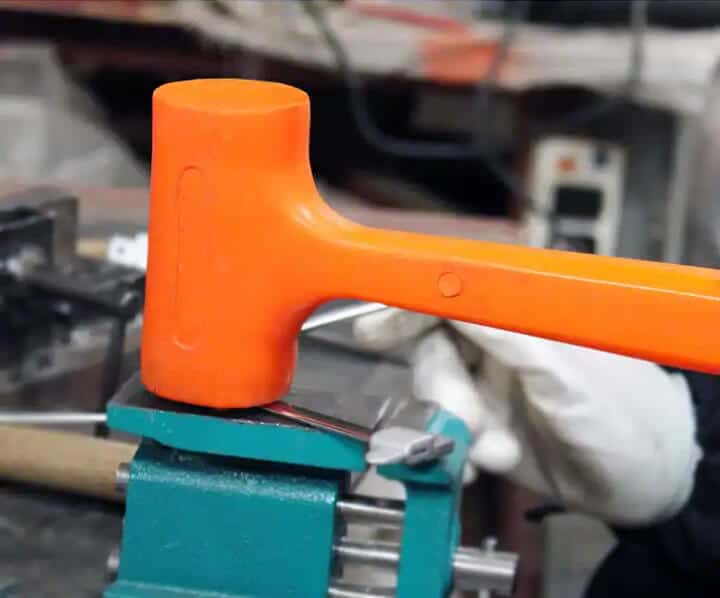
A dead blow hammer uses a hollow head filled with loose shot, such as steel pellets, to deliver a controlled hit with less bounce. When the hammer strikes, the shot keeps moving inside the head. That moving weight adds force to the blow, spreads the impact over a slightly longer time, and helps stop the hammer from springing back.
This makes dead blow hammers useful in American auto shops, home garages, construction sites, machine shops, and maintenance work. They can move or seat parts while reducing dents, sparks, noise, and accidental rebound. However, they are not safe or suitable for every job.

What Is a Dead Blow Hammer?
A dead blow hammer is a striking tool with a hollow head that contains loose material. The handle and head may look like those of a normal mallet, but the internal weight changes how the tool transfers energy.
Most dead blow hammers include these parts:
- Handle: Usually made from steel, fiberglass, or a tough composite.
- Hollow head: Holds the internal shot.
- Internal shot: Often steel pellets, sand, or another loose weight.
- Striking face: May use rubber, urethane, plastic, nylon, brass, copper, or steel.
- Outer shell: Protects the inner chamber and gives the head its shape.
The term “dead blow” refers to the hammer’s low rebound. It does not mean that the hammer has no rebound at all. Any hammer can bounce if the blow is glancing, the target is hard, or the face is damaged.
A dead blow hammer is different from a standard claw hammer. A claw hammer has a solid metal head and is designed for tasks such as driving and pulling nails. A dead blow hammer is mainly a controlled impact and positioning tool.
How Does a Dead Blow Hammer Work?
A dead blow hammer works through inertia, momentum transfer, and energy loss inside the head.
When you swing the tool, the outer head and internal shot move toward the target. At the instant the face hits the workpiece, the outer shell slows or stops first. The loose shot continues moving forward because of inertia. It then strikes the inside of the front wall of the head.
That second movement adds force to the original blow. It also keeps the head against the workpiece for a little longer than a solid hammer would. The pellets then collide with one another and the inner walls of the head. These collisions turn some of the impact energy into sound, heat, and small internal movements.
This process creates four practical effects:
- More controlled force: The internal weight helps transfer energy into the target.
- Less rebound: The shot absorbs and redirects some energy instead of sending it straight back.
- Lower risk of surface damage: Many models use a soft or replaceable face.
- Less vibration and noise: The moving shot disrupts sharp shock waves in the head.
A simple physics view
The basic relationship is momentum:
[
p = mv
]
Here:
- (p) is momentum.
- (m) is mass.
- (v) is velocity.
A heavier hammer head moving at the same speed carries more momentum. A dead blow hammer adds another useful effect: the internal shot moves after the outer shell contacts the workpiece.
The impulse relationship also helps explain the feel:
[
F \times \Delta t = \Delta p
]
If the same change in momentum occurs over a slightly longer time, the peak force can be lower. That does not make the hammer weak. It makes the impact less sudden and easier to control.
The exact result depends on the hammer’s mass, face material, shot type, swing speed, target material, and angle of impact. A dead blow hammer does not guarantee a fixed force or a specific reduction in rebound.

Why Does the Internal Shot Reduce Rebound?
The internal shot reduces rebound because it does not stop at the same instant as the hammer shell.
A solid hammer head and a hard workpiece can act somewhat like two objects pushing against each other. The hammer may bounce back when the target returns part of the impact energy. In a dead blow hammer, the loose shot keeps moving inside the head after contact. Its delayed motion changes the timing of the energy transfer.
The shot also collides with itself and with the inner shell. Those collisions are not perfectly elastic. Some energy becomes heat, sound, and friction. Less energy remains available to launch the hammer back toward the user.
The effect is strongest when:
- The hammer hits squarely.
- The target is firm and stable.
- The face matches the job.
- The hammer has enough mass for the task.
- The user does not swing beyond what the job requires.
A glancing strike can still cause the hammer to twist or bounce. A hard steel face can still rebound from hard steel. “Dead blow” describes a design feature, not a promise of zero kickback.
What Is a Dead Blow Hammer Used For?
A dead blow hammer is used when you need impact without the sharp rebound or marking that a regular metal hammer may cause.
Common uses include:
- Seating bearings and bushings during approved installation procedures
- Aligning machine parts
- Moving stubborn components
- Adjusting fixtures and jigs
- Fitting automotive parts
- Removing parts from a surface without heavy gouging
- Straightening sheet metal with the correct face
- Installing trim or panels
- Setting pavers or landscape blocks
- Positioning steel, aluminum, or wood components
- Breaking loose parts that need controlled impact
In vehicle work, a dead blow hammer may help align brake, suspension, exhaust, or body parts. The correct tool still depends on the component and the service instructions. A hammer should never replace a press, puller, or support fixture when the job requires one.
In machine maintenance, a dead blow hammer can help align covers, shafts, guards, and flanges. The face material matters. A soft urethane face may protect a finished surface, while a brass face may provide more force with less risk than bare steel.
A dead blow hammer is usually not the first choice for:
- Driving hardened nails
- Striking punches or chisels
- Breaking concrete or masonry
- Splitting wood
- Cutting metal
- Hitting a pressurized or energized part
- Striking a hardened steel surface with a soft face
- Jobs that require a measured press force
Use a tool made for the task. If a component needs a precise installation force, follow the manufacturer’s procedure instead of relying on feel.

Dead Blow Hammer vs. Rubber Mallet vs. Regular Hammer
The main difference is how each tool transfers and controls impact.
| Tool | Main design | Typical advantage | Main limitation |
|---|---|---|---|
| Dead blow hammer | Hollow head with loose shot | Low rebound and controlled impact | Usually less useful for nail work |
| Rubber mallet | Solid or hollow rubber head | Gentle contact with many surfaces | May lack force for tight parts |
| Plastic mallet | Nylon, plastic, or polymer head | Firm strike with reduced marking | Face can chip or wear |
| Brass or copper hammer | Non-ferrous metal head | Strong impact with less risk of steel-on-steel sparks | Face deforms and needs inspection |
| Claw hammer | Solid steel head with claw | Nails, framing, and general carpentry | More rebound and more marking |
| Ball-peen hammer | Steel head with peen | Metal shaping and shop work | Can damage finished surfaces |
Choose a dead blow hammer when rebound control and surface protection both matter.
Choose a rubber mallet when you need a softer, broader contact and do not need as much concentrated force.
Choose a plastic or nylon mallet when you need a firm face that will not mark the work as easily as steel.
Choose a regular steel hammer when the job calls for a hard, concentrated blow, such as driving a nail or striking a punch. Use only a hammer rated for that purpose.
Does a dead blow hammer hit harder?
Not always. A dead blow hammer can transfer energy efficiently because the internal shot continues moving after the initial contact. Yet a heavy solid hammer swung at the same speed may deliver more peak force in some jobs.
The better question is not simply, “Which hammer hits hardest?” Ask:
- How much force does the part need?
- Can the target tolerate a hard face?
- Is rebound a concern?
- Could the hammer damage the surface?
- Do you need a focused blow or a broad one?
The best hammer is the one that delivers enough force without damaging the work or putting the user at unnecessary risk.

How to Use a Dead Blow Hammer Safely
Use a dead blow hammer with the same care you would use with any striking tool. The lower rebound does not remove the risk of flying chips, pinched fingers, crushed parts, or tool failure.
Follow these steps:
- Check the hammer. Look for cracks, a loose handle, damaged faces, exposed shot, or a split head shell.
- Choose the correct face. Match the face to the workpiece. Do not use a soft face on a job that requires a hardened striking surface.
- Secure the work. Support the part so it cannot roll, shift, or fall when struck.
- Clear the area. Keep hands, feet, cords, and other people away from the impact zone.
- Wear eye protection. Chips, face fragments, and workpiece debris can travel in unexpected directions.
- Use a controlled swing. Start with light blows. Increase force only when the part and tool respond as expected.
- Strike squarely. A centered hit reduces glancing blows and face damage.
- Stop if the tool fails. Replace the hammer if the head, handle, or face becomes unsafe.
The U.S. Occupational Safety and Health Administration requires hand and power tools to be maintained in safe condition. OSHA also warns against using tools with damaged striking surfaces, such as mushroomed heads. See OSHA’s hand and power tools guidance for workplace safety information.
Do not hit a dead blow hammer with another hammer. Do not use it to strike a punch or chisel unless the hammer is specifically rated for that use. The face may not have the hardness or shape needed for that impact, and the tool could chip or fail.
How to Choose the Right Dead Blow Hammer
Choose the hammer by its face, mass, handle, and intended work—not by weight alone.
1. Select the right face material
The face controls how the tool meets the workpiece.
- Urethane or rubber: Good for many finished surfaces and general assembly work.
- Plastic or nylon: Firm and often replaceable; useful when rubber is too soft.
- Brass or copper: Useful for stronger blows where steel contact could damage the part or create a spark risk. These metals can still create sparks under some conditions.
- Steel: Suitable for jobs that need a hard face, but it can dent, scratch, or mark the work.
- Replaceable faces: Helpful when the tool will see regular use or different materials.
Always check the manufacturer’s instructions. A face advertised as “non-marring” may still leave marks on soft aluminum, paint, plastic, or a polished surface.
2. Match the hammer weight to the job
A heavier hammer carries more momentum, but it also increases hand and wrist strain. A light hammer may be easier to control but may not move a seized part.
Use the lightest hammer that can do the job with controlled blows. Do not compensate for an undersized hammer by swinging harder. If a part does not move, inspect the cause. It may need penetrating oil, heat, a puller, a press, or better support.
3. Check the handle and balance
The handle should fit your hand and remain secure during repeated use. A balanced tool helps you strike the target squarely. A long handle may increase swing speed, but it also reduces control in tight spaces.
For repeated work, consider grip comfort, vibration, and the number of blows required. These factors can affect fatigue more than the hammer’s listed weight.
4. Consider special environments
Some dead blow hammers are made for electrical, chemical, mining, or industrial settings. “Non-sparking” claims require careful interpretation. No hand tool is automatically safe in every flammable atmosphere.
Follow your employer’s hazard assessment, the tool maker’s limits, and applicable workplace rules. For energized electrical work, use tools specifically rated for that task and follow electrical safety procedures.

Common Mistakes When Using a Dead Blow Hammer
Several mistakes reduce the tool’s benefit or create avoidable hazards.
Using the wrong face
A soft face may deform when used against a sharp edge. A hard face may damage a finished part. Replaceable faces are not interchangeable unless the manufacturer approves the replacement.
Striking at an angle
An angled blow can slide off the target. It may also twist the handle, damage the face, or send the workpiece flying. Reposition the work so you can strike straight.
Using too much force
A dead blow hammer is not a way to force every part into place. Excessive force can bend shafts, crack housings, damage threads, or distort seals.
Ignoring the sound and feel
A loose face, cracked shell, or damaged handle may change the way the tool feels. Stop using a hammer that rattles unusually, sheds material, or shows a split.
Some shot movement is normal. A dead blow hammer may rattle when shaken. Rattling alone does not prove a defect. A crack, leak, bulge, or loose handle does.
Treating “non-marring” as “mark-proof”
A soft face lowers the chance of damage, but it cannot protect every surface. Dirt, metal chips, a sharp edge, or excessive force can still leave a mark.

How to Maintain a Dead Blow Hammer
Inspect a dead blow hammer before use and keep the striking faces clean.
Check for:
- Cracks or holes in the head
- Bulges or severe dents
- A loose or damaged handle
- Torn, chipped, or hardened face material
- Missing face inserts
- Exposed internal shot
- Oil or chemicals that have weakened the grip
- Damage caused by heat or welding spatter
Wipe the tool after use. Keep it dry unless the manufacturer gives different care instructions. Do not grind, weld, drill, or reshape the head. These changes can weaken the shell or alter the way the shot moves.
Replace the hammer when its structure or face is no longer sound. Do not attempt a makeshift repair with tape, glue, or a screw. A repaired striking tool may fail during impact.

Key Takeaways
- A dead blow hammer has a hollow head filled with loose shot.
- The shot continues moving after the outer head contacts the workpiece.
- This delayed movement helps transfer force and reduce rebound.
- Internal collisions also absorb part of the impact energy.
- Dead blow hammers are useful for alignment, assembly, maintenance, and controlled adjustment.
- They are not a replacement for a press, puller, chisel hammer, or other specialized tool.
- Choose the face material and hammer weight for the workpiece.
- Inspect the hammer, wear eye protection, secure the work, and use controlled blows.
Frequently Asked Questions
Can a dead blow hammer damage metal?
Yes. A dead blow hammer can dent, scratch, bend, or distort metal, especially thin sheet metal, soft aluminum, copper, or finished parts. A softer face lowers the risk, but it does not remove it. Use a test area or protective block when the surface finish matters.
Why does my dead blow hammer rattle?
The rattle usually comes from the loose shot inside the head and may be normal. Stop using the hammer if you also see a crack, hole, bulge, leaking material, loose handle, or damaged face.
Can I use a dead blow hammer on a punch?
Only if the hammer maker specifically rates it for that purpose. Many dead blow hammers have faces intended for direct contact with parts, not for striking hardened punches or chisels. Use a machinist’s hammer, ball-peen hammer, or drilling hammer when the application calls for one.
Is a dead blow hammer safer than a regular hammer?
It can reduce rebound and surface damage in suitable applications, but it is not automatically safer. The user still faces risks from flying debris, poor support, excessive force, damaged tools, and wrong tool selection.
What weight dead blow hammer should I buy?
Choose the lightest model that can move or seat the part with controlled blows. A heavier model carries more momentum but can increase fatigue and damage if misused. The part’s material, size, access, and required force should guide the choice.
Conclusion
A dead blow hammer works by combining a hollow head with loose internal weight. The shell hits first, while the shot keeps moving, transfers additional momentum, and absorbs part of the rebound through internal collisions.
That design makes the tool valuable when you need controlled impact with less bounce and less surface marking. For safe results, match the face and weight to the job, support the work securely, and replace the hammer when it shows damage.