
The right dead blow hammer weight depends on the job, the material, and the force you need. For most home repairs and light shop work in the United States, an 8- to 16-ounce dead blow hammer is a good starting point. Use a 24- to 32-ounce hammer for larger parts, stubborn fittings, and light automotive work. Choose 48 ounces or more only when the workpiece can safely take a stronger blow.
A heavier hammer is not always better. Too much weight can damage the part, strain your wrist, or make accurate work harder.

What Does “Dead Blow Hammer Weight” Mean?
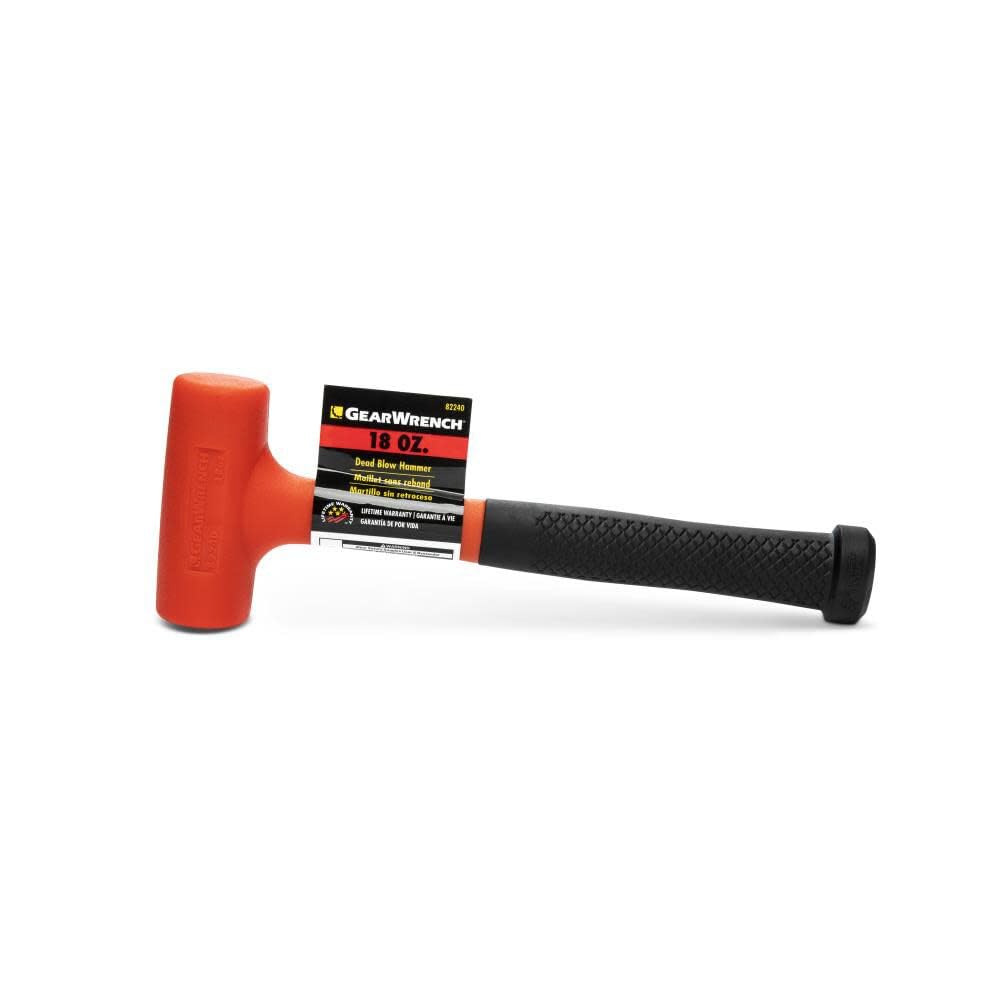
A dead blow hammer has a hollow head filled with shot, sand, or another material. The fill shifts when the hammer hits. This helps the hammer deliver force while reducing bounce and vibration.
The listed weight usually describes the hammer’s nominal weight. However, brands may measure or label their tools in different ways. Some list the head weight, while others list the full tool weight.
Before comparing two hammers, check:
- The manufacturer’s listed weight
- Whether the weight is for the head or the full tool
- The face material
- The handle length
- The intended use
A dead blow hammer is not the same as a rubber mallet. A rubber mallet has a soft, flexible face. A dead blow hammer usually has a firm plastic, urethane, nylon, or metal face with an internal fill.
This design gives you three useful benefits:
- Less rebound: The hammer is less likely to bounce back after impact.
- Better control: More of the blow moves into the workpiece.
- Lower vibration: The internal fill can reduce shock to your hand.
These benefits do not make the hammer safe for every job. You still need the right face, weight, and striking method.
Dead Blow Hammer Weight Chart
The following chart gives a practical starting point for common work in the United States. It is a guide, not a replacement for the tool maker’s instructions.
| Hammer weight | Typical uses | Best fit |
|---|---|---|
| 4–8 oz | Small parts, trim, light assembly, delicate shop work | Precision and low-force jobs |
| 8–16 oz | General repairs, pins, small fixtures, household work | Most home users |
| 16–24 oz | Medium-size parts, machinery setup, light automotive work | General shop use |
| 24–32 oz | Stubborn parts, larger fittings, wheel and suspension work | More force with control |
| 32–48 oz | Heavy assembly, large machinery, thick components | Stronger impacts |
| 48–64 oz | Large industrial parts and very resistant components | High-force work only |
For many people, a 16-ounce dead blow hammer offers the best balance. It has more force than a small 8-ounce model but remains easy to control.
A 24-ounce hammer may be better for automotive repair. A 32-ounce hammer can help with larger metal parts, but it requires more care.

How to Choose the Right Dead Blow Hammer Weight
Choose the lightest hammer that can complete the job without repeated hard swings. This rule improves control and reduces the chance of damage.
1. Start with the part size
small parts need less force. A large part may need more force to move, seat, or align.
Use a lighter hammer for:
- Small pins
- Delicate housings
- Plastic parts
- Thin sheet metal
- Trim and molding
- Small machine components
Use a heavier hammer for:
- Large steel parts
- Stubborn bushings
- Heavy machinery components
- Large flanges
- Thick brackets
- Seized but properly supported parts
Part size does not tell the whole story. A small steel pin may resist more than a large aluminum part. Material, fit, rust, and support all affect the required force.
2. Consider the material
Soft materials can dent or deform under a heavy blow. Aluminum, brass, copper, plastic, and finished surfaces need extra care.
For these materials:
- Pick a lighter hammer.
- Use a soft or non-marring face.
- Strike through a suitable adapter when needed.
- Test on a hidden area first.
Steel can tolerate more impact, but a heavy dead blow hammer can still bend edges or damage precision surfaces.
3. Think about access and control
A heavy hammer needs room for a safe swing. It also creates more momentum.
Use a small or medium hammer when:
- You work in a tight space.
- The part is near wiring or glass.
- You need short, controlled taps.
- You must protect a finished surface.
- You are aligning holes rather than driving a stuck part.
A lighter tool often wins when accuracy matters more than raw force.
4. Look at the handle length
Weight is only one part of impact. Handle length also affects leverage and swing speed.
A longer handle may create more force, but it can be harder to control. A short handle works well in tight spaces and for careful alignment.
For most general users:
- 8–16 ounces: short, controlled work
- 16–24 ounces: general shop and repair work
- 24–32 ounces: more force where space allows
- 48 ounces and above: heavy work with proper support and training
Do not rely on weight alone. A compact 24-ounce hammer may feel very different from a long-handled 24-ounce model.

What Weight Dead Blow Hammer Is Best for Common Jobs?
The best weight changes with the task. The examples below give a useful starting point.
Home repairs
Choose an 8- to 16-ounce dead blow hammer for most household jobs.
This range works well for:
- Assembling furniture
- Adjusting metal parts
- Seating small components
- Tapping stuck hardware
- Working near finished surfaces
- Light framing and repair tasks
A dead blow hammer may be too specialized for simple nail work. Use a claw hammer for nails and a dead blow hammer when rebound or surface damage is a concern.
Automotive work
Choose a 16- to 32-ounce dead blow hammer for many automotive tasks.
This range can help with:
- Wheel and hub work
- Brake component alignment
- Suspension parts
- Exhaust fitting
- Bearing and bushing setup
- Separating parts that are already loose
Do not use a dead blow hammer as a substitute for a proper puller, press, or ball-joint tool. If a part does not move with controlled taps, stop and reassess the method.
Never strike a pressurized, loaded, or poorly supported part. Support the vehicle with approved jack stands on a stable surface.
Machine-shop work
Choose an 8- to 24-ounce hammer for alignment and setup. The exact choice depends on the machine size and the face material.
A smaller hammer gives better control for:
- Fixture setup
- Part alignment
- Light tapping
- Table and vise work
- Seating components without marking them
A larger hammer may help with heavy fixtures, but it can damage precision surfaces if used carelessly.
Large machinery
A 24- to 48-ounce hammer may be suitable for large, well-supported components. Use this range only when the part and surrounding equipment can handle the impact.
Heavy work calls for more than a larger hammer. You also need:
- A stable work surface
- Proper support
- Clear access
- Eye protection
- A suitable striking face
- A plan for where the part may move
If the part is seized by rust or corrosion, more impact may not be the safest answer. Heat, penetrating fluid, a puller, or a press may be better.
Delicate or finished surfaces
Choose a 4- to 8-ounce dead blow hammer with a soft, clean face.
This is useful for:
- Trim
- Finished metal
- Small assemblies
- Plastic housings
- Cabinet and fixture work
- Light alignment
Even a soft face can leave marks if dirt or metal chips become trapped on it. Clean the face before use.
Is a Heavier Dead Blow Hammer Better?
A heavier dead blow hammer delivers more momentum at the same swing speed. That can reduce the number of blows needed. It can also increase damage if the tool slips or the part moves suddenly.
A heavier hammer is better when:
- The part is large and well supported.
- You need more force than a light hammer can provide.
- You have enough room to control the swing.
- The face and workpiece can withstand the impact.
- A lighter hammer requires repeated hard strikes.
A lighter hammer is better when:
- You need precision.
- The part is delicate.
- You work in a tight area.
- You are aligning rather than forcing.
- The workpiece could crack, bend, or dent.
The goal is not maximum force. The goal is controlled force with the least risk.
How Much Force Does a Dead Blow Hammer Deliver?
Impact depends on more than the hammer’s listed weight. A simple physics model uses momentum:
[
p = mv
]
Here, m is the hammer mass and v is its speed. A heavier hammer moving at the same speed has more momentum.
Impact energy can be represented as:
[
E = \frac{1}{2}mv^2
]
This shows why swing speed matters. Doubling swing speed increases the calculated energy by about four times, while doubling mass only doubles it.
These formulas are useful for understanding the trade-off. They do not predict the exact force delivered to a part. The result also depends on:
- Face hardness
- Contact area
- Angle of impact
- Workpiece support
- Internal fill
- Handle design
- How much the part moves
A dead blow hammer transfers force differently from a standard hammer because its internal fill reduces rebound. It does not create extra energy. It helps direct more of the existing blow into the work.

Dead Blow Hammer Weight vs. Regular Hammer Weight
A 16-ounce dead blow hammer is not automatically equal to a 16-ounce steel-faced hammer in use.
A standard steel hammer can produce a sharp, high-energy impact and may rebound quickly. A dead blow hammer usually gives a softer, more controlled impact with less bounce.
Choose a dead blow hammer when you need:
- Less rebound
- Less surface marking
- Better control
- Lower vibration
- A wider, softer contact
Choose a regular steel hammer when the task calls for a hardened striking face and the workpiece is designed for that impact. Do not use a dead blow hammer for tasks that require a hardened steel striking tool unless the manufacturer allows it.
Also remember that a dead blow hammer is not a striking tool for another hammer, chisel, punch, or hardened driver unless its instructions specifically permit that use. Striking tools can chip or break when used incorrectly.
Safety Rules for Using a Dead Blow Hammer
Use eye protection every time you strike a part. Small chips can come from the workpiece, the tool face, or nearby hardware.
Follow these basic rules:
- Inspect the head, face, and handle before use.
- Do not use a hammer with a cracked, loose, swollen, or damaged handle.
- Replace a face that is split, badly worn, or coming loose.
- Keep your grip firm but relaxed.
- Strike squarely, not at an angle.
- Keep your free hand away from the impact zone.
- Support the workpiece so it cannot roll or jump.
- Keep bystanders away from the swing path.
- Use hearing protection during repeated heavy impacts.
- Do not strike flammable, pressurized, or energized components.
- Stop if the part does not move as expected.
The Occupational Safety and Health Administration requires employers to keep hand tools in safe condition and use them properly under its general hand-tool rules. Home users should follow the same basic principle: inspect the tool and use it only for its intended job.
Do not hit hardened steel with a soft-face hammer if the face may break apart. Follow the tool maker’s limits. When a job needs a press, puller, or other special tool, use that tool instead of simply increasing hammer weight.
Common Mistakes When Choosing Hammer Weight
Choosing the largest hammer
A large hammer can make a small job less precise. It may also cause damage before you have time to react.
Start with the smallest practical weight. Move up only if the tool cannot complete the job with controlled blows.
Confusing head weight with total tool weight
Two hammers with the same advertised weight may not feel the same. Check the product specifications before you compare models.
Ignoring the face material
A heavy hammer with a hard face may damage a surface that a lighter urethane-faced hammer would protect.
Weight, face material, and replacement-face availability should be considered together.
Using force instead of fixing the cause
Rust, misalignment, trapped pressure, or poor support may prevent movement. More force can worsen the problem.
Clean the joint, use the correct penetrating product, improve support, or select a puller or press when appropriate.
Holding the workpiece by hand
Never hold a small part in your hand while striking it if the hammer could miss or the part could move. Use a vise, fixture, or stable support.
Quick Takeaways
- Choose 8–16 ounces for most home repairs and light work.
- Choose 16–32 ounces for many automotive and general shop tasks.
- Choose 24–48 ounces for large, supported parts.
- Use 4–8 ounces for delicate surfaces and small components.
- Pick the lightest hammer that can do the job safely.
- Check whether the listed weight means head weight or total tool weight.
- Face material matters as much as weight.
- Stop using a bigger hammer when the problem calls for a puller, press, heat, or better support.
FAQs
What is the best all-purpose dead blow hammer weight?
A 16-ounce dead blow hammer is a strong general choice for many U.S. home, garage, and shop tasks. It offers useful force without being as difficult to control as a 24- or 32-ounce model.
Is an 8-ounce dead blow hammer strong enough?
An 8-ounce model is strong enough for light assembly, trim, small fixtures, and delicate parts. It may be too light for large steel components, seized automotive parts, or heavy machinery.
What weight dead blow hammer should I use for automotive work?
A 16- to 32-ounce hammer covers many automotive jobs. Use the lowest weight that can move or align the part with controlled strikes. Use a puller, press, or other service tool when the part is seized.
Can a dead blow hammer damage metal?
Yes. A dead blow hammer can dent, bend, scratch, or distort metal. Damage is more likely when the hammer is too heavy, the face is hard, the part is thin, or the blow lands near an edge.
Are dead blow hammers safe for bearings?
They may be suitable for some alignment or seating work, but the method must match the bearing maker’s instructions. Never transfer force through the rolling elements when installing a bearing. Use the correct driver, adapter, or press on the proper race.
Should I buy one heavy dead blow hammer or two lighter ones?
Two lighter hammers can give you more control across different jobs. A practical pair is often 8 or 12 ounces for light work and 24 ounces for medium work. Add a heavier hammer only when your tasks truly require it.
Conclusion: Start With the Lightest Suitable Weight
For most people, the best first dead blow hammer is 16 ounces. Choose 8 ounces for delicate work, 24 to 32 ounces for stronger automotive or shop tasks, and 48 ounces or more only for large, stable parts that can safely take heavy impacts.
Before you swing, check the part, the support, the face material, and the manufacturer’s instructions. The right dead blow hammer is not the heaviest one. It is the one that delivers enough force while keeping the work controlled.