
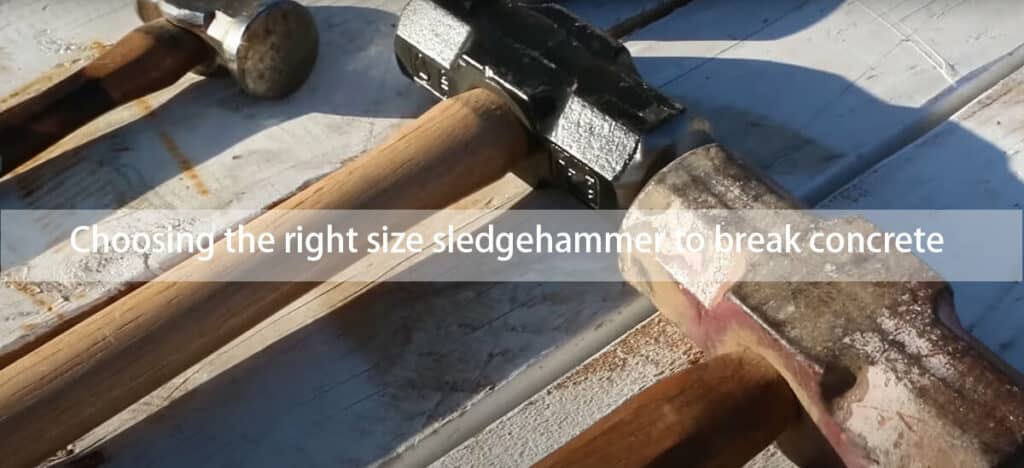
For most homeowners in the United States, an 8- to 10-pound sledge hammer is the best all-purpose size. It can break up small concrete sections, drive stakes, move stubborn posts, and handle many demolition jobs without the strain of a larger hammer.
Choose a 4- to 6-pound hammer for light work and better control. Choose a 12-pound hammer for larger concrete, masonry, or demolition jobs. Use a 16- to 20-pound hammer only when you need high impact force and have enough space to swing it safely.
The right sledge hammer depends on four things:
- The material you need to hit
- How much force the job needs
- How much control and endurance you have
- How much room you have to swing

Sledge Hammer Sizes at a Glance
The hammer’s listed size usually means the weight of its metal head, not the full tool. A longer handle adds reach and swing speed, while a shorter handle gives you more control in tight spaces.
| Sledge hammer size | Typical handle length | Best for | Main trade-off |
|---|---|---|---|
| 2–3 lb | 12–18 in. | Light staking, tile work, small repairs | Limited striking force |
| 4–6 lb | 18–24 in. | Small demolition, fence posts, thin concrete | Easier to control but slower work |
| 8–10 lb | 30–36 in. | General demolition and breaking small concrete | Good force, but tiring over time |
| 12 lb | 30–36 in. | Larger concrete, masonry, heavy posts | Requires strength and clear space |
| 16–20 lb | 36 in. or longer | Major demolition and very hard materials | Hard to control and tiring |
These ranges are practical guidelines, not strict rules. A compact 6-pound sledge may work better than a 10-pound model if you are working indoors or near fragile surfaces.
The best default choice
For a typical U.S. homeowner, start with an 8-pound sledge hammer with a 30- to 36-inch handle. Move up to 10 or 12 pounds if:
- You need to break thick concrete
- You are working on a large masonry wall
- The material does not move after several controlled strikes
- You have enough room for a full swing
Move down to 4 or 6 pounds if:
- You work in a narrow space
- You need precise strikes
- You are driving small stakes
- You are not used to swinging heavy tools
- The job will take many hours
A heavier hammer does not always finish the job faster. It can cause missed strikes, early fatigue, and loss of control.

How to Choose the Right Sledge Hammer Weight
Start with the job, not the hammer. Match the tool to the material and the amount of impact needed.
For breaking concrete
Use a 10- to 12-pound sledge hammer for small slabs, steps, edging, and thin sections of concrete. An 8-pound model may work for thinner concrete or for starting cracks.
A sledge hammer is not a practical substitute for a powered demolition hammer when the concrete is thick, reinforced, or extensive. If the concrete contains rebar, buried utility lines may be nearby, or the work affects a foundation or structural element, stop and get qualified advice before striking.
Practical approach:
- Mark the area you plan to remove.
- Check for buried electrical, gas, water, and communication lines.
- Start with controlled blows near an edge or existing crack.
- Work toward the center after the material begins to fracture.
- Stop if you expose rebar, conduit, pipes, or other embedded materials.
Do not assume that a concrete slab is safe to break just because it looks thin. In the United States, call 811 before digging or breaking ground where underground utility damage is possible. The exact process and timing vary by state.
For demolishing brick or masonry
A 6- to 10-pound sledge hammer is often enough for loose brick, block, small walls, and masonry sections. A smaller 4- or 6-pound hammer gives better control when you need to avoid nearby walls, windows, or plumbing.
Do not strike a masonry wall without checking whether it supports a floor, roof, beam, or another structure. Removing part of a load-bearing wall can cause a collapse. A licensed contractor or structural professional should assess structural work.
For driving fence posts
A 4- to 8-pound sledge hammer is usually suitable for driving metal stakes, ground rods where permitted, and some fence posts. The best size depends on the post material and the soil.
A 6-pound hammer is a useful middle choice because it gives force without being as tiring as a full-size 10- or 12-pound tool. For long posts, a post driver may be safer and more effective because it keeps the impact centered and reduces the chance of a glancing blow.
Do not strike a post if it may contain hidden wiring, plumbing, or other hazards. Use the correct driver for the post rather than hitting a thin or unstable post at an angle.
For moving or loosening stuck objects
Choose a 6- to 10-pound sledge hammer for tasks such as loosening large stakes, shifting stubborn metal parts, or breaking apart old landscaping materials.
Use a block of scrap wood between the hammer and a part that must remain intact. Never strike a hardened tool, bearing, spring, or pressurized part unless the manufacturer permits it. Metal fragments can break away at high speed.
For light demolition and home repairs
A 4- to 6-pound sledge hammer works well for:
- Removing small sections of drywall backing or thin masonry
- Breaking apart old tile beds
- Driving small stakes
- Splitting compacted material
- Removing light framing members
A short handle is often better indoors. It reduces swing distance and makes it easier to stop the hammer before it hits a wall, pipe, cabinet, or other object.

Does a Heavier Sledge Hammer Hit Harder?
Yes, a heavier hammer can deliver more impact energy, but only if you can control and swing it properly.
A hammer’s impact depends on more than head weight. Swing speed, handle length, striking angle, and the hardness of the material all matter. A 6-pound hammer swung accurately may do more useful work than a 12-pound hammer swung slowly or off-center.
A simple physics model is:
Impact energy ≈ ½ × mass × velocity²
This is not a precise field calculation because real impacts include energy loss, handle flex, rebound, and changes in the target. Still, it explains why swing speed matters so much. Because velocity is squared, a faster controlled swing can have a large effect.
Heavy hammer versus light hammer
A heavy hammer offers:
- More force per strike
- Better performance on thick, hard material
- Less need for repeated blows in some jobs
A light hammer offers:
- Better accuracy
- Less fatigue
- Easier use in tight spaces
- Lower risk of damaging nearby material
- Faster recovery between swings
The best choice is the lightest hammer that can do the work without repeated, ineffective blows. If the hammer bounces off the material or makes no visible progress after several careful strikes, consider a larger size or a powered tool.

Handle Length: Short, Medium, or Long?
Handle length changes both control and swing speed.
A 12- to 18-inch handle is useful for light work, indoor demolition, and short swings. It keeps the tool close to your body but gives up some leverage.
An 18- to 24-inch handle offers a balance of control and force. This size suits many fence, landscaping, and repair tasks.
A 30- to 36-inch handle gives a full swing and more reach. It is common on 8- to 12-pound sledge hammers. It works best outdoors, where you can keep your feet stable and maintain a clear swing path.
Long handles also increase the danger of over-swinging. Make sure the head will not hit a wall, vehicle, branch, overhead line, or another person if you miss.
Wood, fiberglass, or composite handle?
Common handle materials include:
- Hickory or other wood: Comfortable and easy to replace, but it can split, dry out, or loosen.
- Fiberglass: Often resists moisture and can reduce some vibration, but damage may be difficult to see.
- Composite materials: May offer molded grips and durability, depending on the design.
Inspect any handle before use. Do not use a hammer with a cracked handle, loose head, damaged grip, or visible separation between the head and handle.
How to Pick a Sledge Hammer for Your Job
Use this five-step method before buying or borrowing one.
1. Identify the material
Ask what you will strike:
- Soil or a post
- Wood
- Brick or concrete block
- Thin concrete
- Thick concrete
- Steel or another hard metal
Harder and thicker materials usually need more impact. Fragile materials need more control.
2. Estimate the job size
A small repair may take only a few dozen strikes. A large demolition project may take hours. If the job is large, fatigue becomes a major factor.
A hammer that feels manageable for five minutes may be too heavy for a full afternoon. Consider using a lighter hammer for breaking edges and a heavier tool only when needed.
3. Check your work area
Measure the swing path. Look above, below, and behind you.
You need stable footing and enough clearance to swing without twisting. A long-handled 12-pound hammer is a poor choice in a basement, crawl space, narrow hallway, or crowded yard.
4. Choose the lightest effective size
Use the table below as a starting point:
- Light, precise work: 2–4 lb
- General home work: 6–8 lb
- General demolition: 8–10 lb
- Thick concrete or masonry: 10–12 lb
- Major outdoor demolition: 16–20 lb, with strong reason and adequate space
5. Test control before full use
Hold the hammer with both hands and make a slow practice swing without striking anything. You should be able to stop, reset, and keep your feet stable.
If the head pulls you forward, your arms tire quickly, or you cannot control the return swing, choose a lighter hammer.

Safety Rules for Using a Sledge Hammer
Wear safety glasses or a face shield, hearing protection, work gloves, sturdy work boots, and clothing that covers your legs. Concrete, brick, metal, and stone can send sharp chips in several directions.
Before each use:
- Check that the head is secure.
- Look for cracks, splits, mushroomed metal, or loose parts.
- Clear people, pets, vehicles, and breakable objects from the area.
- Confirm that the target does not hide pipes, wires, gas lines, or structural supports.
- Use a stable stance with both feet planted.
- Keep both hands on the handle during the swing.
- Start with controlled blows rather than maximum-force swings.
Never strike near another person. Do not let anyone hold the object while you hit it. Use clamps, a vise, blocking, or another safe method to secure work when appropriate.
Do not use a sledge hammer when the head is loose or damaged. Do not use it as a pry bar unless it is designed for that purpose. Do not strike hardened steel tools, such as chisels or punches, with a standard sledge hammer unless the tool manufacturer approves that use.
For concrete or masonry, use dust control and suitable respiratory protection when the work creates airborne dust. Silica exposure can cause serious lung disease. Follow current OSHA requirements when the work falls under workplace rules, and use a qualified professional when the project exceeds basic homeowner work.

Common Mistakes to Avoid
Buying the largest hammer available
A 20-pound sledge is not automatically the best choice. It can cause faster fatigue and less accurate strikes. Choose a larger head only when the target and work area justify it.
Confusing head weight with total tool weight
The number stamped on a sledge hammer generally refers to the head. The complete tool weighs more once the handle is included. Check the manufacturer’s specifications if total carrying weight matters.
Using a long handle in a tight area
A long handle needs more clearance. In a basement or narrow side yard, a short-handled sledge may be safer even if it requires more strikes.
Ignoring what is behind the target
A wall, slab, or post may hide electrical cable, plumbing, gas lines, rebar, or structural supports. Investigate before striking.
Swinging harder instead of improving the method
If the target does not move, check your striking point, angle, support, and tool size. Repeated maximum-force swings increase fatigue and injury risk.
Continuing after the tool or user becomes unsafe
Stop when the head loosens, the handle shows damage, your footing changes, or your grip becomes weak. A break or rest is safer than forcing the last few strikes.

Frequently Asked Questions
Is an 8-pound sledge hammer enough for concrete?
It can be enough for thin concrete, small slabs, edges, and pre-cracked areas. Use a 10- or 12-pound model for thicker sections. For reinforced or large-scale concrete, a demolition hammer may be more suitable.
Is a 10-pound sledge hammer too heavy for a beginner?
Not always, but it can be tiring and hard to control. A beginner may find a 6- or 8-pound hammer easier to use safely. The right test is whether you can make controlled swings without losing balance.
What size sledge hammer is best for fence posts?
A 4- to 8-pound sledge hammer works for many posts. A 6-pound model is a practical starting point. Use a post driver when the post shape and material allow it.
Is a short-handled sledge hammer safer?
A short handle can improve control and fit in tight spaces, but it does not remove the risk of flying chips, missed strikes, or fatigue. Use the smallest handle that still gives you a stable and effective swing.
Should I use a sledge hammer or a demolition hammer?
Use a sledge hammer for small, occasional jobs where you have clear access. Use a powered demolition hammer for thick concrete, large areas, reinforced material, or work that would require many hours of manual striking. Follow the tool maker’s instructions and wear the required protective equipment.
Final Recommendation
For most U.S. home projects, choose an 8-pound sledge hammer with a 30- to 36-inch handle. Choose 4 to 6 pounds for light or precise work, 10 to 12 pounds for larger concrete and masonry, and 16 pounds or more only for major demolition with plenty of clearance.
The best sledge hammer is not the heaviest one you can lift. It is the lightest tool that can break or move the material while you remain balanced, accurate, and in control. Before you swing, inspect the hammer, clear the area, check for hidden hazards, and wear eye and hearing protection.